
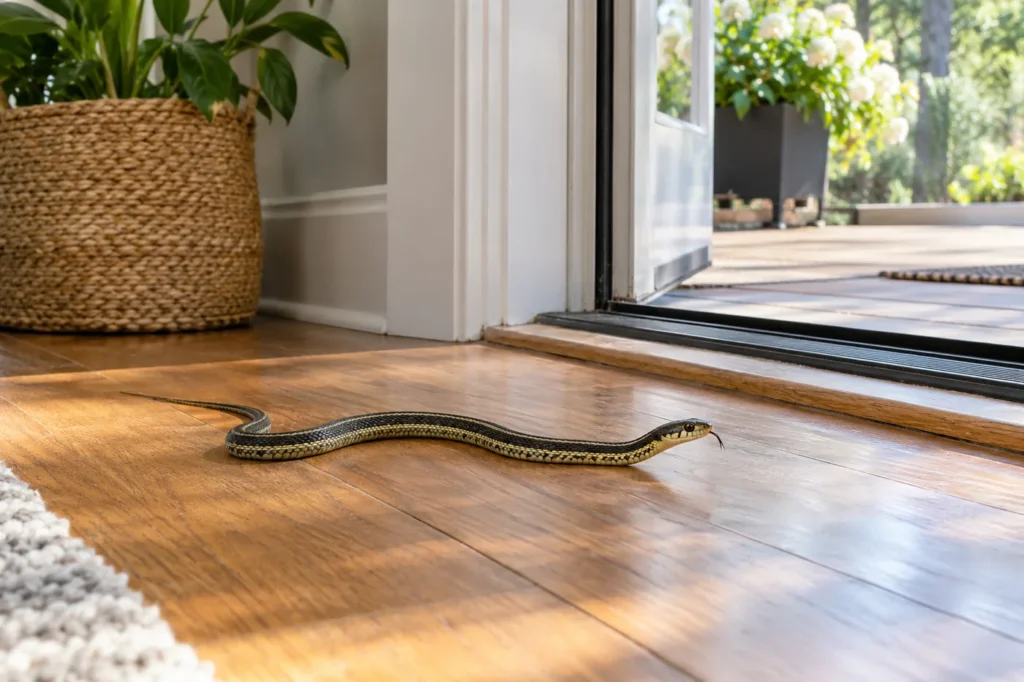
A snake in a house is usually seeking shelter, prey, or an exit—not a confrontation. The safest response creates distance and prevents the animal from disappearing into another room. Removal advice must also account for regional species, wildlife rules, children, pets, and the layout of the home.
If anyone may have been bitten
Call emergency services immediately for a known or possible venomous snakebite. Keep the person calm and still, remove rings or tight items before swelling, and position the bite according to emergency-dispatch instructions. Do not cut or suck the wound, apply ice, use a tourniquet, give alcohol, or attempt to capture the snake. A photo taken from a safe distance may help, but medical care must not be delayed.
Why a snake entered the house
Four conditions that invite an indoor encounter
Open access
Unswept doors, damaged screens, garage gaps, utility penetrations, and vents provide routes inside.
Prey
Rodents, frogs, insects, or other prey can draw snakes toward foundations and outbuildings.
Shelter
Clutter, crawlspaces, stacked materials, and cool or protected voids offer cover.
Season and weather
Heat, cold, flooding, drought, breeding, or dispersal can change local snake movement.
One sighting does not prove an infestation. Snakes do not usually establish a household colony, but repeated sightings can indicate a persistent entry gap or prey problem. Record the room, time, weather, and likely access point after the immediate situation is resolved.
Response options ranked by safety
Choose distance over handling
- Isolate and call qualified help — Preferred when uncertain. This minimizes bite risk and gives responders the last known location.
- Allow a clear exterior exit — Conditional. If the snake is already beside an exterior opening, people can remain far away and the route does not require approaching or cornering it.
- Professional capture and relocation — Preferred for venomous, unidentified, trapped, or hidden snakes. Local animal control and wildlife rules determine the appropriate responder and release practice.
- DIY container removal — High judgment, limited situations. Only a positively identified harmless species, a clear room, a capable adult, and local guidance could make this reasonable; uncertainty means stop.
- Grabbing, pinning, glue traps, chemicals, or killing — Avoid. Close contact raises bite risk, cruel devices injure wildlife, and legal restrictions may apply.
How to isolate the room
Move children and pets behind a closed door. Keep visual contact only from a safe location and avoid surrounding the snake. If it is safe to reach the room’s door without passing near the animal, close it. A rolled towel placed outside the closed door can reduce the chance of movement through a large threshold gap. Do not block an exterior exit the snake is already using.

Call the local animal-control agency, fire department non-emergency line, wildlife agency, or a wildlife-control operator as local practice dictates. Describe size, colors, markings, location, and behavior without claiming an identification you cannot support. A zoomed photograph can help if it can be taken without moving closer.
Do not rely on head shape or pupil myths
Field marks vary by species, age, region, lighting, and defensive posture. Harmless snakes can flatten their heads, and seeing pupil shape requires dangerously close observation. Color patterns are also shared by multiple species. Use reputable regional identification resources after everyone is safe; never make a handling decision from an internet mnemonic.
Professional removal
A trained responder has species knowledge, suitable tools, secure containers, and an understanding of local release or euthanasia rules. Tell them whether the animal is visible, whether a bite occurred, and whether pets or people remain nearby. Do not move furniture, reach into a void, or flush the snake out before they arrive.

Relocation law and ecological guidance vary. Moving an animal across property or jurisdictional boundaries may be restricted and can harm the snake. A qualified local responder should choose the destination and method rather than releasing it at a random park.
Snakebite first aid
CDC advises seeking emergency medical attention as soon as possible after a venomous bite. Do not drive yourself if another safe option exists. Note the time, remain still, and follow emergency instructions. Swelling may progress, so remove constricting jewelry and clothing. Do not delay transport to hunt, kill, or bring the snake.

Dogs and cats can also be bitten. Keep the animal quiet, carry it when feasible without risking another bite, and call an emergency veterinarian. Do not give human pain medication, apply a tourniquet, cut the wound, or attempt suction.
Seal entry points after removal
Inspect door sweeps, garage corners, crawlspace vents, screens, siding transitions, foundation joints, and penetrations for pipes or cables. Repair gaps with durable materials suited to the building assembly. Do not seal a cavity until you are confident no animal remains trapped inside.

Address rodents with sanitation, exclusion, and protected trapping rather than loose poison that can affect pets and wildlife. Store birdseed, livestock feed, and pet food in tight containers. Remove cardboard and clutter from garages, basements, and crawlspace access areas.
Make the foundation less attractive
Move firewood, lumber, sheet material, and rock piles away from the house and elevate them when practical. Trim dense vegetation that touches the structure, manage spilled seed and pet food, and keep the perimeter visible for inspection. These measures reduce shelter and prey but cannot make a property snake-proof.

From discovery to prevention
- Distance: move people and pets away; do not touch the snake.
- Observe: note location and appearance from safety.
- Isolate: close an interior door only if the path is clear.
- Call: use local animal control or qualified wildlife help when uncertain.
- Respond: call emergency services immediately for a possible venomous bite.
- Inspect: after removal, find access, prey, and shelter conditions.
- Exclude: repair gaps and monitor for another sighting.
Myths and facts
Snake safety without risky shortcuts
- Myth: a triangular head proves a snake is venomous.
- Fact: posture and species variation make head shape unreliable, and close inspection is unsafe.
- Myth: mothballs or sulfur repel snakes safely.
- Fact: pesticide products must be used only for labelled sites and pests; household scattering can expose people, pets, and wildlife.
- Myth: every indoor snake should be grabbed and carried out.
- Fact: most bites happen during contact or attempted capture; isolation and qualified removal are safer.
- Myth: a tourniquet or ice helps a snakebite.
- Fact: CDC advises against these measures; seek emergency medical care.
Frequently asked questions
Should I open a door for the snake?
Only when an exterior exit is already close, the snake has a clear route, and you can remain far away. Do not herd or corner it. If opening the route requires approaching, isolate and call for help.
Can I use a trash can to remove a harmless snake?
Even apparently harmless snakes can bite, and misidentification has consequences. Use a qualified local responder when species, skill, or control of the room is uncertain.
What if the snake disappears?
Close doors, remove people and pets, and do not reach into hiding places. Call a local responder, describe the last known location, and follow their instructions.
Are snake repellents effective?
Do not rely on a repellent as a substitute for exclusion, prey control, and shelter reduction. Pesticides must be registered and labelled for the claimed use; many folk materials create exposure without solving entry routes.
If the snake disappears inside
Do not reach behind appliances, into storage or under furniture. Keep people and pets out, close the room when that can be done without approaching the snake, and place a towel at the interior door gap only from the safe side. Tell animal control or a qualified wildlife professional the last confirmed location and whether there are wall, cabinet or utility openings nearby.
Snakes can use ground-level gaps and may follow prey into basements, crawl spaces or utility routes. Some species can also climb textured surfaces. Do not assume that stairs or an upper floor proves the animal is harmless. After professional removal, inspect the actual route instead of sealing random openings while an animal may still be inside.
What to do if a pet is bitten
Move the pet away without trying to capture or kill the snake. Keep the animal as calm and still as practical and contact a veterinarian or emergency veterinary clinic immediately. If a photograph can be taken from a safe distance, it may help, but treatment should never wait for identification. Do not apply ice, cut the wound, use a tourniquet or give medication unless a veterinarian directs it.
Choose removal help by risk, not convenience
| Situation | Safer response | Why |
|---|---|---|
| Species uncertain, snake hidden, or anyone may have been bitten | Keep distance and call animal control, emergency services or qualified help as appropriate | Uncertainty makes close handling an unnecessary risk |
| Snake visible in an isolated room with a clear exit | Wait for qualified removal; follow local instructions | Maintains location without forcing contact |
| Repeated sightings after removal | Inspect prey, moisture, shelter and building gaps | Another entry route or rodent problem may remain |
| Glue board or improvised trap proposed | Do not use it; ask for humane capture and exclusion | Sticky devices can injure snakes and expose the person releasing them |
Prevent another indoor snake encounter
Repair damaged door sweeps and screens, seal suitable gaps around pipes and cables, and maintain foundation vents without blocking required airflow or drainage. Reduce rodents with sanitation, exclusion and monitoring rather than loose poison that can harm other wildlife. Move firewood, dense debris and stored materials away from the foundation where practical.
There is no single gap measurement that applies to every snake or building. Inspect openings in context, use durable materials appropriate to the joint, and have a contractor evaluate structural, electrical or ventilation penetrations you should not alter yourself.
Primary and authoritative sources
- CDC/NIOSH: Venomous Snakes — bite prevention, emergency response, and first-aid actions to avoid.
- National Park Service: Snake safety at Dinosaur National Monument — distance, encounter safety, and bite response.
- University of Georgia Extension: Snakes in Georgia — identification limits, property habitat, and conflict reduction.
- National Pesticide Information Center: Snakes — prevention and pesticide-use context.
HowToRepel.com is an independent educational publisher, not an emergency, medical, or wildlife-control service. This guide was AI-assisted, human-edited, and source-checked. Follow local agency instructions and call emergency services for a possible venomous bite.
Publishing and affiliate notes
Some product links may be affiliate links. If you buy through them, we may earn a commission at no extra cost to you. Product picks are not lab tests. Read the legal disclaimer.