



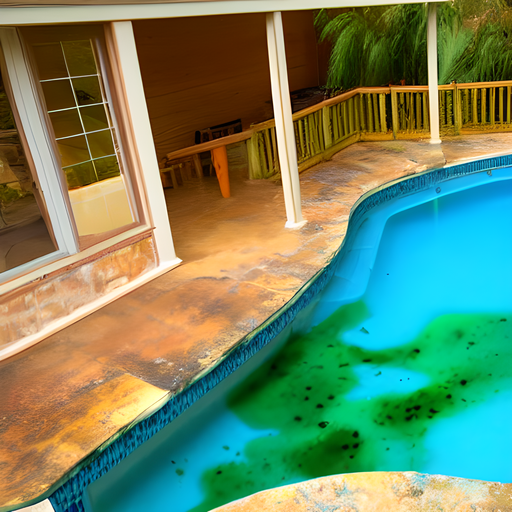
Pool algae is more than an eyesore — it indicates your sanitizer has failed, and it creates slippery surfaces that are a genuine safety hazard. The good news is that even a severe algae outbreak can be cleared within 24–72 hours with the right treatment sequence. The approach varies significantly by algae type, so identifying what you’re dealing with is the critical first step.
Key Takeaways
- Always brush and vacuum before shocking — disturbing algae exposes it to the chlorine and dramatically improves treatment effectiveness
- Shock at dusk or night — UV rays destroy chlorine rapidly, wasting your treatment
- Vacuum to WASTE, not to filter — sending algae through your filter re-contaminates the water
- Black algae has protective layers and roots in plaster — it requires physical scrubbing plus triple-shock treatment
- Run your filter continuously for 24–48 hours after shocking until the water clears
Identify Your Algae Type First
| Algae Type | Appearance | Difficulty | Shock Multiplier |
|---|---|---|---|
| Green algae | Green cloudy water or slimy green walls | Easy | 2x normal shock dose |
| Yellow / Mustard algae | Yellow-brown dusty patches on walls and floor | Moderate | 3x normal shock dose |
| Black algae | Dark blue-green or black spots embedded in plaster | Hard | 4x normal shock dose |
| Pink slime | Pink or reddish slimy patches (actually bacteria) | Moderate | 2x + algaecide |
Step-by-Step Algae Removal Process
Step 1: Test and Balance Water Chemistry
Before shocking, balance your water. Shock is far less effective outside optimal ranges. Target levels:
- pH: 7.2–7.4 (lower end improves chlorine effectiveness)
- Alkalinity: 80–120 ppm
- Calcium hardness: 200–400 ppm
- Cyanuric acid (CYA): 30–50 ppm (high CYA above 80 ppm significantly reduces chlorine power)
Step 2: Brush All Surfaces Aggressively
Brush every surface — walls, floor, steps, corners, and around fittings — before adding any chemical. Brushing physically disrupts algae colonies and breaks through the protective biofilm, allowing chlorine to penetrate. Use stainless steel bristles for concrete/gunite pools; nylon for vinyl liner or fibreglass. For black algae, scrub hard — it has embedded roots and a waxy protective layer that must be physically broken.
Step 3: Vacuum to Waste
Set your multiport valve to WASTE (not Filter) and vacuum the pool floor. This bypasses the filter and expels algae-laden water directly to drain. Running algae through the filter pushes spores back into the pool. Monitor water level as you vacuum and refill as needed to keep the level halfway up the skimmer.
Step 4: Shock the Pool
Use calcium hypochlorite (cal-hypo) shock for maximum effectiveness. Standard dose is 1 lb per 10,000 gallons. Multiply based on algae type (see table above). Add shock at dusk or after dark — sunlight destroys chlorine rapidly. Pre-dissolve shock in a bucket of pool water before adding, never add directly to the skimmer.
Target a free chlorine level of 10–30 ppm depending on algae severity. Keep the pump running continuously after shocking.
Step 5: Run Filter Continuously
Run your filter 24 hours a day until the water clears — typically 24–48 hours for green algae, up to 5–7 days for severe cases. Backwash or clean the filter every 6–8 hours as it loads up with dead algae. A clogged filter stops working and prolongs clearing time.
Step 6: Add a Clarifier
Once chlorine drops back below 5 ppm (safe to add), apply a pool clarifier or flocculent. This clumps together fine dead algae particles that the filter can’t capture alone, dropping them to the pool floor for vacuuming. Dose at 3–4x the maintenance rate during an algae clean-up.
Treating Black Algae (Special Approach)
Black algae is actually a cyanobacterium with a protective outer layer and roots that embed into plaster and grout. Standard shock alone won’t eliminate it. You need:
- A wire brush or pumice stone to physically scrub and break open each spot before chemical treatment
- A trichlor tablet rubbed directly on each spot (wear gloves)
- Triple-dose shock treatment (4 lbs per 10,000 gallons)
- A copper-based algaecide specifically labelled for black algae
- Repeat treatment every 5–7 days until no spots remain
Treating Mustard Algae (Special Approach)
Mustard algae is chlorine-resistant and will reinfect a pool if you don’t also clean everything that contacts the water. Wash all swimsuits in bleach, and wipe down all pool toys, floats, and accessories with a 1 tablespoon bleach per gallon water solution. Brush pool walls first, then apply triple-dose shock and a quat-based algaecide. Mustard algae can resurface from spores on equipment and accessories if not treated comprehensively.
Prevention: Keeping Algae Away Long-Term
- Maintain free chlorine 1–3 ppm consistently — algae cannot establish in properly chlorinated water
- Run the filter 8+ hours daily — algae thrives in stagnant areas with poor circulation
- Brush weekly — especially corners, steps, and behind ladders where water circulation is weakest
- Add a weekly maintenance algaecide dose as an extra layer of prevention
- Shock after heavy use — rain, parties, or high bather loads deplete chlorine rapidly
- Test water twice weekly during summer, weekly in cooler months
Frequently Asked Questions
How long does it take to clear a pool with algae?
Green algae: 24–48 hours with correct shock dosing and continuous filtration. Yellow/mustard algae: 2–4 days. Black algae: 1–2 weeks of repeated treatments. The key variable is water clarity improving quickly enough to vacuum dead algae — keep the filter running and backwash frequently.
Can I swim in a pool with algae?
No. Algae itself is relatively harmless but it indicates chlorine has failed, meaning harmful bacteria may also be present. Algae-covered surfaces are also dangerously slippery. Do not swim until the water is clear, chlorine is back to 1–3 ppm, and pH is balanced.
Why does my pool keep getting algae?
Recurring algae almost always has one of these causes: insufficient filtration run time, high cyanuric acid (CYA) above 80 ppm that neutralises chlorine, pH consistently too high reducing chlorine effectiveness, or inadequate brushing that allows algae to establish in dead spots. Test CYA levels if algae returns despite normal chlorine additions.
Does algaecide alone remove pool algae?
No — algaecide is a preventive maintenance tool, not a cure for active algae outbreaks. For an existing algae problem, shock chlorination is required first. Algaecide then helps prevent regrowth and can assist with residual algae once the main chlorine treatment is complete.