
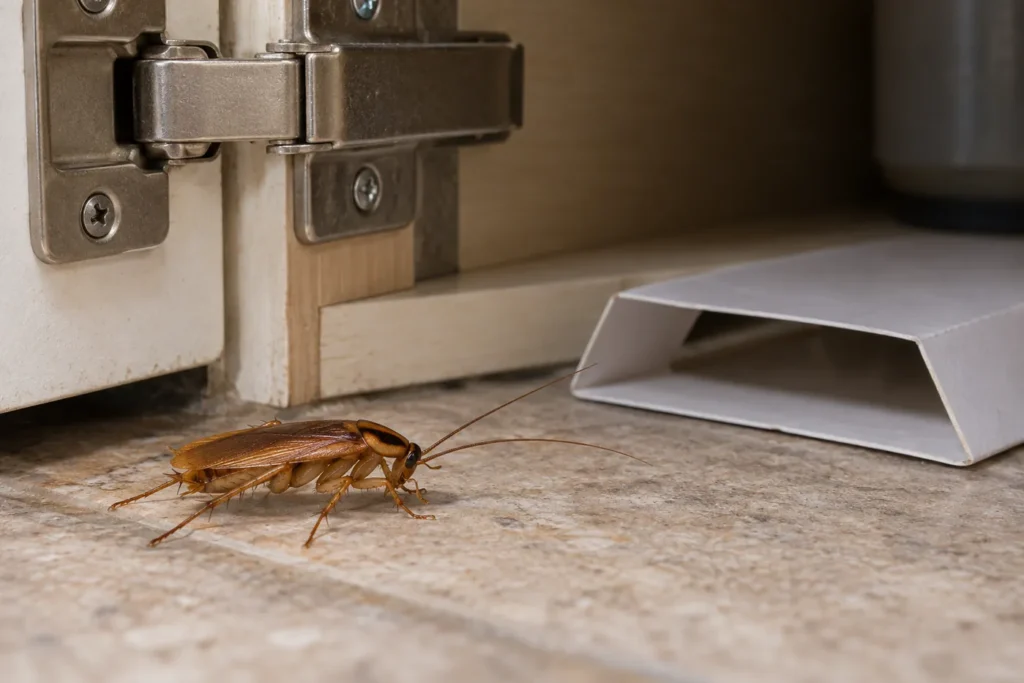
Different cockroaches use buildings differently. An outdoor invader at a doorway and an established indoor-breeding species (such as German cockroaches) do not automatically need the same treatment. Use identification and observations to decide whether exclusion, resource management, targeted treatment or professional help fits.
Cockroach species, food sources and harborage
Identify the conditions that shape the plan
Species and setting
Confirm whether the activity suggests indoor breeding or entry from outside.
Food and residues
Inspect accessible storage and appliance edges.
Moisture
Check dripping or repeated water accumulation.
Shelter and access
Accessible cracks, clutter and entry defects can complicate inspection.
Natural cockroach control methods and targeted treatment
Match each method to the inspection findings
Identification and monitoring
Match the plan to the species and observed locations.
Sanitation and moisture repair
Remove accessible food residue and correct leaks.
Appropriate exclusion
Repair suitable building defects while preserving required functions.
Labeled treatment or qualified help
Use the intended pest, site and method, and arrange follow-up.
Kitchen cabinet, sink and food-storage inspection steps
Place and inspect accessible cockroach monitors
Use an appropriate device according to directions, inaccessible to children and pets. Mark its location in a simple record. Continuing activity is a reason to reassess species, source or treatment rather than increase a pesticide dose.

Clean accessible food residue
Use appropriate ordinary cleaning at appliance edges. Do not move heavy equipment unsafely or dry-vacuum contaminated rodent debris. Keep preparation surfaces and food protected during any treatment work.

Correct a visible leak
Check accessible plumbing and arrange a suitable repair. Continued moisture may need a plumber’s assessment. Drying the floor once cannot establish that a leaking joint has been repaired.

Maintain sealed food storage and covered waste
Store dry food and pet food in tight, suitable containers and keep waste covered. Clean spilled crumbs and liquids promptly. Check container lids after use; a sealed pantry does not remove roaches already hiding in the room.

Cabinet inspection safety
Use a flashlight to examine hinges and corners without reaching into unknown spaces. Record sightings and obtain identification if unclear. Do not dismantle electrical equipment to search.
Sequence and follow-up
Check progress against the agreed scope
Initial assessment
Identify the cockroach and record affected places.
Maintenance
Address the food, water or entry defect that was found.
Conditional treatment
Apply only a suitable labeled method or qualified plan.
Reassessment
Compare observations and inspect unresolved sources without assigning an efficacy percentage.
Myths and facts
Avoid universal dose and elimination promises
Myth: every cockroach lives in the same hidden nest
Fact: species and setting influence the plan.
Myth: pea-sized gel dots are always correct
Fact: use the amount and placement stated on the exact label.
Myth: more spray improves every bait plan
Fact: products and placements can be incompatible; follow directions.
Myth: permanent elimination follows one cleaning
Fact: maintain prevention and monitor for continuing or introduced activity.
Questions before treatment
Request identification, inspection findings and a written description of the proposed work. Ask what preparation is required, which occupants or pets need arrangements, and how continuing activity will be assessed. Compare qualified providers using the scope and follow-up terms rather than an unsupported success percentage or a nationally fixed price.
Related guides
German cockroaches: apartment bait stations · How to get rid of ants · Repellent evidence database
Let monitoring decide whether the plan is working
Dead insects alone do not show that harborage and reproduction have stopped. Date-stamped trap counts, fresh droppings, egg cases, and sightings by room give a clearer trend.
If activity persists after sanitation, moisture correction, and correctly placed controls, reassess species, neighboring units, and inaccessible harborages. Multi-unit or widespread infestations usually need coordinated professional treatment.
Cockroach-control products: where each one fits
Affiliate disclosure: Product links may earn HowToRepel.com a commission at no extra cost to you. Always follow the exact label and keep treatments inaccessible to children and pets.
| Product category | Useful for | Check before buying | Important limit |
|---|---|---|---|
| Sticky monitoring trap | Mapping activity and measuring change | Low profile, inspection window, date/location marking and protected placement | Monitoring alone rarely controls an established infestation |
| Enclosed bait station | Targeted treatment in permitted indoor sites | Target species, tamper-resistant design, label sites and replacement directions | Placement and competing food strongly affect results |
| Gel bait | Cracks and crevices allowed by the label | Active ingredient, package control, application sites and storage | Never copy a generic dot size or combine with incompatible sprays |
| Desiccant dust and applicator | Only labeled voids or sites in a coordinated plan | Exact indoor-use label, application tool and exposure precautions | Visible piles and airborne dust are not acceptable |
| Caulk and door sweep | Closing suitable movement and entry gaps | Gap width, surface compatibility, cure conditions and sweep size | Do not seal unsafe utilities or trap unresolved activity |
Frequently asked questions about natural cockroach control
Do baking soda and essential oils eliminate cockroaches?
Evidence for dependable whole-infestation control is weak. Peppermint or other essential-oil odors do not replace sanitation, monitoring and targeted treatment, and concentrated oils can create exposure concerns.
Is boric acid natural and safe?
Boric acid is a pesticide. Use only a registered product exactly as labeled, never on food-contact surfaces or where children and pets can reach it.
Does diatomaceous earth work on cockroaches?
Some labeled desiccant-dust products can contribute to control in suitable dry, inaccessible locations. More is not better: avoid airborne dust and follow the application directions.
When should I call a pest-control company?
Get professional help for persistent daytime sightings, activity across several rooms, shared-building infestations, unsafe treatment locations or continued catches after the food, water and harborage plan is corrected.
Identify the cockroach before choosing a plan
German cockroaches usually concentrate in warm indoor kitchens and bathrooms, while American, smokybrown and Oriental cockroaches may be linked to basements, drains, sewers or outdoor entry. Species, life stage and capture location change the inspection. Photograph a specimen or save it in a sealed container for professional identification.
Use sticky monitors along protected wall edges near sinks, appliances and suspected routes. Date and number each one. A count by location is more useful than one dramatic sighting because it shows where food, water and harbourage overlap.
Why natural does not mean non-pesticide
Boric acid and diatomaceous earth are pesticides when sold for cockroach control. They can contribute to an integrated plan, but only a registered product may be used at the sites and in the manner stated on its label. Loose piles, food-contact placement and airborne dust create avoidable exposure and often cause cockroaches to route around the treatment.
Essential oils, bay leaves, baking soda mixtures and ultrasonic devices do not provide dependable colony control. Sanitation, leak repair and exclusion reduce resources, but an established indoor infestation often also needs well-placed bait or professional treatment.
A four-week monitoring framework
| Stage | Work | Evidence to record |
|---|---|---|
| Initial map | Identify species, place monitors, correct exposed food and water | Trap location and baseline catches |
| Targeted treatment | Use label-permitted bait or dust only in suitable protected sites | Product, placement date and consumption |
| Follow-up | Clean competing food, repair leaks and refresh treatment as the label permits | Catches by room and life stage |
| Escalation | Reinspect adjoining rooms or units and involve a professional when counts remain high | Persistent hotspots and daytime sightings |
This is a review framework, not a promise that every infestation clears in four weeks. Multi-unit buildings, heavy harbourage, resistance, inaccessible voids and untreated neighbouring units can prolong control.
How baits and dusts fit together
Place cockroach bait close to confirmed harbourage and travel routes according to its label, away from children, pets and food-contact surfaces. Do not contaminate bait with repellent sprays or strong cleaners. More bait in one glob is not automatically better than distributed label-directed placements.
A labeled desiccant or boric-acid dust may fit dry, inaccessible cracks or voids. Apply only with the equipment and quantity specified by the product. Visible piles and drifting dust are warning signs of poor application. Do not improvise with food-grade powders that lack a cockroach-control label.
When professional cockroach control is warranted
Call for persistent daytime activity, catches in several rooms, repeated nymphs, unsafe treatment sites, asthma concerns, a shared-building infestation or no downward trend after sanitation and label-directed treatment. Ask the company to identify the species, map activity, describe products and placements, coordinate adjoining units when necessary, and define follow-up.
Frequently asked questions
What kills cockroaches instantly?
Physical removal can kill an individual, but instant knockdown is not colony control. Use monitoring and targeted treatment to reach harbourages.
Can I get rid of cockroaches naturally overnight?
You can remove accessible food residue, dry up a corrected leak and start monitoring tonight. Those actions do not prove that an established cockroach infestation has ended. Roaches and egg cases in inaccessible hiding places need an inspection-led control plan, often with labeled bait. UC IPM recommends regular monitoring to evaluate treatment. Check the same monitor locations over time rather than accepting one quiet night as clearance.
Can cockroaches return after treatment?
Yes. Surviving egg cases, untreated adjacent units, new introductions and restored food or water can restart activity.
Are gel baits safe around pets?
They are pesticides. Use only as labeled and place them where pets and children cannot contact them.
How do I know the plan is working?
Compare dated monitor catches in the same locations. A sustained decline is stronger evidence than fewer sightings on one night.
Egg cases, nymphs and a returning cockroach infestation
An egg case is an ootheca, not a hidden nest containing every cockroach in the room. German cockroaches, Blattella germanica, usually carry it until near hatching; other species deposit cases earlier. Don’t apply one egg-hatching schedule to every species or assume killing visible adults ends reproduction.
Young cockroaches are called nymphs. Repeated nymph catches help an inspector evaluate local breeding, but record species and location before drawing conclusions. Save a clear photograph rather than dismantling an appliance or reaching into a warm motor compartment.
Natural home remedies for roaches: what the claims miss
Vinegar, citrus and ordinary cleaners can help with compatible surface cleaning. They are not substitutes for getting rid of cockroaches in inaccessible harborages. Baking soda and sugar, bay leaves or essential oil sprays do not provide a dependable whole-infestation plan.
Borax laundry products are not interchangeable with labeled boric acid cockroach products. Diatomaceous earth acts on an insect’s protective outer covering, but a dust’s physical mechanism does not make it safe to scatter wherever roaches walk. Use only the labeled pest, site, equipment and exposure precautions.
A targeted bait plan is chemical treatment, even when the rest of your integrated pest management is nonchemical. You don’t have to choose between prevention and effective treatment. Explain the confirmed problem, then choose the least-exposing suitable control rather than relying on a “natural” claim.
Why bug bombs aren’t the shortcut
A total-release fogger spreads insecticide into room air without reliably reaching tight hiding places. EPA warns about exposure and ignition hazards. Don’t buy foggers merely because trap catches remain high; have the source, species and current bait placements reviewed.
Safe cockroach cleanup and new introductions
Removing accessible crumbs, shed skins and egg cases supports control. Cockroach debris can become airborne, so use suitable filtration and exposure precautions; don’t dry-sweep a heavily contaminated area. An asthma-sensitive household or extensive contamination needs a suitable professional cleanup plan.
Inspect incoming stored boxes, used furniture and secondhand appliances before placing them beside food storage. Avoid dismantling energized equipment. If a delivery or shared building route is implicated, record it for the property manager instead of treating every sighting as a failure of cleaning.
Keep your monitor locations consistent when comparing results. Separate adults and nymphs in the record, note whether bait was consumed or dried out and tell the pest control company about new introductions. The next action should follow that evidence, not a higher pesticide dose.
Publishing and affiliate notes
Production note: AI assisted with drafting and original instructional images. A human editor checked claims against the cited primary sources.
Some product links may be affiliate links. If you buy through them, we may earn a commission at no extra cost to you. Product picks are not lab tests. Read the legal disclaimer.