
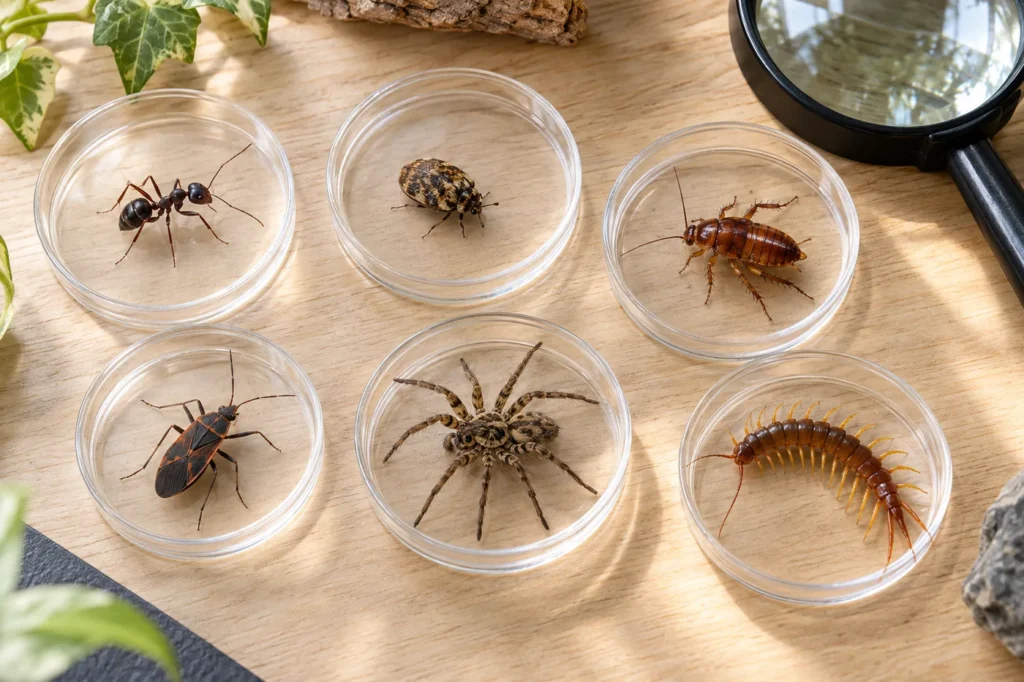
Correct identification prevents wasted pesticide use and missed structural or health problems. “Small brown bug” can describe a beetle, cockroach nymph, bed bug, tick, or harmless outdoor visitor. Start with observable anatomy and context before naming the species.
Do not handle an unknown arthropod
Avoid bare-hand contact, crushing on skin, or sniffing damaged specimens. Keep children and pets away. Seek medical or veterinary advice for a suspected venomous bite, tick attachment, allergic reaction, breathing trouble, spreading symptoms, or significant pain. For an unknown pesticide exposure, follow the label and contact Poison Control in the United States at 1-800-222-1222.
Start with body plan and context
Four identification clues
Anatomy
Count legs and body regions; inspect antennae, waist, wings, tail-like appendages, and hard wing covers.
Scale
Record actual length. Photo zoom routinely makes tiny insects look much larger.
Location
Food, fabric, drains, beds, plants, wood, pets, and windows each narrow the possibilities.
Pattern
One accidental visitor differs from repeated specimens, shed skins, damage, droppings, or a concentrated source.
Adult insects normally have six legs; spiders and adult ticks have eight. Centipedes and millipedes have many. Larvae and damaged specimens may not fit a simple count, so retain context and request expert help rather than forcing a match.

Identification methods ranked
Build evidence before treatment
- Clear specimen or macro photographs with scale — Strong. Multiple angles preserve diagnostic features.
- Location, behavior, and damage record — Strong. Feeding signs and source often distinguish lookalikes.
- Extension, public-health, or professional identification — Strong for consequential cases. Experts can examine features a phone image misses.
- Image-recognition apps — Preliminary only. Use suggestions as candidates, not final proof.
- Identifying from a bite or one color — Avoid. Skin reactions overlap and lighting changes color.
Capture and document safely
Place a clear glass or container over a crawling specimen and slide stiff card underneath. Seal a ventilated container only when appropriate; do not confine stinging insects or medically important spiders yourself. Alternatively, use clear tape for tiny pantry or fabric insects, taking care not to destroy key features.

Photograph the back, side, and underside if visible. Add a ruler or neutral scale marker without placing a valuable coin where it could be contaminated. Note date, room, exact surface, time, movement, number found, weather, recent travel, used furniture, packages, plants, and pets.

Common household groups
- Beetles: hardened front wings meet in a straight line; pantry and carpet species differ in source and shape.
- Cockroaches: flattened oval bodies, long antennae, spiny legs, and fast running; nymphs lack full wings.
- True bugs: piercing mouthparts; bed bugs are broad, flat, wingless, and associated with harborages near resting hosts.
- Flies: one functional pair of wings; larvae often point to drains, decaying material, fruit, or moist organic matter.
- Ants and termites: winged ants have a pinched waist and elbowed antennae; termite swarmers have a broad waist and straighter antennae.

Ticks and other health-relevant specimens
Save a removed tick in a sealed container or clear bag if local health guidance recommends it, and record the date and likely location of exposure. Do not delay medical advice while waiting for species identification or testing. Follow current CDC guidance for removal and symptom monitoring.

Seven-step identification workflow
- Isolate: keep people and pets away.
- Capture: use a container or clear tape without bare-hand contact.
- Measure: record true body length.
- Photograph: take sharp views from several angles.
- Record: note location, activity, number, damage, and recent changes.
- Compare: use multiple anatomical and contextual traits.
- Confirm: consult an appropriate expert before consequential treatment.
Myths and facts
Identification without guesswork
- Myth: every tiny insect in a bed is a bed bug.
- Fact: carpet beetles, booklice, fleas, and other arthropods may occur nearby; confirm anatomy and harborages.
- Myth: a bite pattern identifies the culprit.
- Fact: skin reactions are nonspecific and sometimes have non-arthropod causes.
- Myth: winged insects near wood are always termites.
- Fact: ant swarmers are common lookalikes; compare several structures.
- Myth: spray first and identify later.
- Fact: treatment can scatter pests, destroy evidence, and expose occupants unnecessarily.
Common household bugs: choose the first source to inspect
Use this list to narrow an inspection, not to confirm a species from location alone. University of Maryland Extension organizes household insects by the materials and settings involved.
- Small moths in the kitchen: inspect dry foods, pet food and packaging for larvae or webbing. Pantry moths and fabric moths need different source checks.
- Small beetles near a window: inspect both food stores and natural-fiber materials; where an adult rests may differ from where its larvae feed.
- Fast, flattened insects by warm appliances: obtain a clear specimen image and inspect accessible food, water and hiding places for possible cockroach activity.
- Tiny insects around damp paper: note condensation and mold as well as anatomy; moisture-associated insects should not all be called silverfish.
- Repeated flies by plants or a sink: compare the fly’s shape with the actual damp breeding material before selecting a control guide.
Separate what you observed from what you suspect. A useful report says “three small beetles beside this pet-food bag,” with photos, rather than “the entire house is infested.” That gives an expert a specific place to begin.
Frequently asked questions
Where can I get a specimen identified?
Try a county cooperative-extension office, state diagnostic laboratory, health department for relevant vectors, or a licensed pest professional who provides the basis for the identification.
Should I upload only one photo?
Provide multiple sharp angles, measured size, location, and behavior. Avoid extreme digital zoom and color filters.
Can an app confirm a dangerous species?
No. App output is a lead; consequential identifications need qualified review.
Resolve the household lookalikes that change treatment
Start with a clear dorsal photograph beside a ruler, then record the room, surface, time and movement. Size and location often eliminate more possibilities than colour. Do not rely on a phone camera’s automatic label for a medically important specimen.
| Lookalikes | Useful distinction | Why it matters |
|---|---|---|
| Winged ant vs termite | Ants have elbowed antennae and a narrow waist; termite swarmers have straighter antennae and a broad waist | Termite evidence calls for a building assessment, not ant spray |
| Bed bug vs flea vs tick | Bed bugs are broad, flat insects; fleas are laterally compressed jumpers; ticks have eight legs as nymphs or adults | Each requires a different inspection route |
| Fruit fly vs drain fly vs fungus gnat | Compare body shape, wing texture and the exact breeding source | Adult traps fail when the larval source remains |
| Carpet beetle larva vs clothes-moth larva | Carpet beetle larvae are bristly; moth larvae may occur with silk webbing or cases | Cleaning and storage checks target different materials |
| Centipede vs millipede | Centipedes have one leg pair per body segment; millipedes have two on most segments | Both often indicate moisture, but handling risk differs |
Use damage and residue as identification evidence
Cast skins, droppings, webbing, sawdust-like material, holes and food damage can be more diagnostic than a crushed adult. Photograph evidence before cleaning and save a specimen in a sealed container when safe. Do not collect an unknown biting arthropod with bare fingers.
Powder beneath wood does not automatically prove termites, and pepper-like spots do not automatically prove bed bugs. Note whether evidence recurs after cleaning and where it is concentrated. Structural damage, repeated bites or activity in several rooms justifies professional identification.
Choose the right identification route
- Extension or university diagnostic service: useful for insects, spiders and garden-related pests.
- Licensed pest professional: useful when identification and treatment must happen together.
- Medical or veterinary professional: appropriate for symptoms, attached ticks, stings or animal exposure; an insect guide cannot diagnose a lesion.
- Wildlife authority: appropriate when the evidence may come from bats, rodents or other vertebrates rather than insects.
Build a photo set an expert can use
Take one overall image, one close dorsal view, one side view if possible and one image of the surrounding evidence. Include a ruler without covering the specimen. Keep the original files because messaging apps may remove detail. State the city or region, indoor location and date without posting a private home address.
From identification to proportional action
Once the group is confirmed, ask whether it is a single accidental visitor, a moisture indicator, a stored-food pest, a fabric pest, a wood-damaging insect or a health-relevant parasite. That category determines the inspection. Treating first can scatter specimens, contaminate evidence and make the source harder to find.
Beneficial or incidental arthropods often need only capture, vacuuming or exclusion. Infesting pests require source correction and monitoring. Hazardous or structurally important findings need qualified help. A positive identification should narrow the work, not automatically increase pesticide use.
Frequently confused household arthropods
Is every tiny red bug a chigger?
No. Clover mites and other mites may appear red. Chigger identification depends on exposure and expert assessment; skin symptoms alone are not enough.
Are all small brown beetles pantry pests?
No. Compare where adults and larvae occur and inspect food, natural fibres and windowsills before choosing a guide.
Can I identify an insect from a bite?
Usually not with confidence. Many skin conditions resemble bites. Preserve any actual specimen and seek medical advice for concerning symptoms.
Primary and authoritative sources
- EPA: Safe Pest Control — identify and use least-risk targeted controls.
- CDC: After a Tick Bite — removal and follow-up.
- UC IPM: Home and landscape pest identification — insect groups and anatomy.
- Purdue Extension: Insect identification cards — diagnostic context.
- Additional primary guidance for the practical questions above
HowToRepel.com is an independent educational publisher, not a medical, diagnostic, or pest-control service. This guide was AI-assisted, human-edited, and source-checked.
Publishing and affiliate notes
Some product links may be affiliate links. If you buy through them, we may earn a commission at no extra cost to you. Product picks are not lab tests. Read the legal disclaimer.