
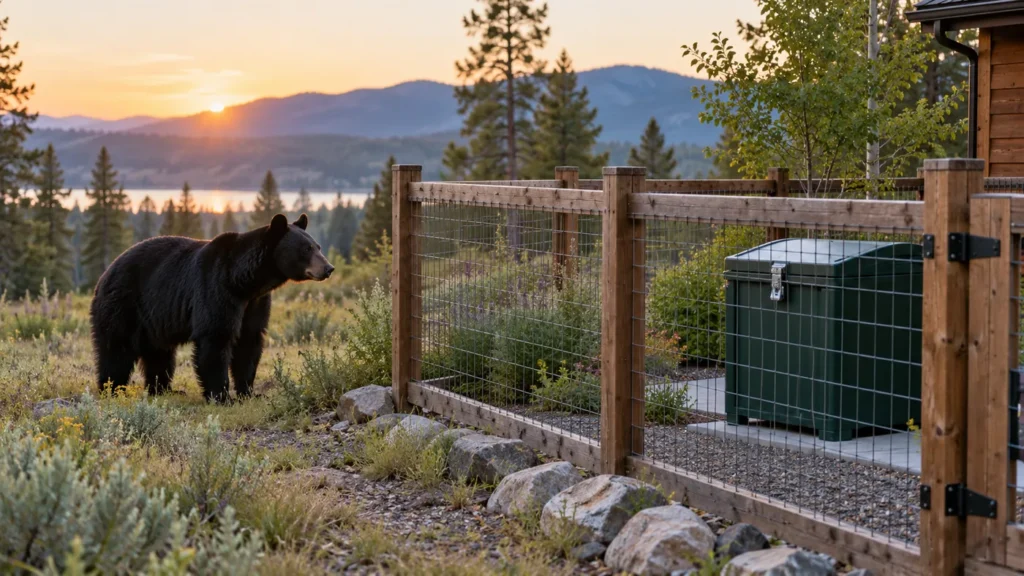
Bears learn from successful meals. A single unsecured bin, bird feeder, pet bowl, or greasy grill can reward a visit and make another visit more likely. The durable solution is property-wide attractant control, backed by local wildlife guidance and appropriately installed deterrents for high-value food sources.
If a bear is nearby
Do not run toward or away from the bear, crowd it for a photo, or let a dog chase it. Move indoors or to a vehicle if that route is safely available. Otherwise, stay together, speak calmly, back away slowly, and leave the bear an escape path. Encounter guidance differs by bear species, behavior, and jurisdiction; follow the responsible wildlife agency. Call emergency services for an attack or immediate threat.
Why bears return to a property
Four reward categories
Waste
Garbage, recycling residue, food packaging, compost, and outdoor freezers can provide concentrated calories and odors.
Cooking and feeding
Grills, grease, smokers, pet food, birdseed, and livestock feed reward investigation.
Crops and animals
Fruit trees, gardens, beehives, poultry, carcasses, and feed storage may need seasonal protection.
Human behavior
Intentional feeding, unsecured photography approaches, and inconsistent neighborhood practices teach bears to remain near people.
A bear passing through natural habitat is different from one repeatedly obtaining food near homes. Record the time, attractant, behavior, and direction of travel from safety. Report food-conditioned, property-damaging, injured, unusually bold, or conflict-involved bears to the relevant state, provincial, tribal, or park wildlife agency.
Bear-conflict controls ranked
Prevent the reward first
- Bear-resistant waste and food storage — Strong. Correctly latched certified containers or secure structures remove the most common household reward.
- Property-wide attractant cleanup — Strong. Pet food, grill grease, birdseed, fallen fruit, feed, and compost must be managed together.
- Properly installed electric fencing — Strong for selected attractants. Wildlife agencies recommend it for apiaries, poultry, livestock feed, orchards, and similar concentrated foods when designed and maintained correctly.
- Agency-approved hazing — Conditional. Only use techniques allowed and recommended locally, from a secure position, and never on a trapped, defensive, injured, or close bear.
- Scent gadgets, ammonia, mothballs, ultrasonic devices, or food-based lures — Avoid. Odor recipes are unreliable, may attract investigation, and pesticides used off-label can harm people and wildlife.
Secure garbage before the next collection day
Use a bear-resistant container or keep ordinary bins inside a locked, bear-resistant building until the approved set-out time. A lid is only effective when every latch is engaged. Clean residue, repair damaged hardware, and avoid leaving overflow bags beside the container. Follow local ordinances; bear-resistant storage and timing requirements vary.

Freezers, coolers, feed sacks, and scented household goods can also attract bears. Store them in a robust enclosed structure rather than on a porch. Vehicle storage is not a universal substitute: food odors and visible containers can lead to vehicle damage in bear country.
Check the exact bear-resistant container model
A heavy-looking garbage can is not the same as a tested bear-resistant container. Look up the exact product and certification number in the Interagency Grizzly Bear Committee (IGBC) product directory, rather than trusting a similar-looking model or a retailer’s “bear-proof” claim. Follow the listed closure instructions every time; certification does not make an unlocked cooler or unlatched bin resistant.
Before buying, ask your waste collector whether the cart fits its equipment and how pickup and latch release are handled. BearWise recommends checking collection compatibility before buying or modifying a container. Also confirm which storage systems your local authority accepts. Certification is not automatic approval for every park, municipality or campsite.
Keep bears from entering food-storage buildings
Close and lock garage, shed and enclosure doors, and secure windows where attractants are stored. An open garage defeats otherwise careful garbage storage. Choose durable construction and dependable latches rather than treating an easily opened shed as bear-resistant. Keep the same closure routine when visitors, renters or workers use the building.
Remove cooking, pet, and bird-food rewards
Clean grill grates, grease traps, smokers, and cooking surfaces after use. Store grease and food waste with secured garbage. Feed pets indoors and bring bowls inside. Store kibble, birdseed, chicken feed, and mineral supplements in a bear-resistant location—not a plastic tote on a deck or in an easily opened shed.

In active bear season, many wildlife agencies recommend removing bird feeders or using non-food alternatives such as water, native plants, and nesting habitat. If local guidance allows seasonal feeding, clean spilled seed and suspend feeding immediately when bear activity occurs. Hummingbird nectar and suet are also attractants.
Protect gardens, orchards, beehives, and poultry
Harvest ripe fruit promptly and collect fallen fruit. Manage compost under local bear-country guidance; meat, grease, and other high-odor foods should not be accessible. Apiaries, chicken coops, feed storage, and small livestock often need a well-designed electric fence before a bear receives its first reward.

Consult the local wildlife agency or extension service for fence specifications suited to the bear species, soil, snow, livestock, and target. Post warnings and comply with electrical and fencing laws. Check voltage regularly with a tester and keep vegetation from grounding the fence.
What to do during an encounter
From indoors, keep doors closed, bring people and pets away from windows or exits, and allow the bear to leave. Do not step outside to film it or test a deterrent. From outdoors, do not run. Group together, keep children close, speak calmly, and back away without blocking the bear’s route.

Do not use one slogan for every close encounter. Black-bear, grizzly/brown-bear, polar-bear, defensive, predatory, food-conditioned, and surprise encounters require different response details. Before travel or outdoor work, learn the current guidance from the agency responsible for that location.
Bear spray: emergency tool, not property repellent
Where legal and recommended, carry an EPA-registered bear deterrent spray in an accessible holster—not buried in a pack. Read the label, check the expiration date and safety clip, understand wind and range, and practice with an inert trainer. Bear spray is for a threatening encounter; do not spray tents, garbage, people, equipment, or property as a preventive scent barrier.
Transportation and possession rules differ, especially for aircraft and cross-border travel. Follow the product label and local authority. Accidental discharge can seriously irritate eyes and lungs; move away from the cloud and obtain medical help when symptoms are severe or persistent.
A seven-step property plan
From audit to maintenance
- Inventory: list every edible or scented attractant on the property.
- Secure: lock garbage, recycling, food, feed, coolers, and freezers.
- Clean: remove grill grease, spills, fallen fruit, pet bowls, and seed.
- Protect: install agency-recommended fencing around concentrated attractants.
- Coordinate: share the plan with neighbors, renters, staff, and visitors.
- Report: contact the wildlife agency about conflict behavior or damage.
- Review: inspect latches, fencing, and seasonal attractants every week in active periods.
Myths and facts
Bear safety without folklore
- Myth: ammonia, mothballs, or a strong household scent keeps bears away.
- Fact: odor tactics are unreliable and may create illegal pesticide use or hazardous exposure; remove food rewards.
- Myth: a fed bear will leave after one snack.
- Fact: food rewards reinforce return visits and increase risk to people and the bear.
- Myth: dogs always scare bears away.
- Fact: an uncontrolled dog can provoke a chase and bring the conflict back to its owner.
- Myth: bear spray should be applied around camp or bins.
- Fact: it is an emergency deterrent used according to its label, not a preventive property treatment.
Bear spray versus personal-defense pepper spray
They are not interchangeable purchases. BearWise advises choosing a genuine bear-deterrent product with an EPA registration number. A small personal-defense pepper spray is not automatically formulated or delivered for a threatening bear encounter. Check the intended use on the label rather than relying on the appearance of the canister.
Read your canister’s range and discharge instructions before an encounter. Product sizes differ, and wind can change where the cloud travels. Practice drawing with an inert trainer while wearing the equipment you normally carry; knowing where the holster is matters as much as owning the spray. This preparation supports, but never replaces, the location’s encounter guidance.
Store bear spray without creating a household hazard
Keep the safety clip engaged and store the canister in a cool, dry place inaccessible to children and pets. Do not leave it in a hot vehicle or glove compartment. Inspect the expiration date and package condition before use. Do not test a live canister around a house or apply it to bins as a preventive bear repellent.
Frequently asked questions
Should I call about every bear sighting?
Agency policies differ. A bear moving through may not require intervention, but repeated food access, property entry, lack of wariness, aggression, injury, or conflict should be reported. Call emergency services for an immediate threat.
Can I haze a bear from my yard?
Only follow locally authorized guidance. Hazing from a secure position may be recommended for some black-bear situations, but it is not appropriate for every species, distance, behavior, or jurisdiction.
Are bear-resistant containers bear-proof?
No. They are designed and tested to resist access when intact and fully latched. Overflow, damage, unlatched lids, or food beside the container defeats the system.
What should I do if a bear attacks?
Response depends on species and behavior. Use the current guidance for that location and call emergency services. Learn it before entering bear habitat rather than trying to decide during an attack.
Bear-deterrent products: what is worth buying?
Affiliate disclosure: Product links may earn HowToRepel.com a commission at no extra cost to you. Selection criteria come first; no product replaces local wildlife guidance.
| Product category | Best use | Check before buying | Main limitation |
|---|---|---|---|
| Bear-resistant garbage container | Routine household waste storage | Recognized bear-resistant certification, latch operation, capacity and collection compatibility | Fails when overfilled or left unlatched |
| Electric-fence kit | Beehives, poultry, compost and fruit | Energizer rating, grounding system, wire layout, tester and local rules | Needs vegetation control and regular voltage checks |
| Bear spray | Personal emergency protection where lawful | EPA registration, expiration date, holster access and training instructions | Not a perimeter spray or substitute for attractant control |
| Motion alarm or light | Supplemental detection near a secured area | Weather rating, detection zone and false-trigger controls | Bears can habituate; never rely on it alone |
Frequently asked questions about repelling bears
What smell keeps bears away?
No household odor is a dependable property barrier. Remove food rewards, secure garbage and use site-appropriate exclusion instead.
Do ammonia or mothballs repel bears?
Do not scatter either around a property. Mothballs are pesticides whose labels control where they may be used, and ammonia can expose people and animals without solving the attractant.
Will lights or radios keep bears away?
They may interrupt a visit, but bears can habituate. Treat them as temporary supplements while you secure the food source.
When should I call wildlife authorities?
Call for a bear that is aggressive, repeatedly entering occupied areas, attempting to enter a building or creating an immediate safety risk. Follow the instructions for your state or province.
Match prevention to the bear activity cycle
Bear visits are easier to prevent before an animal receives a food reward. In spring, inspect winter-damaged bins, sheds, coop latches and fence conductors before regular activity increases. During fruiting season, harvest ripe produce promptly and remove fallen fruit. In late summer and fall, recheck every concentrated calorie source because bears may spend more time feeding as winter approaches.
Weather, natural-food availability and local bear populations can change the timing. Treat the calendar as a maintenance prompt, not a promise that bears are absent in another season. Local wildlife-agency alerts should override a generic schedule.
Read the evidence a bear leaves behind
Tracks, scat, overturned containers, claw or tooth marks, displaced hive equipment and a repeated travel path can help locate the reward. Photograph signs from a safe place and note the time without approaching a bear. A camera or driveway alert can document timing, but it is only a monitoring tool; it does not replace attractant removal or a suitable barrier.
After an incident, inspect beyond the obvious bin. Recycling residue, a grease tray, pet bowls, seed beneath a feeder, livestock feed, compost and outdoor refrigerators may all be part of the same pattern. Correct the whole reward chain so the bear does not simply move to the next item.
When electric fencing is the right layer
Properly designed electric fencing can protect compact, high-value attractants such as apiaries, poultry areas, feed storage and orchards. Its effectiveness depends on an appropriate energizer, grounding, wire layout, vegetation control and routine testing. Ask a state wildlife agency or experienced installer for a design suited to the bear species, site and local rules; an improvised fence that is not energized or maintained can create false confidence.
Make the protected area unattractive as well as difficult to enter. Remove food spills, secure feed and close gates consistently. Post warnings where required and keep children and pets away from electrified components.
Coordinate with neighbours and wildlife authorities
One secured property cannot fully offset accessible garbage or intentional feeding next door. Share collection-day practices, feeder pauses and fruit cleanup with neighbours or a homeowners association. Report food-conditioned, injured, trapped or repeatedly bold bears to the appropriate wildlife authority, and follow emergency instructions for any immediate threat.
Bear spray remains a last-resort personal-defense tool for an aggressive or charging bear. It is not a yard treatment: never spray it on property, people, tents or equipment. Carry only a lawful, EPA-registered bear-spray product where it is immediately reachable, learn its label directions, and check local restrictions.
Primary and authoritative sources
- National Park Service: Staying Safe Around Bears — distance, food, encounters, and species-specific response.
- National Park Service: Hiking in bear country — storage, travel, encounters, and bear spray.
- BearWise: Six BearWise Basics — attractant management developed by state bear biologists.
- National Park Service: Bear-spray precautions and limitations — registration and label-directed use.
- Montana FWP: Living in Bear Country — property attractants, electric fencing, and reporting.
- BearWise: Bear Spray Safety and Use
HowToRepel.com is an independent educational publisher, not an emergency or wildlife-management agency. This guide was AI-assisted, human-edited, and source-checked. Follow the rules and species-specific guidance of the agency responsible for your location.
Publishing and affiliate notes
Production note: AI assisted with drafting and original instructional images. A human editor checked claims against the cited primary sources.
Some product links may be affiliate links. If you buy through them, we may earn a commission at no extra cost to you. Product picks are not lab tests. Read the legal disclaimer.