
Quick answer: how to repel clover mites
Vacuum mites from windowsills without crushing them, seal suitable gaps around windows, and separate lawn growth from the foundation with an 18–24-inch strip of clean bare soil. Landscape rock alone is not a dependable barrier. For a persistent outdoor invasion, confirm the identification and ask about a treatment labeled for the pest and location.
Clover mites (Bryobia praetiosa) are tiny plant-feeding mites that can gather at sunny windows. They don’t bite people or pets, but crushing them leaves red stains. Your first job is gentle removal and finding the entry route. University of Minnesota identification guidance.
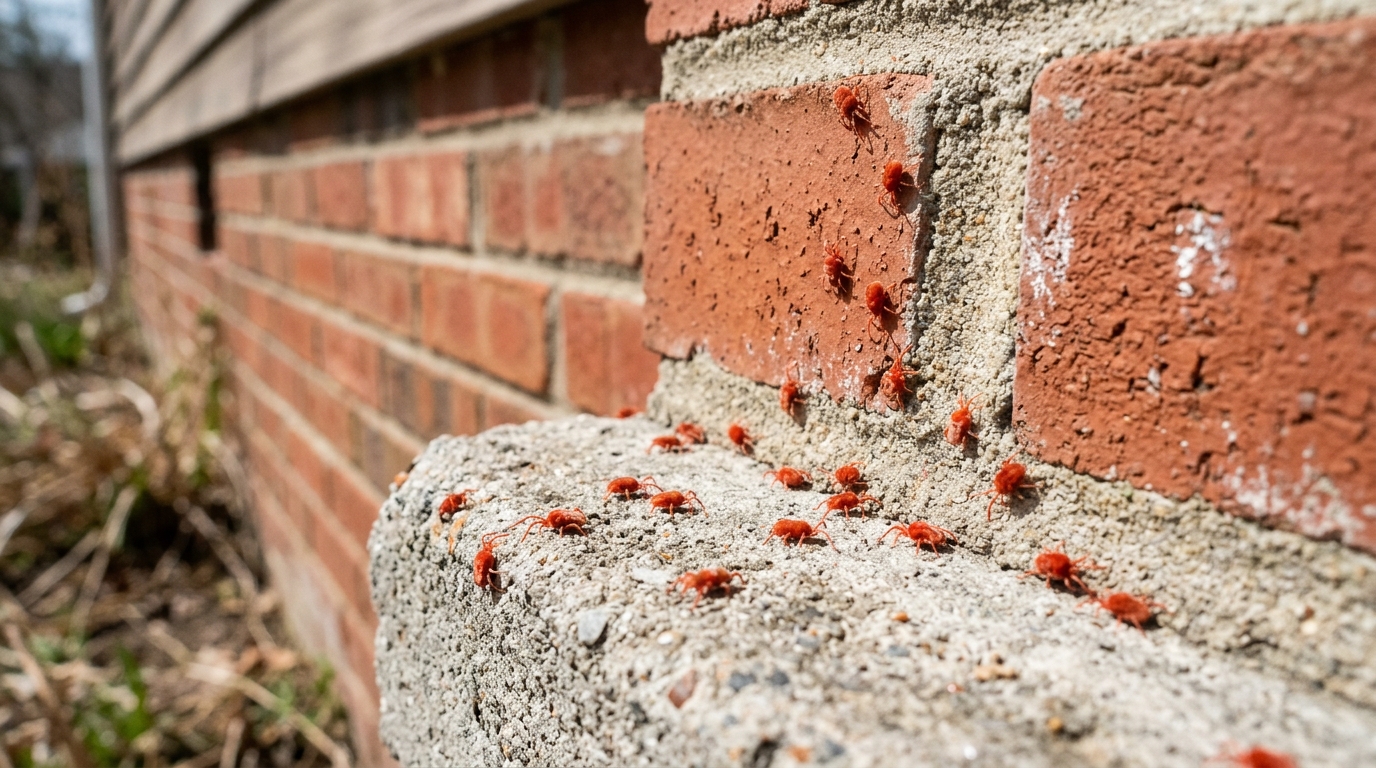
Mites are much smaller than they appear in close-up images; don’t diagnose an unknown biting pest from color alone.
Food-grade DE is not a blanket safety claim
Don’t spread food-grade diatomaceous earth around accessible sills, floors, or pet areas as a default treatment. NPIC distinguishes food use from concentrated pest-control exposure and warns about breathing dust. If a dust pesticide is considered, select a pesticide-labeled product and follow its permitted uses, protective equipment, and access restrictions. NPIC guidance. Product performance varies with conditions and exposure; don’t assume a fixed kill time.
Why clover mites collect at windows and foundations
Lawn proximity, plant growth, and sheltered building crevices influence invasions. Activity is seasonal, with local spring and fall patterns; a warm spell can also bring movement. Use those clues to inspect the building instead of treating it like a breeding site for indoor insects. Penn State biology and management.
Find the source, route, and indoor nuisance
Plant food outside
Nearby grass and clover support plant-feeding mites. Minnesota Extension.
Entry around openings
Inspect stationary window joints and foundation cracks; keep drainage openings clear.
Sunny surfaces
Look where you see repeated activity, rather than applying a whole-house treatment. Penn State.
Red smears indoors
Remove gently. Color left by crushed mites does not mean they fed on blood. Minnesota Extension.
Clover-mite methods ranked by evidence
Choose removal and prevention first
Compare the practical role, source support, and limits of each method.
Vacuum or moist-cloth removal
Strong guidance — Useful for indoor nuisance mites; avoid crushing them. Minnesota and Penn State.
Grass-free foundation strip
Strong prevention guidance — Minnesota specifies 18–24 inches of clean bare soil and says landscape rock alone is insufficient. Source.
Entry-point repair
Practical exclusion step — Seal suitable stationary cracks after inspection; preserve weep holes, vents, and drainage.
Labeled exterior pesticide
Conditional option — For a persistent large invasion, follow the exact site and pest instructions or use a professional. EPA label rules.
Food-grade dust and household sprays
Not a default recommendation — Food-grade status does not establish inhalation safety, application directions, or reliable clover-mite performance. NPIC.
Step-by-step windowsill and foundation plan
1. Remove indoor mites without staining
Use a vacuum attachment or a moist cloth, taking care not to grind mites into paint or fabric. Minnesota removal guidance. Work on the affected sill and record where the specks reappear. Follow your vacuum’s normal emptying instructions rather than adding pesticide to the machine.

2. Inspect stationary window joints and entry gaps
Check the affected window from inside and outside where safely accessible. Repair suitable stationary joints with a compatible sealant; use the window manufacturer’s instructions for moving seals. Leave weep holes and ventilation openings unobstructed. Sealing a gap should not create a drainage problem.

3. Separate grass from the foundation
Where the site allows it, maintain an 18–24-inch clean bare-soil strip beside the foundation and remove grass, leaf litter, and plant bridges across it. Minnesota’s guidance specifically cautions that landscape rock alone is not enough. Read the barrier guidance. Preserve drainage and avoid excavation near utilities or an unstable slope.

4. Reserve pesticides for a confirmed persistent problem
Indoor chemical treatment is generally unnecessary for confirmed clover mites: Penn State recommends vacuuming and notes that they cannot reproduce indoors. Penn State indoor management. If exterior activity remains severe, ask a licensed operator or local extension office about an appropriate next step. Use only the pesticide’s allowed application area, amount, interval, and access restrictions; don’t copy a generic foundation-band recipe. EPA guidance.
5. Monitor the same locations through seasonal activity
Record dates, affected windows, and whether mites are present outside as well as inside. Recheck the soil strip and seals after yard work or weather changes. A fixed 10–14-day invasion window is not reliable for every climate or building; changing weather and sheltered mites can extend activity.

Window-by-window prevention checklist
A repeatable inspection routine
Affected room
Remove mites gently; note the window and photograph the pest if identification is uncertain.
Exterior window
Check accessible stationary joints and preserve drainage holes.
Foundation edge
Remove grass and plant bridges from the bare-soil strip without changing drainage.
Next inspection
Compare indoor and outdoor observations. Seek identification help if biting, damage, or a different pest is involved.
Clover-mite myths and facts
Replace misleading shortcuts with source-backed distinctions
Myth: food-grade means safe to scatter
Food status does not settle concentrated exposure or inhalation risk. NPIC.
Myth: a gravel moat solves every invasion
Landscape rock alone is not enough; the cited barrier is clean bare soil. Minnesota Extension.
Fact: clover mites feed on plants
They do not bite people or animals. Unknown biting mites need a different diagnosis. Minnesota Extension.
Fact: they do not reproduce indoors
Outdoor entry and sheltered crevices explain the nuisance better than an indoor breeding infestation. Penn State.
Frequently asked questions
Do clover mites bite people or pets?
Confirmed clover mites are plant feeders and do not bite. If you have bites, don’t assume the tiny red specks explain them; seek identification help for the actual pest. Minnesota guidance.
Will gravel keep clover mites away?
Not reliably on its own. University of Minnesota recommends an 18–24-inch strip of clean bare soil and explicitly says landscape rock is insufficient. Keep vegetation from bridging the strip.
How long will mites remain indoors?
Penn State says they cannot reproduce indoors and die within a few days, but that does not stop additional mites entering. Remove those present and address the route; no fixed hour-by-hour guarantee applies. Source.
Should I spray the windowsill or dust the foundation?
Start with physical removal and exclusion. A food-grade dust is not a default pesticide recommendation. Any chemical step needs the correct product label and site; persistent heavy outdoor activity is a reason to ask a professional. NPIC; EPA.
Related house and pet-safety resources
Use the indoor pest hub, identification guide, and lower-risk methods for homes with pets to plan your next step.
Sources and review notes
Reviewed October 2, 2026. Evidence labels describe the scope of the linked guidance; they are not measured success rates.
- University of Minnesota Extension — Clover mites
- Penn State Extension — Clover mites
- NPIC — Food-grade DE and pest-control risks
- EPA — Pesticide labels and permitted use
This guide was drafted with AI assistance and manually edited against these sources. Images illustrate the steps and are not field-test evidence. Product labels and local requirements take priority. See our editorial methodology, evidence database, and safety disclaimer.
Some product links may be affiliate links. If you buy through them, we may earn a commission at no extra cost to you. Product picks are not lab tests. Read the legal disclaimer.