


Japanese beetles (Popillia japonica) are one of the most destructive garden pests in North America. A single beetle does limited damage, but they feed in groups and use pheromones to attract more — a small infestation can strip a plant bare within days. The good news: there are 10 proven natural methods that repel, trap, and kill Japanese beetles without toxic chemicals that harm beneficial insects or soil health.
Key Takeaways
- Japanese beetles are most active June–August, peaking in the morning hours — that’s the best time to hand-pick or spray
- Neem oil is the most effective broad-spectrum natural insecticide against Japanese beetles at all life stages
- Beneficial nematodes and milky spore target the grub stage underground — the most impactful long-term strategy
- Avoid commercial Japanese beetle traps — research shows they attract more beetles than they catch
- Companion planting with garlic, catnip, and white geraniums repels adults and disrupts feeding aggregations
Identifying Japanese Beetles
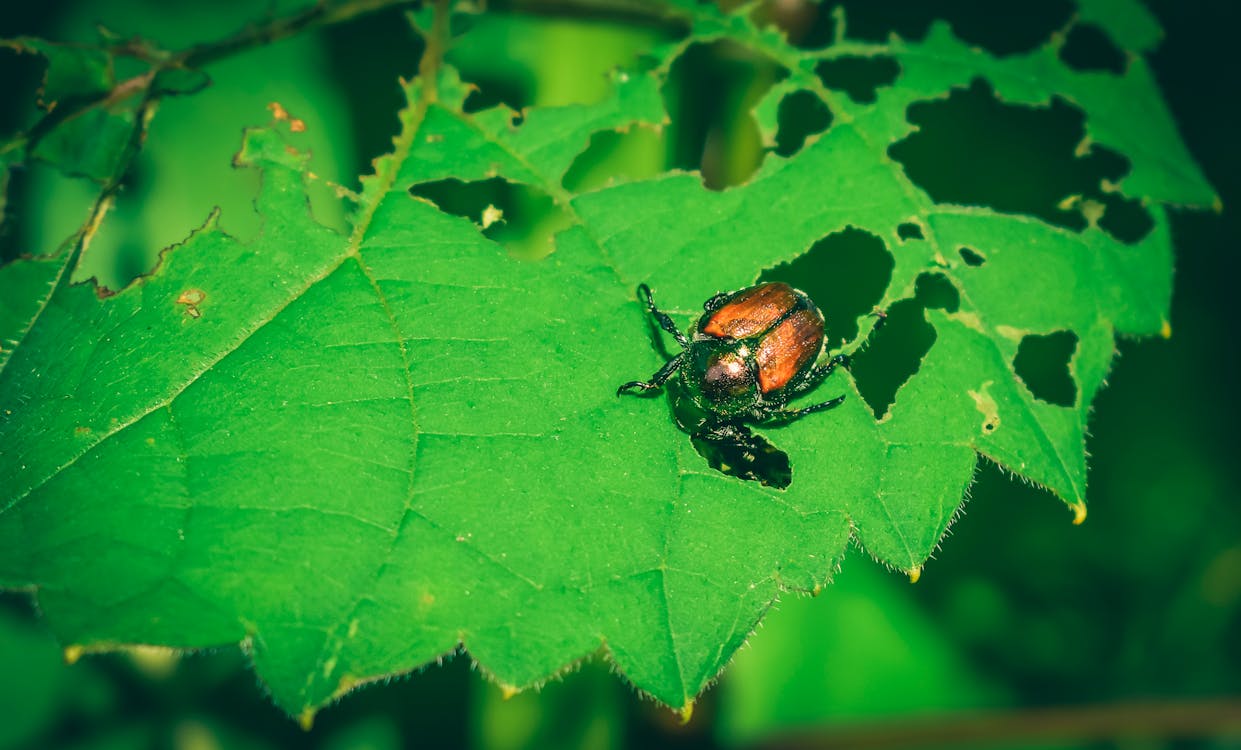
Japanese beetles are easy to identify once you know what to look for: metallic green head and thorax, copper-brown wing covers, about 1/2 inch long, with small white hair tufts along the sides of the abdomen. They feed in groups, skeletonizing leaves by eating the tissue between the veins. Common target plants include roses, grapes, raspberries, linden trees, basil, and corn silk.
Their life cycle matters for treatment timing: adults are active June–August, laying eggs in lawns. Grubs hatch in late summer and feed on grass roots underground through fall. Grubs overwinter, pupate in spring, and emerge as adults in early summer.
1. Hand-Pick Into Soapy Water (Fastest Immediate Control)
The simplest and most immediate method: hold a bucket of soapy water under an infested branch and shake. Japanese beetles drop when disturbed and fall directly into the water where they drown. Do this in the early morning when beetles are sluggish and cold. Check daily during peak season (June–July). For heavy infestations this can remove hundreds of beetles per session.
2. Neem Oil Spray (Best All-Round Natural Insecticide)
Neem oil disrupts Japanese beetle feeding, mating, and reproduction. Its active compound (azadirachtin) acts as an insect growth regulator — beetles that feed on neem-treated foliage lay fewer viable eggs. Mix 2 tablespoons of pure neem oil + 1 teaspoon dish soap per gallon of water. Spray directly on leaves, covering tops and undersides, in the evening (neem degrades in sunlight). Reapply every 7 days and after rain. Safe for bees when applied at dusk after bees are done foraging.
3. Dish Soap and Garlic Spray
A contact-kill and repellent spray you can make in minutes. Mince a handful of garlic and simmer in 2 cups water for 20 minutes. Strain, cool, and add 2 tablespoons of dish soap. Spray directly on beetles and infested foliage. The garlic compounds repel beetles and the soap suffocates them on contact. Reapply every 3–5 days. Test on a small leaf area first to check for sensitivity.
4. Beneficial Nematodes (Best Long-Term Underground Strategy)
Beneficial nematodes (Heterorhabditis bacteriophora) are microscopic roundworms that parasitize and kill Japanese beetle grubs underground. Apply to lawn areas in late summer (August–September) when young grubs are in the top 2 inches of soil. Mix with water and spray or water into the lawn. Keep soil moist for 2 weeks after application. Results improve year over year as nematode populations establish. This is the most impactful strategy for breaking the population cycle.
5. Milky Spore (Long-Term Grub Control)
Milky spore (Bacillus popilliae) is a naturally occurring bacterium that specifically infects and kills Japanese beetle grubs. Apply granules to lawn areas once; effectiveness builds over 2–3 years as spores multiply in the soil and can persist for 10+ years. Best applied when soil temperature is above 65°F. Completely harmless to people, pets, plants, and beneficial insects. This is the best set-and-forget long-term solution for beetle grub control.
6. Companion Planting to Repel Adults
Strategic companion planting creates a naturally less hospitable environment for Japanese beetles:
| Plant | Why It Works | Where to Plant |
|---|---|---|
| White Geraniums | Paralyzes beetles within 30 min of consumption; acts as a trap crop | Border of rose beds and vegetable gardens |
| Garlic & Chives | Sulfur compounds repel adult beetles | Interplanted throughout garden beds |
| Catnip | Nepetalactone strongly repels Japanese beetles | Garden perimeter |
| Marigolds (odorless) | Repel beetles and other pests | Throughout vegetable beds |
| Chrysanthemums | Contain pyrethrin, a natural insecticide | Garden borders |
7. Lavender as a Natural Repellent
Lavender’s strong aromatic compounds deter Japanese beetles from treated plants. Plant lavender around rose bushes and vegetable beds as a living repellent. For a spray, mix 20 drops of lavender essential oil in 1 cup of water and spray on foliage every 7–10 days. Lavender also attracts beneficial pollinators and predatory insects that help control beetle populations naturally.
8. Kaolin Clay Barrier
Kaolin clay (sold as Surround WP) is a food-grade mineral powder that creates a physical barrier on plant surfaces that beetles find irritating and avoid. Mix with water and spray on foliage to create a thin white film. Beetles that land on treated plants are irritated and leave. Safe for edible crops, pollinators, and beneficial insects. Needs reapplication after rain. Particularly effective for protecting fruit trees, grapes, and corn.
9. Attract Natural Predators
Several birds and beneficial insects prey on Japanese beetles. Encourage them by:
- Installing bird boxes to attract starlings, robins, and catbirds that eat adult beetles
- Keeping guinea fowl if you have the space — they are voracious beetle hunters
- Planting native flowers to attract tachinid flies and ground beetles that prey on grubs
- Avoiding broad-spectrum pesticides that kill natural predators alongside beetles
10. Row Covers for Vulnerable Plants
Lightweight garden fabric (row cover/fleece) draped over plants during peak beetle season (June–August) creates a complete physical barrier. Secure edges with soil, rocks, or staples. Particularly useful for protecting vegetable crops like corn, beans, and raspberries during their most vulnerable flowering stage. Remove covers briefly in mornings for pollination if needed, then replace.
Why You Should Avoid Commercial Beetle Traps
Commercial Japanese beetle traps use pheromone and floral lures to attract beetles. Research from the University of Kentucky found these traps actually attract 3–4 times more beetles to your area than they catch. If you use them, place them at the far edge of your property — never near plants you’re trying to protect. Soapy water hand-picking is a more effective and safer alternative.
Conclusion
The most effective Japanese beetle control combines: hand-picking for immediate relief, neem oil spray for ongoing surface protection, and beneficial nematodes or milky spore for long-term grub control underground. Add companion planting as a passive year-round deterrent. This layered approach addresses all life stages and significantly reduces beetle populations each successive year without any toxic chemicals.
Frequently Asked Questions
What plants do Japanese beetles hate most?
Japanese beetles strongly avoid catnip, garlic, chives, white geraniums, and lavender. White geraniums are particularly notable — beetles that eat them become temporarily paralyzed, making them vulnerable to predators. Plant these throughout and around the perimeter of your garden as a living repellent barrier.
When is the best time to spray for Japanese beetles?
Spray neem oil or garlic-soap sprays in the evening to avoid harming daytime pollinators and to prevent the oil from degrading in direct sunlight. Hand-pick in the early morning when beetles are cold and sluggish. Treat lawns with nematodes in late summer (August–September) when grubs are young and close to the surface.
How long does Japanese beetle season last?
Adult Japanese beetles are active from late June through August, with peak activity in July. The season typically lasts 6–8 weeks. Populations taper off as temperatures cool in late summer. Starting control measures at the first sign of adults in June gives the best results.
Does neem oil kill Japanese beetles?
Neem oil kills Japanese beetles on contact and also disrupts their ability to feed and reproduce when consumed. It is effective against adults, larvae, and eggs. It’s the most versatile natural insecticide for Japanese beetle control. Reapply every 7 days and after rain for consistent protection.