
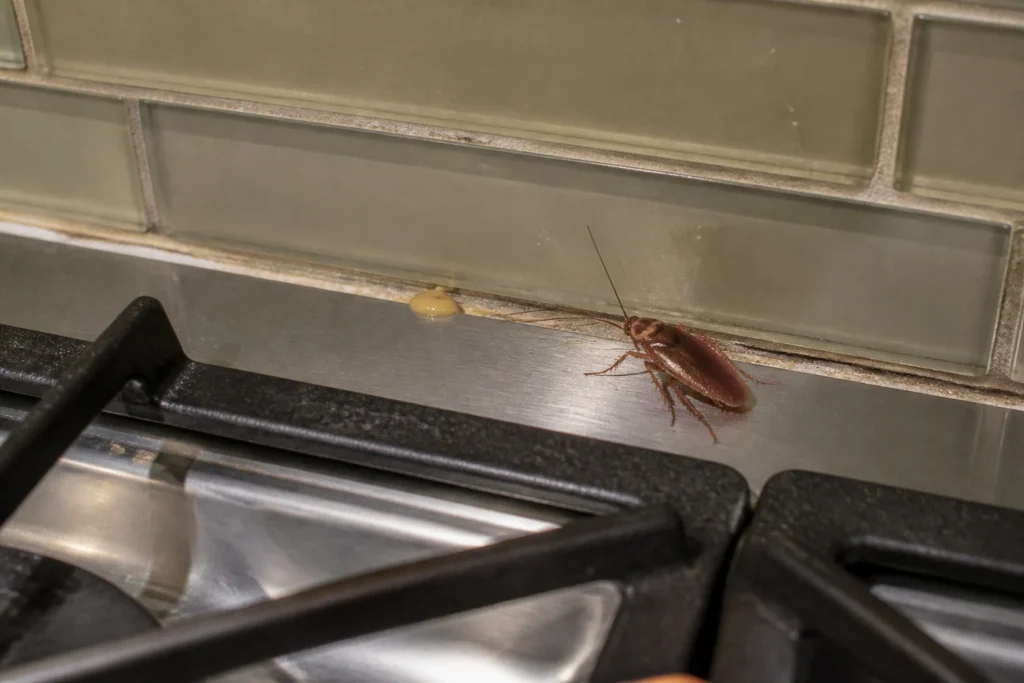
German cockroach activity often clusters in warm, humid kitchen edges—behind the fridge, under the sink, along cabinet hinges—especially in apartments where units share walls and plumbing. Cleaning matters, but established indoor breeding usually needs labeled bait stations (or gel) plus follow-up monitoring. Coordinate with building management; one unit’s bait plan rarely covers adjacent units alone.

German cockroach hiding places and sources
Identify the conditions that shape the plan
Accessible food
Crumbs, spills and unsealed storage can support activity.
Water sources
Visible leaks and repeated moisture deserve attention.
Concealed shelter
Inspect accessible cabinet and appliance edges without opening electrical equipment.
Introduced or connected activity
Belongings and shared-building routes can complicate control.
German cockroach control: monitoring, sanitation and bait
Match each method to the inspection findings
Identification and monitoring
Confirm the species and record locations before treatment.
Food and water management
Correct accessible resources and leaks.
Suitable labeled bait
Use placement and amount from the exact directions, not a generic dot size.
Qualified coordinated treatment
Useful for established, persistent or shared-building activity.
Kitchen monitoring, leak repair and food protection
Position a suitable monitor
Follow the monitoring-device directions and place it where children and pets cannot reach it. Record its location and catches to guide follow-up. A monitor is not a bait prescription or a guarantee that all hiding sites were found.

Address visible dripping
Inspect an accessible sink joint. Perform only fixture-compatible maintenance you understand; contact a plumber for concealed damage or unresolved leaks. Avoid work near electrical equipment.

Remove accessible crumbs and spills
Clean suitable floor and appliance edges without opening panels or moving heavy equipment unsafely. Avoid spraying a monitor or bait location with an incompatible product. Follow provider and label instructions when combining methods.

Protect pantry food
Use hard containers with tight lids, remove residue and keep waste covered. Maintain the arrangement after treatment so new spills or accessible food do not undermine the plan.

Sequence and follow-up
Check progress against the agreed scope
Confirm activity
Identify the roach and map monitor locations.
Prepare
Correct food, moisture and accessible shelter.
Treat as needed
Use the labeled plan or qualified provider’s directions.
Follow up
Compare catches and sightings; do not promise a fixed clearance week.
Myths and facts
Avoid universal dose and elimination promises
Myth: one bait dose fits every product
Fact: ingredients, amount and placement depend on the label.
Myth: growth regulators instantly sterilize every roach
Fact: use a suitable product as part of a monitored plan, without an instant guarantee.
Myth: routine dusting is always necessary
Fact: assess the site and application restrictions first.
Myth: a clean kitchen needs no monitoring
Fact: established or introduced activity can still need follow-up.
Questions before treatment
Request identification, inspection findings and a written description of the proposed work. Ask what preparation is required, which occupants or pets need arrangements, and how continuing activity will be assessed. Compare qualified providers using the scope and follow-up terms rather than an unsupported success percentage or a nationally fixed price.
German cockroach signs and hiding places
German cockroaches are small indoor roaches that favor warm, humid areas close to food and water. Check monitors and accessible crevices near refrigerators, dishwashers, sinks and cabinet hinges. Pepper-like droppings, shed skins, egg cases and small nymphs help confirm activity; one visible roach does not reveal the full extent of an apartment infestation. Penn State explains German cockroach identification and biology.
Daytime sightings can indicate that hiding places are crowded or disturbed, but they are not a precise population count. Record locations and dates. In a multi-unit building, share that pattern with the property manager or pest-control technician because roaches can move through shared walls and utility routes.
Confirm a German cockroach rather than an outdoor visitor
German cockroaches (Blattella germanica) are small indoor cockroaches associated with kitchens, bathrooms and other warm places close to food and moisture. Adults are light brown to tan with two dark, parallel stripes behind the head. Nymphs are smaller and darker. Unlike several larger cockroach species that commonly live outdoors and wander inside, German cockroaches reproduce indoors, so repeated sightings usually call for a focused inspection rather than a perimeter-only response.
Use a clear photograph or a safely contained specimen when identification is uncertain. Species matters because outdoor habitat changes may help with an occasional invader but will not resolve a population breeding behind cabinets or appliances. UC IPM’s cockroach identification and management guidance recommends identifying the species before choosing control methods.
Map the infestation before placing bait
Inspect after dark when practical, using a flashlight without dismantling electrical equipment. Check accessible cabinet corners and hinges, the edges beneath sinks, plumbing penetrations, rubbish storage, pantry shelving and the exterior gaps around refrigerators or other food-area appliances. Look for live adults and nymphs, pepper-like droppings, shed skins and egg cases. Daytime activity can indicate crowding or a substantial infestation, although one sighting alone does not measure the population.
Place sticky monitors against edges or in corners where cockroaches travel, following the device directions and keeping them inaccessible to children and pets. Number the monitors and record catches by location and date. The goal is not merely to prove that a roach exists. A simple monitoring map shows where activity is concentrated, whether treatment reaches those harborages and whether another unit or plumbing route may be contributing.
How sanitation, exclusion and bait work together
Remove competing food and water
Clean grease and crumbs from accessible surfaces, wash dishes instead of leaving them overnight, close rubbish containers and store dry foods in hard containers with tight lids. Repair accessible leaks and dry repeated condensation. Sanitation rarely eliminates an established infestation by itself, but it removes competing resources and makes monitoring and bait placement more informative. It also helps prevent a reduced population from rebounding.
Seal accessible movement routes
Repair gaps around plumbing penetrations, damaged cabinet joints and other accessible routes with materials appropriate for the surface. Do not seal an electrical enclosure or block ventilation. In multi-unit housing, maintenance may need to address connected pipe chases, wall gaps and damaged finishes across more than one apartment. Exclusion supports treatment; it cannot substitute for treating an active indoor population already established in hidden harborages.
Use bait without contaminating the feeding area
Bait stations and gel baits can be effective when the label permits the site and placement is close to activity. Follow the exact product directions for amount, spacing and replacement. Do not copy a universal dot size from a website. Avoid spraying repellent insecticide on or beside bait unless the labels and treatment plan specifically allow the combination, because contaminated or disturbed bait locations may be less useful. Keep every application away from food-contact surfaces and inaccessible to children and pets.
Understand the limited role of dusts and growth regulators
Some labeled programs use an insect growth regulator or a dust in appropriate voids, but neither category is a reason to improvise. The selected product, application site and equipment determine whether it belongs in a particular apartment. Visible piles of dust are not a better treatment and can create avoidable exposure. Leave inaccessible voids, electrical areas and building-wide pesticide work to a qualified professional.
Measure progress and diagnose a stalled treatment
Compare catches in the same monitor locations instead of relying only on occasional sightings. A falling count suggests progress; unchanged or rising activity means the plan needs reassessment. Check for missed food and water, bait that has dried or been removed, incompatible spray use, untreated harborages, deliveries that reintroduce insects and movement from neighboring units. Continue sanitation and monitoring after sightings decline.
Report dated findings to the property manager in an apartment building. EPA’s multi-family housing guidance describes pest management as a shared responsibility among residents, maintenance staff, housing management and pest professionals. That coordination matters more than repeatedly treating one kitchen while connected activity remains elsewhere.
Health, food and allergy considerations
Cockroaches can contaminate food and surfaces, and cockroach debris can contribute to indoor allergy and asthma concerns. Protect food, clean contaminated preparation surfaces appropriately and avoid crushing or sweeping dry debris into the air. People with significant asthma or allergy symptoms should discuss medical care with a qualified clinician; pest control guidance cannot diagnose the cause of a reaction.
Frequently asked questions
Should I spray when using gel bait?
Do not spray over or beside a bait placement unless both product labels specifically permit that combination. Repellent residues can interfere with feeding, and every bait must be placed where children, pets and food-contact surfaces are protected.
What do German cockroach egg cases look like?
The brown capsule is called an ootheca. A female may carry it until shortly before hatch, so removing one visible adult does not establish control. Monitor for nymphs and continuing activity.
Why do German cockroaches return after cleaning?
Cleaning removes food and improves bait performance, but it does not by itself reach every hiding place or adjoining apartment. Moisture, inaccessible harborages and untreated neighboring units can keep the infestation active.
When should an apartment resident call a professional?
Escalate when monitoring shows repeated activity, roaches appear during the day, several rooms are involved, or building-wide coordination is needed. Ask for the inspection findings, product labels and follow-up plan in writing.
Related guides
Cockroach identification and control (all species) · How to get rid of ants in the kitchen · Repellent evidence database
Apartment control must cross unit boundaries
German cockroaches can move through shared walls, plumbing routes, and deliveries. Cleaning one kitchen helps reduce resources but cannot resolve activity maintained by adjacent untreated harborages.
Keep dated monitor counts and notify property management early. Effective control may require coordinated inspection, bait placement, repairs, and follow-up across more than one unit.
German cockroach nymphs after treatment: what they tell you
Small, dark roaches are not necessarily a new species. German cockroach nymphs lack the fully developed wings of adults. Note the life stages in each sticky monitor as well as the total count. New nymphs deserve follow-up, but they don’t prove that bait is working or that the infestation is collapsing.
A female German cockroach carries an egg case, or ootheca, until close to hatching. UC IPM explains this biology and the need for continued monitoring. Compare catches in unchanged locations after treatment; a monitor that was moved across the kitchen cannot provide a clean before-and-after comparison.
Why German cockroach gel bait can stall
Check whether the bait remains in its permitted placement and condition. Cleaning can remove deposits, drying can change a gel, and food residue can offer an easier meal. Inspect the area without moving or adding pesticide outside the directions. Record what changed before deciding the product failed.
Resistance is one possible explanation, not the first diagnosis to make from a single sighting. UC IPM recommends reassessing food, water, entryways and hiding places when populations persist. Ask a qualified pest control technician to review the active ingredient and feeding response when the monitored plan stalls. Switching brand names alone does not necessarily change the treatment chemistry.
Inspect deliveries and secondhand appliances without spreading roaches
Check accessible seams and packaging before putting an item into kitchen storage. Remove unnecessary cardboard promptly and keep suspect belongings away from clean food cupboards while you arrange assessment. Don’t shake an infested box over the floor or move it into another apartment.
Warm appliance edges are useful inspection locations, not permission to spray a motor housing. Leave opening panels, internal electrical work and heavy appliance movement to someone qualified. Give the technician a list of affected appliances so the control plan can account for inaccessible harborages.
Prepare for a cockroach exterminator’s follow-up visit
Have the monitor map, recent counts and preparation instructions ready. Explain which cleaning or repair tasks you could not complete, rather than concealing an inaccessible area behind storage. Ask whether nearby units and shared pipe routes were assessed and what evidence will trigger further treatment.
Request the actual product names, permitted sites, reentry precautions and included follow-up visits. A routine outdoor barrier service is not automatically a German cockroach treatment plan. Compare the written scope, not a permanent-elimination promise.
Publishing and affiliate notes
Some product links may be affiliate links. If you buy through them, we may earn a commission at no extra cost to you. Product picks are not lab tests. Read the legal disclaimer.