
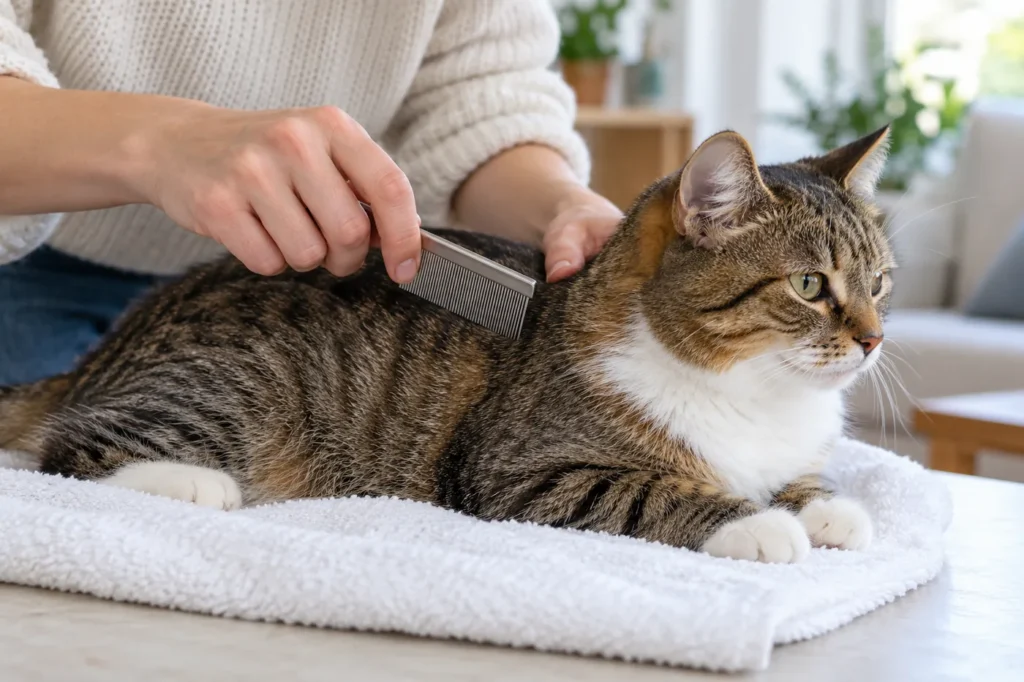
Cats can develop intense itching, flea-allergy dermatitis, hair loss, skin infection, or anemia from fleas. Kittens, older cats, and medically fragile cats need faster veterinary assessment. A home routine helps with detection and environmental cleanup, but it does not replace an animal-specific treatment plan.
Dog flea products can be dangerous to cats
Use only a product whose current label names cats and includes your cat’s age and weight range. EPA warns that products intended for dogs can harm or kill cats. Keep cats away from recently treated dogs for the interval on the dog product’s label, because grooming or close contact can transfer residue. If exposure or a reaction is suspected, contact a veterinarian immediately and keep the package available.
Why cat fleas persist
The cat and home share one flea cycle
Adult fleas on animals
The cat flea, Ctenocephalides felis, feeds and reproduces on cats and other suitable hosts.
Eggs in resting areas
Eggs fall from the coat into bedding, rugs, upholstery, floor gaps, and carriers.
Larvae and pupae in shelter
Immature stages develop in protected debris and crevices; pupae can keep producing new adults after cleanup begins.
Untreated hosts
A dog, another cat, foster animal, or visiting pet without coordinated prevention can maintain the cycle.
Indoor cats can acquire fleas from another animal, rodents, used furnishings, shared building spaces, or people carrying an adult flea inside. Fleas do not prove poor housekeeping. They do mean that every animal and the places where animals rest need to be assessed together.
Cat flea controls ranked
Use species-specific treatment plus environmental control
- Veterinarian-selected cat treatment — Strong. The choice accounts for age, weight, health, pregnancy, seizure history, other medicines, and local parasites.
- Coordinated treatment of every pet — Strong. Leaving one suitable host untreated can continue flea reproduction.
- Flea combing and environmental cleaning — Strong supporting controls. They remove fleas and debris and show whether activity is declining, but they are not complete prevention alone.
- Label-directed premise treatment — Conditional. It may be needed for a substantial infestation, with cats, belongings, aquariums, ventilation, and re-entry handled exactly as directed.
- Essential oils, garlic, vinegar, alcohol, bleach, or dog products — Avoid. These are unreliable substitutes and can poison or injure a cat.
Step 1: confirm fleas and assess the cat
Comb slowly near the neck, back, belly, groin, and base of the tail. Drop collected dark debris onto a damp white paper towel; a reddish-brown halo can indicate digested blood in flea dirt. A veterinarian can distinguish flea allergy from mites, lice, ringworm, food allergy, and other skin disease.

Call sooner if the cat is very young, pregnant or nursing, underweight, elderly, ill, taking medication, or has a neurologic history. Bring the names and application dates of every parasite product used on every pet. That list helps prevent accidental duplication or incompatible treatment.
Step 2: select and apply the right product
Read the entire label before purchase and again before application. Confirm species, minimum age, weight band, dose, application site, schedule, bathing directions, storage, and first aid. Do not divide a larger tube, use a product more often than directed, or combine a collar, topical, tablet, shampoo, or spray without veterinary instruction.

Apply topical products where the cat cannot lick them and as the label shows. Separate animals until the product is dry or for the stated interval so they cannot groom one another. Wash hands after application and store the package away from children and animals.
Step 3: clean the places the cat rests
Vacuum rugs, floor gaps, baseboards, upholstered furniture, cat trees, and beneath furniture, concentrating on sleeping and grooming areas. Dispose of vacuum debris so fleas cannot escape back inside. Wash bedding, removable covers, and blankets according to their fabric labels and dry them completely.

Clean carriers and vehicle upholstery used by the cat. If professional premise treatment is needed, disclose every cat, other pet, and aquarium. Remove food, water, bowls, toys, bedding, and litter equipment as the label or professional directs, and observe the full ventilation and re-entry interval.
Step 4: monitor rather than redose early
Comb on a consistent schedule and record live fleas, flea dirt, scratching, skin lesions, and medication dates. Protected light or sticky monitors can track environmental activity only when completely inaccessible to the cat. Newly emerged fleas can appear while protected pupae complete development; respond by checking the plan, not by adding an unscheduled dose.

Step 5: respond to a product reaction
Possible signs include drooling, vomiting, skin irritation, agitation, weakness, tremors, difficulty walking, seizures, or breathing changes. Remove access to the product and call a veterinarian or emergency clinic. Follow the product’s first-aid directions. Do not induce vomiting, give human medication, or bathe the cat unless the veterinarian or label directs it for that exposure.

EPA asks consumers to report adverse incidents involving EPA-registered flea-and-tick pesticides. The veterinarian may also report through the manufacturer or appropriate regulator. Reporting supports product surveillance but never replaces immediate treatment.
Cat flea treatment checklist
- Confirm: comb the cat and obtain a veterinary exam when uncertain or medically concerning.
- List: record weight, age, health conditions, and every current product or medicine.
- Select: use only the veterinarian-recommended, cat-labelled option.
- Coordinate: place every household pet on its appropriate plan.
- Clean: vacuum resting areas and wash washable bedding.
- Monitor: track comb findings and symptoms without early redosing.
- Escalate: call promptly for illness, heavy burden, skin infection, or a suspected reaction.
Myths and facts
Cat flea care without dangerous shortcuts
- Myth: a small amount of a dog product is safe for a cat.
- Fact: dog products can contain ingredients or doses that seriously harm cats; only the exact cat label controls.
- Myth: essential oils are a gentle flea treatment.
- Fact: concentrated oils can cause dermal, gastrointestinal, respiratory, or neurologic exposure and do not replace proven control.
- Myth: one bath removes the infestation.
- Fact: bathing affects only some fleas on the animal and does not control immature stages throughout the home.
- Myth: seeing fleas after treatment means you should redose.
- Fact: pupae can keep producing adults; contact the veterinarian before changing any schedule.
Frequently asked questions
Can I treat a kitten at home?
Minimum ages and weights differ among products, and a heavy burden can cause dangerous anemia. A veterinarian should assess a young kitten rather than relying on an adult-cat product or online dose.
Do indoor cats need flea prevention?
Risk varies, but indoor cats can be exposed through other animals, building spaces, rodents, furnishings, and people. Ask the veterinarian to weigh local exposure against the cat’s health.
Can I use dish soap?
It may remove some adult fleas during a bath but provides no ongoing control and can irritate skin or interfere with a topical schedule. Ask the veterinarian before bathing a treated or symptomatic cat.
Why is my cat still itching when fleas are gone?
Skin inflammation can persist, and secondary infection, allergy, mites, or another condition may be involved. Continued itching, sores, hair loss, or behavior change needs veterinary reassessment.
Topical flea treatment, oral treatments or flea collars?
The best flea treatment for an individual cat depends on its age, weight, health and the product’s approved use—not simply whether it is a pill, spot-on or collar. The FDA’s pet-product guidance recommends choosing with a veterinarian and following the exact instructions.
- Topical treatment: check the application site, dry-skin requirements, bathing instructions and how long animals must be separated. A household flea spray and a spray for dogs are not substitutes for a cat-labeled product.
- Oral treatments: confirm that the medicine is approved for cats of your cat’s age and weight. Ask whether it provides ongoing flea prevention or a shorter treatment role; do not assume all tablets last the same time.
- Flea collars: check that the collar is intended for cats, how it should fit and the product’s precautions. Do not combine it with other flea medication without veterinary advice.
Flea and tick prevention are separate label claims. A product chosen for fleas does not automatically provide tick protection. Read the active ingredients and approved pests instead of selecting a similar-looking box intended for dogs and cats interchangeably.
Tell the veterinarian about seizures or other neurological history
The FDA has identified possible neurological adverse events, including tremors, poor coordination and seizures, associated with the isoxazoline class. Events can occur in animals without a previous history. This does not mean every flea medicine belongs to that class or that approved products should be abandoned: FDA considers these products safe and effective for most animals. Discuss the cat’s history and alternatives before choosing; seek prompt veterinary help for a suspected reaction.
Natural flea remedies for cats: what home care can actually do
A flea comb can remove some adult fleas and help you check for flea dirt. Work gently in short sessions, especially around the neck and tail. Remove caught fleas from the comb into soapy water, kept out of the cat’s reach; this is a way to contain captured fleas, not advice to coat or bathe the cat in dish soap. Cleaning pet bedding and carpets supports treatment by addressing the environment.
Home remedies are not interchangeable with approved flea control. Apple cider vinegar, essential oils and improvised flea and tick shampoo mixtures are not a reliable replacement for a veterinarian’s plan. “Natural” on a package does not establish that it is safe to use on your cat. If the cat has fleas despite treatment, take the product packaging and dated observations to the vet rather than adding another remedy.
Why is my cat still itchy after treating fleas?
Itching alone cannot show whether the flea medication failed. Look for live fleas or flea dirt while checking for irritation, skin injury or another cause. A flea allergy can require veterinary care beyond removing fleas. Keep monitoring and environmental cleaning separate from medication decisions: never give an early extra dose merely because scratching continues.
Sources: EPA flea-comb and household-care advice; FDA isoxazoline safety information.
Primary and authoritative sources
- US EPA: Controlling Fleas and Ticks on Your Pet — species, dose, application, and adverse-reaction guidance.
- US EPA: Protecting Pets — cat warnings, label use, and incident reporting.
- FDA: Safe use of flea and tick products in pets — regulatory roles and product selection.
- University of California IPM: Fleas — life cycle, monitoring, and environmental control.
- CDC: About Fleas — biology and health context.
HowToRepel.com is an independent educational publisher, not a veterinary provider. This guide was AI-assisted, human-edited, and source-checked. A veterinarian should make animal-specific treatment and reaction decisions.
Publishing and affiliate notes
Some product links may be affiliate links. If you buy through them, we may earn a commission at no extra cost to you. Product picks are not lab tests. Read the legal disclaimer.