
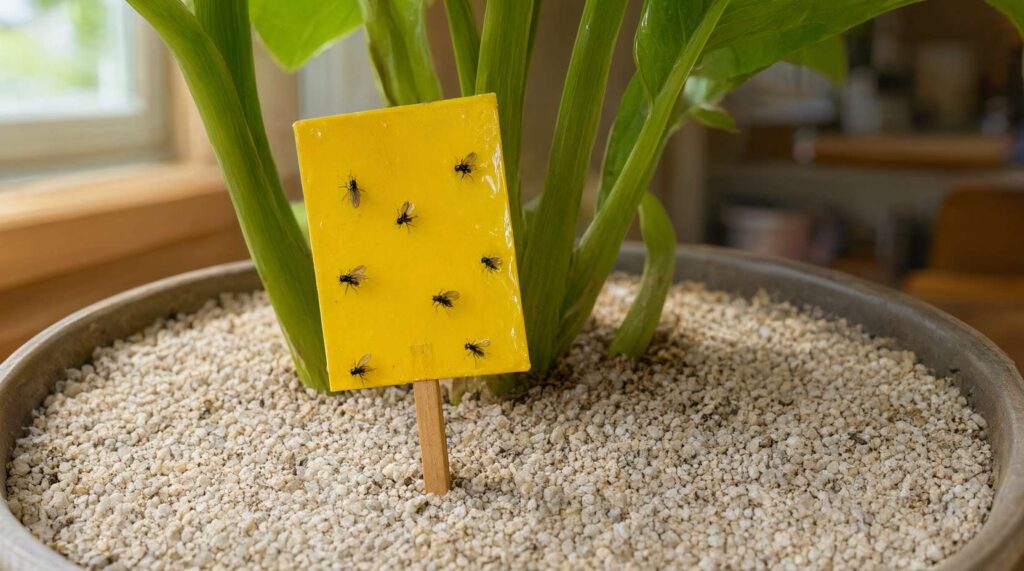
The place where adults gather is a clue, not a diagnosis. A window can collect flies from several sources. Start by inspecting the nearby plant soil, produce and drains rather than assuming that a fixed percentage of household gnats comes from pots.
What attracts gnats: houseplants, produce and drain deposits
Follow the source rather than the adult fly
Plant pots
Fungus gnat larvae develop in moist growing media. CSU fungus-gnat guidance
Produce and containers
Fruit flies use fermenting material, including damaged fruit and beverage residues. CSU household-fly guidance
Drain deposits
Fuzzy moth flies can develop in wet organic deposits. Penn State
Unresolved activity
A leaking or inaccessible source may need a plumber or pest professional; an adult trap alone cannot diagnose it.
Ways to get rid of gnats and their breeding source
Match each method to its role
Identify and correct the source
First priority. Match the intervention to the fly and breeding material.
Watering and plant hygiene
For fungus gnats: let the surface dry as the plant tolerates; remove decaying material. CSU
Sticky-card monitoring
Useful for adult activity near pots; does not directly treat larvae in the soil.
Labeled larval control
Conditional on confirmation and persistence. Bti is an option in suitable labeled formulations; not every mosquito product authorizes a houseplant drench. EPA
Fungus gnat monitoring and houseplant drainage steps
Inspect the plant before changing watering
Check the pot, drainage tray and growing medium. Record where flies occur. Avoid declaring a plant infested solely because a fly rested on a leaf.

Monitor adult activity
Position an appropriate sticky card near the pot, out of reach of children and pets. Compare observations over time; trapped adults are not proof that larvae are gone.

Let plant needs set the watering schedule
Empty standing water from the saucer and reduce persistently wet surface conditions where the plant tolerates it. Do not impose a universal number of dry days or allow a moisture-dependent plant to wilt.

Check drainage and any proposed treatment label
Make sure the pot can drain, then confirm fungus gnats, the houseplant site, mixing directions and repeat-application instructions. Do not substitute a homemade drench or assume a product is harmless to every pet.

When to reassess
Check source correction and remaining activity
At identification
Record the suspected source and check other nearby breeding sites.
At the next watering
Reassess moisture and drainage using the plant’s requirements.
During monitoring
Compare adult activity and the condition of the growing medium.
If activity persists
Recheck the diagnosis and source, then consider suitable labeled larval control or professional help; no fixed overnight elimination promise.
Myths and facts
Avoid traps that leave the source behind
Myth: all tiny indoor flies are fungus gnats
Fact: fruit flies and drain flies need different source work.
Myth: sticky cards treat the whole population
Fact: they capture adults; larvae can remain in the growing medium.
Myth: sand guarantees that eggs cannot be laid
Fact: this guide does not treat a surface dressing as a proven universal barrier.
Myth: Bti means every formulation is suitable
Fact: the exact label governs the pest, plant site, preparation and precautions.
Fungus gnat larvae, sticky traps and vinegar limits
Fungus gnat larvae develop in moist growing media and feed on fungi and decaying organic material. Adult sticky cards help monitor where activity is concentrated, but they do not correct wet potting mix or kill every larva. Let each plant’s needs—not a fixed calendar—guide watering, and empty standing water from compatible saucers. Colorado State Extension explains fungus gnat biology and management.
Apple-cider-vinegar traps are more relevant to some fruit flies than to fungus gnats, and even then they capture adults rather than removing the breeding source. Identify the fly before adding a trap or treatment. If using a larvicide or biological product, confirm that its label permits the plant, indoor site and application method.
Identify which small fly is actually indoors
“Gnat” is a description, not a diagnosis. Fungus gnats are delicate dark flies with long legs and antennae. They make short, erratic flights near moist potting mix and often collect at windows. Fruit flies hover around fermenting produce, recycling residue and drains contaminated with food. Drain flies look fuzzy and moth-like, while phorid flies have a humpbacked profile and often run across surfaces. Follow the adults back to a breeding material before choosing treatment.
For houseplants, gently disturb the soil surface and watch for adults that hop or fly close to the pot. Fungus gnat larvae are translucent and worm-like with a dark head capsule; they live mainly in the upper growing medium where moisture, algae, fungi and decaying material are available. Colorado State University Extension identifies Bradysia species as common indoor fungus gnats and notes that the adults do not bite.
Understand why potting mix keeps producing adults
Moist organic growing medium supports eggs and larvae even when sticky cards remove many adults. Older mix can break down and hold water longer, saucers may remain wet and reduced winter light can slow plant water use. Plants brought indoors after summer may also introduce an existing population. This is why a trap-only plan seems successful for a few days and then another group appears.
Larvae mostly feed on fungi, algae and decaying matter, although they may also feed on fine roots. Established houseplants often experience nuisance rather than severe damage, but seedlings, cuttings and stressed plants deserve closer attention. Treat the watering and growing-medium problem without deliberately dehydrating a plant that requires steady moisture.
Inspect each plant instead of treating the whole collection blindly
Map adult activity with sticky cards
Place yellow sticky cards close to the soil surface without touching leaves, children or pets. Label them by pot and date. Cards show which plants produce the most adults and whether activity is declining; they do not reach larvae in the mix. Replace a card when dust or insects make comparisons difficult.
Check moisture, drainage and decaying material
Inspect drainage holes, saucers, decorative cachepots and fallen leaves. Empty standing water and remove decaying surface material. Adjust watering to the plant species, pot size, light and season. Allowing the upper mix to dry between waterings is useful for many plants, but “dry two inches” is not a universal prescription for seedlings or moisture-sensitive species.
Use a potato slice as a monitoring tool
Colorado State’s peer-reviewed fungus gnat guide describes placing a thin potato slice on the growing medium and checking its underside after a few days for larvae. Use this as confirmation and monitoring, not as the treatment itself. Discard the slice after inspection and keep it away from pets.
Choose larval treatment only when cultural control is not enough
First correct overwatering, poor drainage and decomposing material. If activity persists for several weeks, a product specifically labeled for fungus gnat larvae in houseplant growing media may be appropriate. Some labels use the biological agent Bacillus thuringiensis subspecies israelensis (Bti); formulations and approved sites differ, so a mosquito product is not automatically suitable for pouring into pots. Follow the exact label for dilution, frequency, edible plants and occupant safety.
Beneficial nematodes may be an option in larger plant collections when the species, storage and application conditions are appropriate. Repotting can help when mix has decomposed, drainage is failing or a valuable plant needs a reset, but routine repotting can stress roots and is not necessary for every pot. Use clean containers and suitable fresh mix, and inspect new plants before placing them with the collection.
Why common gnat shortcuts fail
Apple-cider-vinegar traps are designed around fermentation attraction and are more useful for fruit flies than fungus gnats. Hydrogen-peroxide drenches, cinnamon, essential oils and household pesticide mixtures are not substitutes for correcting moisture and confirming a labeled treatment. Surface sprays aimed at adults also leave larvae in the pot. The practical combination is identification, moisture correction, removal of decaying material, adult monitoring and a suitable larval control only when needed.
Measure progress across a full life cycle
Do not expect every adult to disappear as soon as watering changes. Existing larvae and pupae can continue producing flies while the growing medium becomes less favorable. Compare catches by plant over several weeks and look for a sustained downward trend. If numbers remain steady, check overlooked pots, propagation jars, stored potting mix, drains and rubbish before repeating treatment.
Escalate when many plants are affected, seedlings or valuable specimens are declining, the breeding source cannot be located or the proposed treatment is not labeled for the plant and setting. A greenhouse or interiorscape specialist can assess irrigation and biological controls at a scale that differs from a few household pots.
Frequently asked questions
Do fungus gnats bite?
CSU describes the adult houseplant fungus gnats as non-biting. That does not identify every small fly found indoors.
How soon should the flies disappear?
Timing depends on identification, source correction and remaining life stages. Check the trend rather than promising a day or two.
Do I need to throw away every plant?
No. First identify the source and correct growing conditions. Severely decayed material or unsuitable media may need replacement.
Can I pour a mosquito product into every pot?
Only use a product whose current directions authorize the intended pest and site.
Related guides
Small-fly identification · Drain-fly sources
Get rid of gnats in the kitchen without treating every plant
Inspect the fruit bowl, stored potatoes and onions, food-waste container and recycling before assuming all the flying insects came from houseplants. A forgotten fermenting item can keep producing fruit flies after the countertop looks clean. Remove the spoiled material and clean residue from the container; moving it to an uncovered indoor bin simply moves the breeding source.
Apple cider vinegar traps can help catch some adult fruit flies, but vinegar and dish soap don’t clean the source. Keep a monitoring trap away from food preparation and check whether catches decline after sanitation. Avoid leaving multiple open food lures around the kitchen while overlooking the original spill.
Drain flies: remove the organic film, not just flying adults
Fuzzy flies resting near a sink deserve a drain-source check, not a houseplant drench. University of Minnesota explains the role of the gelatinous film inside drains and why pouring bleach or boiling water is not dependable control. Have accessible deposits physically cleaned with equipment appropriate to the fixture. A drain that looks clear at its opening can still hold breeding material farther inside.
Don’t reach into a garbage disposal or dismantle plumbing while it is operating. Follow its servicing instructions and leave inaccessible deposits, persistent leaks or a suspected broken drain to a plumber. Never mix a drain cleaner with bleach, vinegar or another product. For the full source-check process, use our drain fly guide.
Keep gnats from coming back with new houseplants
Check new potted plants and their saucers before placing them among the collection. Keep suspect pots identifiable so their sticky-card results aren’t confused with established plants. Inspect damp stored potting soil, fallen leaves and enclosed decorative pots that conceal standing water.
Correct the growing conditions rather than treating every arrival automatically. Bti for fly larvae is not the same subspecies of Bacillus thuringiensis used for caterpillars. UC IPM distinguishes those products; the exact fungus-gnat and houseplant label still controls preparation and repeat applications. Don’t translate a greenhouse treatment schedule into a universal indoor recipe.
Publishing and affiliate notes
Some product links may be affiliate links. If you buy through them, we may earn a commission at no extra cost to you. Product picks are not lab tests. Read the legal disclaimer.