
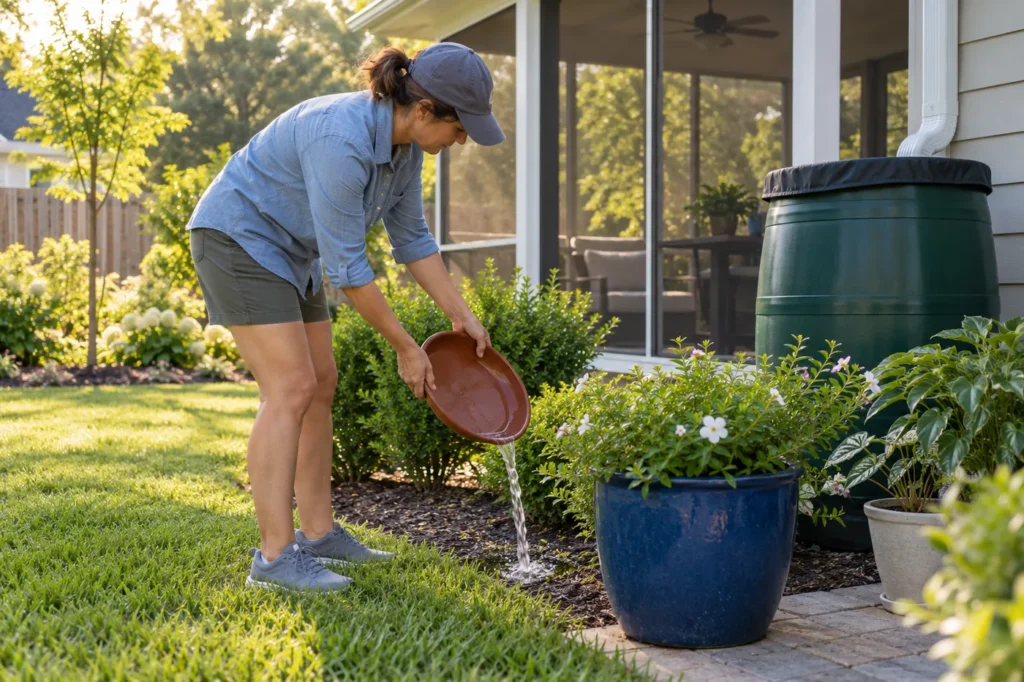
Yard mosquito control works best before adults are flying. Many common species develop in small containers that are easy to miss: a saucer, toy, tarp fold, blocked gutter, tire, or uncovered barrel. No single spray makes a property mosquito-free. Drain and disrupt larval habitat first; indoor screen and room tactics belong on the indoor mosquito guide when biting happens inside.
Illness and pesticide safety
Seek medical advice for severe symptoms after mosquito exposure, especially fever with confusion, weakness, severe headache, breathing difficulty, or other urgent concerns. Disease risks vary by location and season; follow local health alerts. Never pour pesticides into drains, ponds, birdbaths, or rain barrels unless the product label specifically allows that use. Keep children and pets away during application and for the label-directed interval. The label is the law.
Find where yard mosquitoes are coming from
Four conditions keep mosquito pressure high
Small containers
Plant saucers, toys, buckets, tarps, cans, tires, and debris can hold enough water for larvae.
Permanent water
Rain barrels, catch basins, ornamental features, and neglected pools need screening, circulation, maintenance, or labeled larval control.
Shaded resting sites
Dense, humid vegetation and sheltered undersides give adult mosquitoes places to rest between host searches.
Off-property sources
Storm drains, vacant lots, wetlands, and neighboring containers can sustain mosquitoes beyond one household’s reach.
Start with a slow perimeter walk after rain. Look at anything that can retain water, not just obvious ponds. Mosquito larvae often wriggle near the surface and dive when disturbed, but identification is not required before eliminating a disposable container. For a suspected storm-drain or neighborhood source, photograph and report the location rather than applying an unapproved product.

Yard mosquito methods ranked
Start with the source
- Weekly source reduction — Strong. Emptying and preventing standing water removes the habitat needed by container-breeding mosquitoes.
- Labeled larvicides for unavoidable water — Strong when correctly matched. Products containing Bacillus thuringiensis israelensis (Bti) or another registered active ingredient can control larvae at approved sites.
- Personal protection and patio airflow — Useful. Registered repellents, clothing, screens, and fans reduce contact where people gather.
- Targeted professional adult control — Conditional. It may be part of an integrated program during high pressure or disease response, but timing, species, resistance, and re-entry instructions matter.
- Citronella plants, ultrasonic devices, coffee grounds, garlic, and broad essential-oil spraying — Unsupported or short-lived. These do not replace habitat removal and can create exposure or environmental risks.
Step 1: empty and reset containers every week
Empty water onto a dry area where it will soak in, then scrub residue from container walls because some mosquito eggs adhere above the waterline. Store buckets, toys, wheelbarrows, and small boats upside down or under cover. Stretch tarps so they drain. Drill drainage only where it will not damage the item or create another wet site. Refresh birdbaths frequently and scrub them according to wildlife-safe guidance.
Remove discarded tires through an approved program. Correct low spots created by equipment or poor drainage with appropriate landscaping help. Do not divert water onto a neighbor’s property, foundation, septic area, or public walkway.
Step 2: manage water that must remain
Fit rain barrels and cistern openings, overflows, and vents with intact fine screening and keep lids closed. Maintain pools to public-health and manufacturer guidance, including covers that do not collect water. Keep ornamental water moving and serviced, but do not assume circulation alone is sufficient.

Bti targets mosquito and certain fly larvae and is available in several formulations. “Natural” does not mean directions are optional: confirm the site, amount, frequency, water use, and storage instructions on the specific label. Never improvise a dose or apply an agricultural, pond, or professional product to a different setting.
Step 3: reduce sheltered resting areas
Clean gutters and confirm downspouts discharge properly. Remove leaf-filled debris, thin excessive vegetation near occupied areas, and correct leaking irrigation. Preserve useful habitat rather than stripping the whole yard; focus on dense, damp cover immediately around doors, play areas, and seating. Wear gloves and avoid unsafe ladder work.

Step 4: protect the places people use
Repair window and door screens. On a covered patio, an oscillating fan can make flight and landing more difficult while improving comfort. Position it on a stable surface with guarded blades and weather-appropriate electrical protection. It protects only the airflow zone and does not reduce breeding elsewhere.

Use an EPA-registered skin repellent with an active ingredient such as DEET, picaridin, IR3535, oil of lemon eucalyptus/PMD, or 2-undecanone, choosing one appropriate for the user and following its label. Adults should apply products to children’s hands for them and avoid eyes, mouth, irritated skin, and enclosed-space spraying. CDC advises against oil of lemon eucalyptus/PMD for children under three. Permethrin is for labeled clothing and gear uses, not skin.

When a spray treatment is considered
Adulticide treatment can reduce adult mosquitoes temporarily when correctly timed and targeted, but repeated blanket applications are not a substitute for source reduction. A licensed operator should identify resting areas, select a registered product, protect pollinators and aquatic sites, account for wind and weather, and explain re-entry. Ask local mosquito control whether surveillance or area treatment is already underway.
Seven-day yard routine
- Walk: inspect containers, gutters, covers, drains, equipment, and toys after rain.
- Dump and scrub: remove disposable water and eggs stuck to container walls.
- Cover: screen rain storage and store movable items dry or inverted.
- Treat only unavoidable water: use a registered larvicide exactly as labeled.
- Maintain: clear gutter blockages, leaks, and dense damp cover near people.
- Protect: use screens, clothing, airflow, and registered personal repellents.
- Report: send persistent public or off-property sources to local mosquito control.
Myths and facts
Mosquito control without false promises
- Myth: one fogging treatment eliminates yard mosquitoes.
- Fact: adult control is temporary when nearby larvae continue emerging or mosquitoes move in.
- Myth: mosquitoes breed only in dirty swamps.
- Fact: several important species use clean-looking water in small household containers.
- Myth: citronella plants repel mosquitoes across a patio.
- Fact: a plant sitting nearby does not create a dependable protective zone.
- Myth: more pesticide means better control.
- Fact: off-label dosing increases risk and can harm non-target organisms without solving hidden water sources.
Frequently asked questions
How often should I check the yard?
Use a weekly routine and add a check after rain, irrigation problems, or outdoor projects that leave containers exposed.
Should I treat a storm drain myself?
Not unless the responsible authority and product label explicitly authorize it. Report public drains to municipal or mosquito-control staff.
Do mosquito traps solve a yard problem?
Trap performance varies by species, attractant, placement, and competing hosts. They can support surveillance but should not displace source reduction or personal protection.
Why are mosquitoes still present after I removed water?
Adults may arrive from neighboring sources, wetlands, drains, or missed containers. Recheck the property and ask local mosquito control about area conditions.
Related guides
Repel mosquitoes indoors · In the yard hub · Gnats in the house
Map mosquito sources by water type
Start with containers you control: buckets, plant saucers, toys, tarps, wheelbarrows, clogged gutters, pool covers and open rain storage. Empty, scrub when appropriate and reset them on a weekly route. Eggs from some container-breeding mosquitoes can remain attached above the waterline, so simply tipping out water without cleaning the surface may leave the next hatch in place.
Water that cannot be dumped needs a different decision. Cover it with intact screening where practical, maintain circulation and sanitation in managed features, or use an EPA-registered larvicide only when the label permits that exact site. Do not treat drinking water, storm drains, natural wetlands or a neighbour’s property on your own.
Larvicide choices and limits
| Approach | Suitable role | Important limit |
|---|---|---|
| Bacillus thuringiensis israelensis (Bti) | Label-permitted standing water that cannot be emptied | Targets larvae; it does not kill biting adult females |
| Insect growth regulator | Preventing immature mosquitoes from completing development where labeled | Product, water use and reapplication directions vary |
| Container removal or covering | Small artificial breeding sites | Must be repeated as rain and irrigation create new water |
| Professional larval treatment | Large, inaccessible or community-scale sources | Needs licensed application and surveillance |
More product is not better. Follow the label dose and interval, store products away from children and pets, and track whether larvae are still present before repeating a treatment.
Why adult mosquitoes remain after source reduction
Adults may have emerged before the cleanup, moved from nearby properties or rested in cool, humid vegetation. Improve airflow around seating, trim dense growth without stripping wildlife habitat unnecessarily, and use screens and EPA-registered personal repellents for bite protection. Source reduction works over the life cycle; it is not an instant force field.
Report neglected pools, blocked public drainage or unusually heavy activity to the local mosquito-control or public-health program. Community surveillance matters when disease risk is elevated.
Compare spraying, barriers and personal protection
A targeted adulticide treatment can temporarily reduce adult mosquitoes when a labeled product is applied to appropriate resting areas. It does not remove eggs or larvae, and drift, pollinator exposure, weather and timing affect the decision. Ask a professional what was found, which sites will be treated, how pollinators will be protected and when people and pets may re-enter.
Automatic residential misting is a poor substitute for inspection and monitoring. CDC does not recommend homeowner residential misting systems because routine timed spraying can create unnecessary exposure and harm beneficial insects. Foggers and yard sprays also cannot compensate for untreated water nearby.
Personal protection while yard pressure is high
Wear clothing that covers exposed skin when conditions allow and use an EPA-registered repellent according to its label. Choose a product by active ingredient, age restrictions, activity and expected duration rather than assuming “natural” means safer or longer lasting. Keep screens and doors in good repair, and use a fan across a patio seating area as a supplemental comfort measure.
Primary and authoritative sources
- CDC: Preventing Mosquito Bites — source reduction and personal protection.
- CDC: What mosquito control programs do — integrated community control.
- EPA: Find the Repellent That Is Right for You — registered skin repellents.
- EPA: Controlling Mosquitoes at the Larval Stage — registered larvicides.
- EPA: Mosquito Control — pesticide and integrated-management context.
HowToRepel.com is an independent educational publisher, not a medical, public-health, or pesticide-application service. This guide was AI-assisted, human-edited, and source-checked. Follow product labels and current local mosquito-control guidance.
Publishing and affiliate notes
Some product links may be affiliate links. If you buy through them, we may earn a commission at no extra cost to you. Product picks are not lab tests. Read the legal disclaimer.