
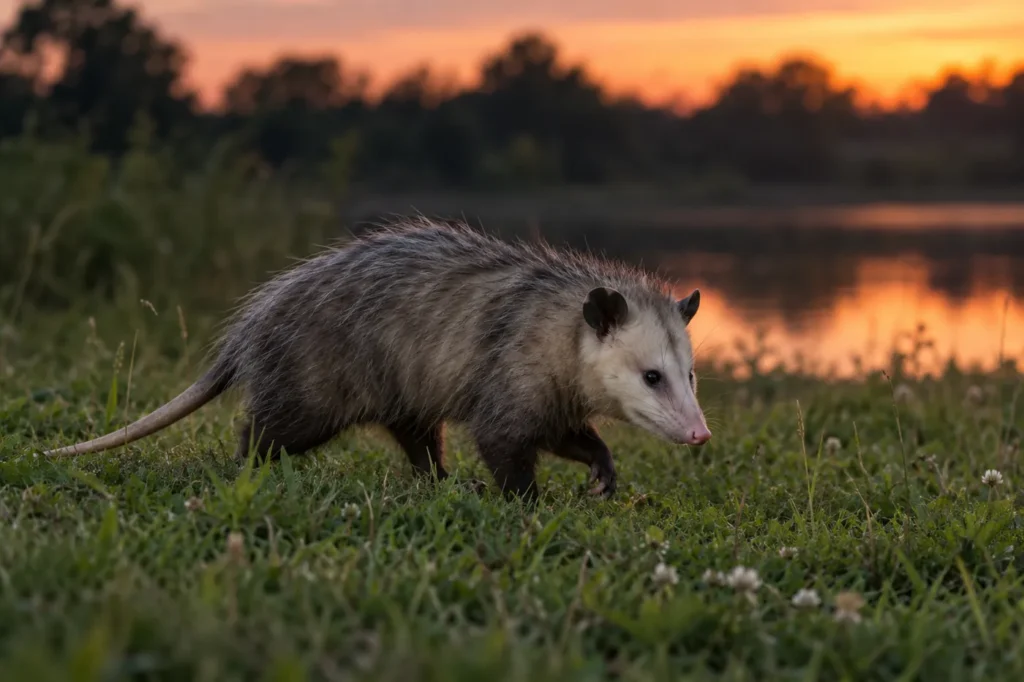
Seeing an opossum on a property does not automatically establish a den or a need for control. Inspect the resources and access conflict from a safe distance. A qualified wildlife provider can help with an occupied or uncertain structural opening and applicable local requirements.
Identification and conditions
Assess resources and occupancy
Food
Pet bowls, waste or fallen produce can provide access.
Shelter
An opening under a deck needs occupancy assessment.
Pets
Avoid contact or pursuit.
Actual conflict
Differentiate passing wildlife from repeated damage.
Methods ranked by their role
Reduce resources before considering intervention
Food and waste management
Remove accessible resources when the area is unoccupied.
Observation
Record recurring access without disturbing animals.
Qualified occupancy assessment
Resolve uncertain shelter before exclusion.
Later compatible repair
Maintain an appropriate barrier after safe vacancy assessment.
Inspection and prevention steps
Secure the waste container
Wait until wildlife has left the immediate area, then close and maintain a fitting lid. The illustration explains the resource being managed; it is not advice to work beside an animal. Do not feed or try to push it away.

Bring pet food indoors after feeding
Remove leftovers and clean suitable bowls while keeping pets away from wildlife. Maintain feeding hygiene rather than promise that one change clears every animal within a night.

Observe the deck perimeter
Inspect from a safe distance without crawling underneath, blocking the opening or reaching inside. Ask qualified help about occupancy, dependent young and appropriate exclusion if the shelter creates a conflict.

Check local wildlife guidance
Find the relevant wildlife authority or experienced provider for the location. Describe the actual damage, access and animal condition. Rules and feasible methods vary; do not assume every capture or relocation is lawful.

Sequence and reassessment
Resolve occupancy before repair
Observe
Identify the actual resource or access conflict.
Maintain
Reduce food and waste access safely.
Assess
Obtain help for an occupied or uncertain opening.
Repair
Close suitable defects after a safe vacancy assessment.
Myths and facts
Avoid quick-departure and vacancy guarantees
Myth: removing food guarantees departure tomorrow
Fact: monitor the actual conflict.
Myth: flour alone proves an empty den
Fact: obtain an appropriate occupancy assessment.
Myth: relocation is automatically humane and lawful
Fact: check local rules and qualified advice.
Myth: every passing opossum needs removal
Fact: assess damage and access rather than the sighting alone.
Let occupancy determine the repair date
Food, open waste, pet bowls, and sheltered spaces can support repeat visits. An opossum seen once does not prove that a den is occupied, while blocking a confirmed occupied space can separate or trap animals.
Remove accessible attractants, observe from a distance, and repair only after lawful vacancy is established. Injured animals, dependent young, or recurring access beneath a structure require local wildlife help.
How to get rid of opossum visits without creating another problem
Start by identifying the conflict. An opossum crossing the yard once is different from repeated feeding at a pet bowl or suspected shelter under a deck. You can often address the reward or access without capturing the animal. Decide whether the goal is protecting food, securing a structure or obtaining help for an injured animal.
Possum versus Virginia opossum
In North America, the Virginia opossum is Didelphis virginiana, a marsupial commonly called a possum in casual speech. Australian and New Zealand possums are different animals, with different management rules. This guide concerns North American opossums; do not transfer its wildlife-control advice to another country’s species. MassWildlife explains the distinction.
Observe from a distance. A nighttime visit, a damaged food container and a shelter opening are clues to investigate, not proof of a den. A camera can help you understand the route without approaching an animal. Do not corner it beneath furniture or encourage a pet to chase it.
Remove food access: pet bowls, garbage and fallen fruit
Make the routine practical. Bring pet food indoors after feeding, secure waste lids and pick up accessible spilled feed. Review bird seed and stored animal feed as well as the kitchen garbage. UC IPM identifies food and shelter management as core steps in reducing opossum conflict. Read UC IPM’s opossum guidance.
- Porch: remove food when the feeding period ends rather than leaving it overnight.
- Waste area: replace broken lids or containers that do not close.
- Fruit trees: collect reachable fallen produce as part of the garden routine.
- Garage: store feed securely and inspect the normal door closure.
Ask household members to use the same routine. If one person secures the waste while another keeps an open bowl beside it, the attractant remains. Where activity involves adjoining properties, politely share what you observed; a control method cannot guarantee that a nearby food source disappears.
If you have identified the visitor as a raccoon, follow our raccoon trash-storage and exclusion guide instead. Disturbed garbage alone does not identify which animal visited.
Why a “possum-unfriendly yard” should not mean habitat destruction
Target the actual resource rather than clearing every planted area. Maintain safe access for inspecting a deck edge or waste bin, but leave unrelated habitat alone. A neat lawn does not prevent an animal from reaching an open trash bag. Specific changes are easier to monitor and less disruptive than indiscriminate clearing.
Opossums under a deck or shed: check occupancy before exclusion
Do not seal an opening simply because you have not seen the animal recently. Hidden spaces can contain wildlife you cannot observe from outside, including young. Stop work where occupancy is uncertain and ask a qualified wildlife provider to assess the space.
What a useful exclusion plan includes
Describe the opening, building condition and repeated observations to the provider. Ask how occupancy will be established, which access points need attention and what will happen if young or injured animals are found. A plan should address the whole relevant boundary rather than block one route while leaving another usable.
Once appropriate vacancy is confirmed, make a durable repair suited to the structure. Keep ventilation, drainage and service access functional. Sharp loose wire, an unstable cover or a gap that returns whenever a door moves is unfinished work. Recheck repairs after normal use and weather rather than relying on a departure deadline.
Should I use flour tracks or a paper plug?
A sign of movement may help observation, but the absence of a mark does not prove safe vacancy. Do not use a single overnight test to authorize closure. An occupancy assessment must consider the space, other openings and the possibility of young, not just whether one visible entrance changed.
Repellents, motion sprinklers and trapping
Devices and scent products should not replace food management or safe exclusion. If a motion sprinkler fits the site, monitor actual visits and make sure it does not create a slippery path or obstruct a wildlife exit. Repeated activity is a reason to inspect what remains attractive, not to keep adding devices automatically.
Why garlic, essential oils and mothballs are poor defaults
Homemade mixtures offer no dependable application directions for the animal, surface and household exposure involved. Do not spray oils onto pet-contact areas or pour mixtures under a deck. Mothballs are pesticides, not general outdoor wildlife deterrents; only label-permitted use is appropriate. A strong smell does not establish that the shelter is unoccupied.
Can I trap and relocate an opossum myself?
Check local rules before considering capture. Trapping creates responsibilities for frequent inspection, humane handling and lawful disposition. A release on another person’s land or in a park is not a default option. Ask the relevant wildlife agency or licensed provider which methods are permitted for your location and actual conflict.
A passing animal does not justify a capture program. If a provider recommends trapping, ask why source correction or exclusion is insufficient and how the method will avoid separating young. Do not accept a generic plan designed for a different species merely because the animal is using the same shed.
Frequently asked questions about humane opossum deterrence
What if the opossum does not move when I approach?
Keep your distance and move people and pets away. Do not prod it to test whether it is alive or attempt to handle an uncertain animal. Obtain suitable wildlife help for suspected injury, entrapment or a condition you cannot assess safely.
What should I do if a pet encounters one?
Separate them safely without putting yourself between fighting animals. Contact a veterinarian about any bite, scratch or uncertain exposure. A general claim that opossums are harmless is not a reason to ignore a wound or a stressed pet.
Will it leave once the food is gone?
Removing the reward can reduce visits, but there is no reliable one-night promise. Continue observing and inspect other resources or shelter access if activity persists. Avoid sealing a suspected den merely to speed the outcome.
Who should handle injured animals or dependent young?
Contact the local wildlife authority or a permitted rehabilitator for instructions. Do not feed, relocate or raise them on assumptions from an internet recipe. Describe the location and what you observed, and keep the area quiet while obtaining advice.
Publishing and affiliate notes
Some product links may be affiliate links. If you buy through them, we may earn a commission at no extra cost to you. Product picks are not lab tests. Read the legal disclaimer.