
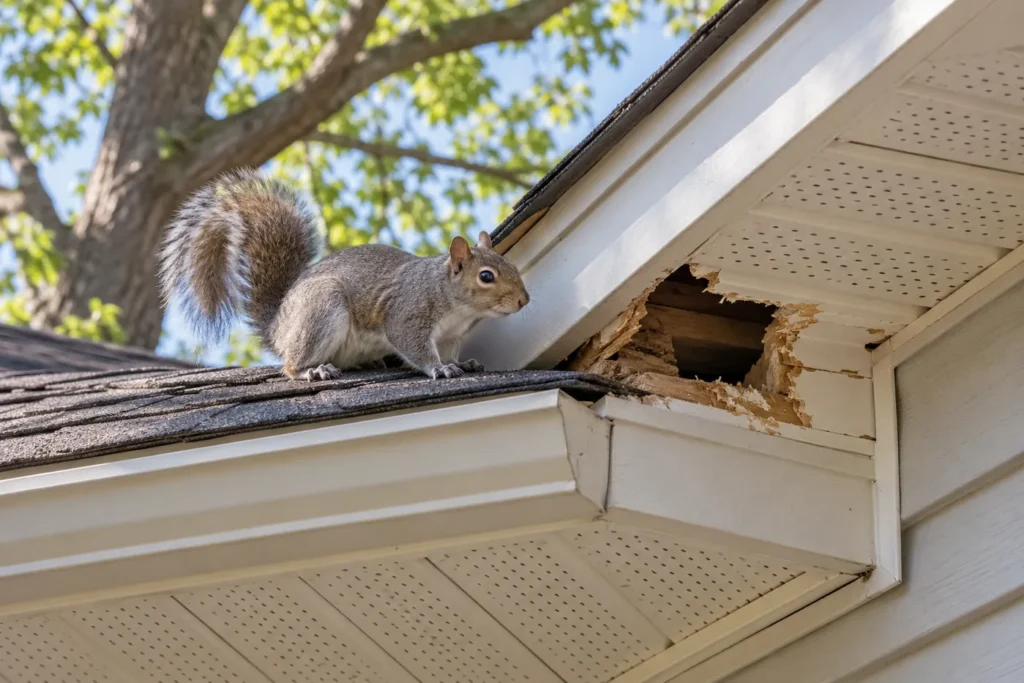
Attic noise can be squirrels, raccoons, or something else; a damaged vent alone does not identify the occupant. Squirrels are often daytime climbers using smaller roof and soffit gaps; raccoon jobs usually need heavier-duty exclusion and different legal/safety handling. Ground-level observations help, but concealed nests, unsafe roof access, and electrical damage need appropriate specialists. If signs point to raccoons, use the raccoon guide instead of a squirrel-only plan.
Attic squirrel nests, entry points and building damage
Assess the occupant, access and building condition
Identification
Noise alone does not confirm squirrels.
Entry evidence
Record damaged vents or roof-edge gaps from stable ground.
Dependent young
A vacancy assessment must account for concealed young.
Unsafe damage
Wiring or structural concerns require appropriate specialists.
Squirrel removal methods ranked by their role
Sequence wildlife exclusion with building repair
Qualified occupancy assessment
Identify active routes and dependent young.
Appropriate exclusion plan
Select lawful methods fitting the species and site.
Compatible entry repair
Repair after the occupancy condition is safely resolved.
Ongoing maintenance
Inspect vents and manageable access opportunities.
Soffit, roof vent and attic inspection steps
Observe the vent from the ground
Use binoculars from a safe place and record observations. Do not approach an occupied opening or use a ladder to collect proof. A photo of damage does not establish an empty attic.

Record roof-edge damage safely
Note visible defects without climbing or probing. Ask a wildlife provider and appropriate building specialist what repairs are needed and when they can be made without trapping occupants.

Arrange a safe internal inspection
Only an appropriate qualified inspector should enter where access is safe, using a stable maintenance walkway. The illustration depicts an unoccupied inspection, not permission to step on insulation or approach a nest. Electrical damage requires the appropriate trade.

Maintain a manageable branch
If safe, prune a small accessible branch with appropriate equipment from stable ground after checking for wildlife and other hazards. Use an arborist for larger, overhead or utility-adjacent work. Pruning is maintenance, not proof that attic occupancy was resolved.

Sequence and reassessment
Resolve occupancy before closing the route
Assess
Identify the occupant and any young.
Plan
Agree a suitable lawful exclusion approach.
Repair
Close appropriate routes after safe vacancy assessment.
Monitor
Reinspect repaired details and continuing signs.
Myths and facts
Avoid vacancy and harassment assumptions
Myth: a fixed breeding calendar rules out young
Fact: species and local conditions vary.
Myth: radio and bright light guarantee departure
Fact: concealed occupants require assessment.
Myth: three quiet days prove vacancy
Fact: silence alone is insufficient.
Myth: every attic entry gets the same one-way door
Fact: fit the plan to species, site and dependent young.
Related guides
Deter raccoons humanely (attic fork) · Wildlife hub · Rats: safer step-by-step plan
Confirm every occupant has left
Noise can stop temporarily while an animal remains in another part of the attic or while dependent young stay hidden. Closing the main hole without checking secondary routes can trap animals inside.
Use ground observations and a qualified interior inspection to establish species, entry points, and occupancy. Complete exclusion and repair as one coordinated job, then monitor the repaired area for renewed damage.
How to identify squirrels in the attic
Eastern gray squirrels (Sciurus carolinensis) and fox squirrels are active mainly during daylight. Scratching or running soon after sunrise and before dusk, a chewed soffit edge, and repeated travel along a roofline point toward squirrels. Heavy night thumps may indicate raccoons; faint night scratching can be mice or rats. Identification matters because the entry hardware, legal rules and young-rearing risks differ.
Inspect from the ground. Look at roof returns, fascia boards, gable vents, attic louvers, soffit joints and gaps where two rooflines meet. A phone camera or wildlife camera can document the active entry point without putting you on a ladder.
One-way doors, traps and squirrel repellents compared
Affiliate disclosure: Product links may earn a commission at no extra cost to you. Choose equipment for the building and species; no product makes an occupied attic safe to seal.
| Option | Best use | What to check | Limit |
|---|---|---|---|
| Wildlife camera | Confirming the active route | Night vision, weather rating and field of view | Observation only |
| One-way exclusion door | Letting an adult exit after a young assessment | Species fit, mounting surface and local rules | Wrong timing can separate a mother and young |
| Live trap | Only where lawful and appropriate | Local capture, transport and release rules | Does not repair the entry; relocation may be restricted |
| Hardware cloth and flashing | Durable repair after confirmed vacancy | Metal gauge, fasteners and ventilation needs | Installation may require a roofer |
| Odor or ultrasonic repellent | Temporary disturbance at most | Label, placement and exposure risks | Not dependable squirrel removal |
A safe squirrel-removal sequence
1. Confirm the species and active entry point
Record when you hear sounds and watch the suspected opening from a safe position. Don’t assume silence means vacancy. Flying squirrels are nocturnal, and a mother may spend long periods away from a concealed nest.
2. Check for baby squirrels
Breeding timing varies by species, climate and year. Chirping from one area, repeated adult trips carrying nesting material, or an adult urgently trying to regain entry are warning signs. A wildlife professional can reunite or remove a family without sealing young inside.
3. Use exclusion only when conditions are suitable
A correctly sized one-way door over the primary opening can let squirrels leave while secondary gaps are secured. It is not a universal DIY step: roof height, uncertain species, dependent young and local wildlife law can change the plan.
4. Repair damage after vacancy is confirmed
Replace rotten wood and use metal flashing or firmly fastened hardware cloth where suitable. Expanding foam alone is easy to chew. Preserve attic ventilation and have damaged electrical wires checked before restoring insulation.
5. Prevent another squirrel problem
Trim manageable branches where safe, repair loose vent screens, maintain roof edges and avoid feeding wildlife close to the house. Reinspect the repair after storms and during spring and fall maintenance.
Frequently asked questions
What is the fastest way to get squirrels out of an attic?
The fastest reliable route is identification, a check for young, species-appropriate exclusion and immediate repair. Peppermint, vinegar, bright lights and radios can delay the real fix.
Will mothballs repel squirrels?
No. Mothballs are pesticides labeled for controlled spaces, not loose attic wildlife treatment. Their vapors can expose occupants and they do not close an entry point.
How much does professional squirrel removal cost?
Cost depends on height, number of openings, young, contamination and repairs. Ask for an itemized inspection, exclusion, repair and warranty scope rather than comparing a single headline price.
Can squirrels damage electrical wires?
Yes. Rodents gnaw, and damaged insulation can create shock or fire risk. Do not touch suspect wiring; use a qualified electrician.
Use sound and timing to narrow the attic occupant
Tree squirrels are usually most noticeable during daylight, especially near morning and late afternoon travel periods. Flying squirrels are active at night. Mice, rats, raccoons and birds can produce similar attic sounds, so record the time, location and type of movement before selecting an exclusion device.
Watch the suspected exterior opening from the ground. Repeated travel to one soffit, fascia edge or vent is more useful than following noise across the ceiling. Do not climb onto a roof or enter a cramped attic simply to confirm the species.
If young squirrels may be present
Stop before fitting a one-way door when you hear concentrated chirping, see an adult repeatedly carrying nesting material, or observe urgent attempts to re-enter. Birth timing varies by species, climate and year; a calendar alone cannot prove that no dependent young are inside.
A wildlife professional can locate the nest, assess development and choose reunion, hand removal or delayed exclusion as local law and conditions allow. Sealing a mother outside can leave young to die in a wall or ceiling and can provoke more chewing around the former entrance.
What to do if a baby squirrel enters a wall cavity
Do not cut into wiring, plumbing or structural members based only on sound. Mark where the noise is strongest and call a qualified wildlife professional. If the animal reaches a living space, close interior doors, contain pets and avoid handling it with bare hands. Local wildlife rehabilitators or animal control can explain lawful next steps.
Inspect damage after the attic is vacant
| Finding | Who should assess it | Reason |
|---|---|---|
| Gnawed or exposed wiring | Licensed electrician | Damaged insulation can create shock or fire risk |
| Wet, compressed or contaminated insulation | Wildlife-remediation or insulation contractor | Removal and replacement require exposure control |
| Rotten fascia, soffit or roof decking | Qualified roofer or carpenter | A cosmetic patch will not hold in unsound wood |
| Droppings or nesting material | Trained remediation provider when extensive | Dry sweeping can spread dust and contamination |
Photograph the repair area and keep the contractor’s scope. Reinspect after storms and during seasonal roof maintenance rather than assuming one patch will last forever.
DIY exclusion or professional removal?
Ground-level observation and maintenance of an accessible branch may be reasonable DIY tasks. Hire help when the entry is high, the species is uncertain, young may be present, wiring is damaged, contamination is extensive or local trapping and relocation rules are unclear. Ask whether the quote includes inspection, exclusion, repairs, cleanup, follow-up and a written warranty.
Repellent odors, lights and ultrasonic devices don’t repair a hole. Mothballs are pesticides and should never be scattered through an attic for wildlife control. The durable solution is verified vacancy followed by chew-resistant repair.
Why squirrel repellent is not an attic-removal plan
Readers searching for a natural squirrel repellent often find peppermint, apple cider vinegar, predator odors, bright lights or a radio recommended together. Combining weak options doesn’t turn them into verified exclusion. A smell or temporary quiet period cannot tell you whether baby squirrels remain concealed.
UC IPM describes limited repellent performance and habituation to frightening devices. Don’t spray insulation, soak wiring-adjacent materials or place heat-producing lights in cramped attic space. Mothballs are not an attic wildlife treatment. Follow product labels rather than improvising a scent mixture.
Professional squirrel removal should distinguish resolving occupancy from preventing re-entry. Ask whether the proposed method accounts for young, how vacancy will be checked and who will repair the opening. Selling a stronger squirrel repellent alone leaves those questions unanswered.
Why live traps do not finish a squirrel infestation
A live trap captures an animal; it does not identify every occupant, reunite a family or close the entry point. Transport and release rules vary. Get local wildlife-agency advice before buying equipment, and agree on the lawful outcome before a trap is set.
A one-way device also needs a complete plan. If dependent young cannot leave, excluding the adult can make the situation worse. Humane World’s squirrel guidance explains why family assessment matters. Don’t substitute a fixed number of days or a single calendar window for that inspection.
Repair attic louvers without blocking ventilation
A damaged louver, roof vent or soffit is part of a building system, not simply a hole to stuff. The repair must resist chewing while preserving ventilation, drainage and the opening’s intended function. A roofer should assess deteriorated mounting wood before mesh or flashing is fastened over it.
Ask for photographs of the repaired entry and other inspected roofline details. Keep the inspection, exclusion and repair scope together. A warranty should explain which openings are covered and what you must maintain, rather than promising that squirrels can never visit the roof again.
Manage nearby food and accessible climbing routes after the repair, but don’t feed or chase wildlife to test it. Repeated chewing, renewed attic sounds or an adult urgently trying to regain entry calls for reassessment, not another layer of foam. Record where and when it occurs so the provider can investigate the actual route.
Publishing and affiliate notes
Production note: AI assisted with drafting and original instructional images. A human editor checked claims against the cited primary sources.
Some product links may be affiliate links. If you buy through them, we may earn a commission at no extra cost to you. Product picks are not lab tests. Read the legal disclaimer.