
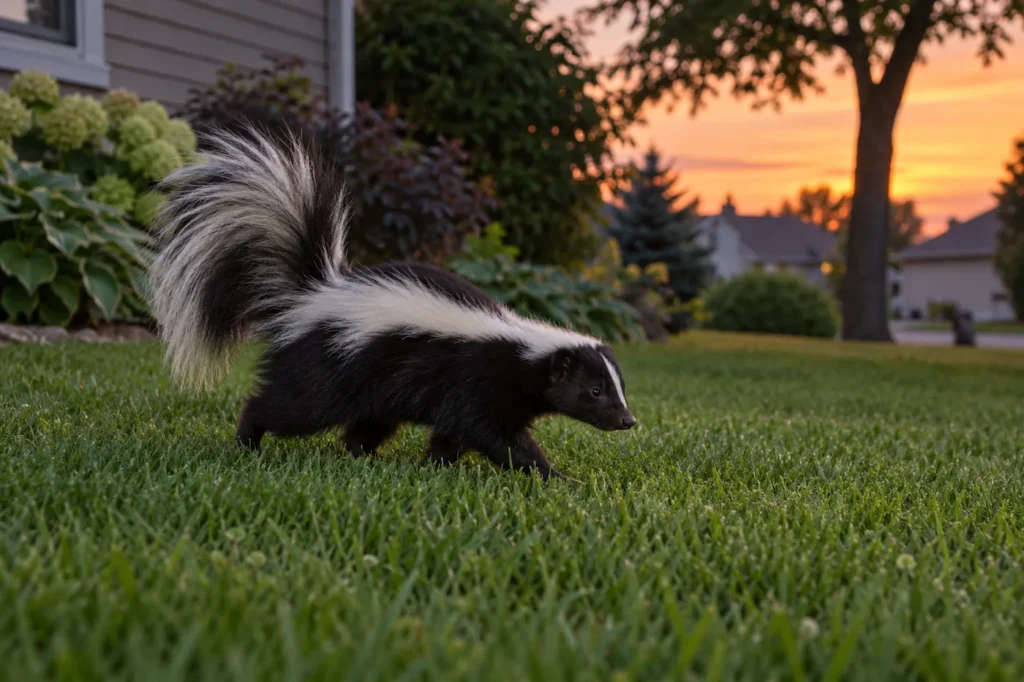
Skunks generally visit a yard for food, water, grubs, or a sheltered den. The safest long-term fix is to remove those rewards and prevent access, while giving an occupied den enough care that adults or dependent young are not trapped.
Rabies and pet safety
Keep people and pets away from any skunk that is unusually aggressive, disoriented, unable to move normally, active in a concerning way, or involved in a bite or scratch. In the United States, skunks are among the wildlife species that can carry rabies. If a person may have been exposed, contact the local health department promptly. If a cat had direct contact, call a veterinarian and animal-control or public-health authorities immediately—even when the cat is vaccinated.
Why skunks visit yards with cats
Four common attractants
Pet food
Outdoor cat food and water provide a predictable meal after dark.
Rubbish and compost
Loose lids and food residue reward repeated visits.
Natural food
Fallen fruit, grubs, insects, and spilled bird seed support foraging.
Den shelter
Openings beneath decks, sheds, slabs, porches, and crawlspaces offer cover.
Small cone-shaped holes in turf can be feeding digs rather than a den. An opening beneath a structure, tracks, odor, or repeated dusk activity needs observation before it is sealed. Never send a cat under a deck or into a suspected den to investigate.
Methods ranked for cat-safe deterrence
Start with the lowest-risk durable controls
- Remove food and secure waste — Strong. It removes the reason for repeat visits without exposing cats to a chemical.
- Prevent den access — Strong. An L-shaped wire footer or other durable barrier provides long-term protection when the space is confirmed empty.
- Keep cats indoors at night — Strong safety measure. It reduces encounters while the yard is being corrected.
- Motion-triggered light or water — Limited and site-dependent. It may discourage a visitor temporarily but does not replace food control or exclusion; place it so it does not distress the resident cat.
- Odor repellents, mothballs, and ammonia — Poor choice. They may be ineffective, temporary, or hazardous and can expose pets and wildlife.
Cat-safe skunk deterrence and den inspection steps
Step 1: Protect the cat and remove food
Bring cat food and water indoors before dusk and clean the feeding area. Keep the cat indoors overnight, and supervise any outdoor time until skunk activity stops. Check that rabies vaccination and identification are current with your veterinarian.

Step 2: Check a suspected den before sealing
Look for tracks, a worn entrance, fresh digging, odor, or repeated use. From a safe distance, loosely place leaves or crumpled paper at the opening and watch for disturbance, or hire a humane wildlife professional. Seasonal and weather conditions affect how long an animal may remain inactive, so an undisturbed marker is evidence—not an automatic guarantee.
Dependent young are the critical risk. Do not close an occupied den or install a one-way device unless you know no young will be separated. Wildlife rules and permitted methods vary by jurisdiction. A licensed, insured wildlife-control professional or local wildlife agency can choose timing and a lawful method.

Step 3: Exclude skunks after the space is empty
Close access beneath sheds, decks, porches, and similar structures with durable mesh attached to the structure and extended outward as an L-shaped footer so an animal cannot simply dig beside it. Secure gates, repair crawlspace openings, and cover window wells with a purpose-built cover.
Monitor the work after installation. Fresh digging, bent mesh, or renewed odor can indicate an animal is trying to return—or, more seriously, that one was trapped. Reopen a safe exit and contact a professional if occupancy is uncertain.

Step 4: Use temporary disturbance carefully
A motion-triggered light or sprinkler can make an exposed route less comfortable, but it is not a guaranteed eviction tool and can also startle a cat. Aim devices away from windows, feeding areas, and the cat’s normal route. Stop if they create stress or conflict.

Secure rubbish, compost and lawn resources
Secure rubbish with a fitted locking lid, close compost, clean grills, gather fallen fruit, and store bird seed and livestock feed in hard-sided containers. If lawn digging is frequent, correct overwatering and identify the turf problem before applying any pesticide. A lawn insecticide can also expose pets and beneficial organisms and should never be used without a confirmed target and label-compliant need.

Cat-safe action checklist
- Keep the cat indoors and observe the skunk from a distance.
- Remove pet bowls, rubbish access, fallen fruit, and spilled seed.
- Map travel routes and suspected den openings without approaching.
- Check occupancy and the possibility of dependent young.
- Use professional eviction when required by the site or local law.
- Install durable exclusion only after the space is empty.
- Monitor for renewed digging and keep attractant controls in place.
If the cat is sprayed or makes contact
Move the cat to a ventilated, easy-to-clean area without letting it rub against furniture. Avoid the eyes and mouth when cleaning. Use a veterinarian-recommended skunk-odor product or ask the clinic for instructions appropriate to the cat’s coat, skin, age, and medical condition. Do not apply concentrated peroxide, essential oils, bleach, ammonia, or unlabelled products to a cat.
Flush eyes with clean lukewarm water if spray entered them and contact a veterinarian for persistent redness, squinting, breathing difficulty, vomiting, weakness, or other concerning signs. A bite, scratch, or possible saliva exposure is not merely an odor problem: call the veterinarian and public-health or animal-control authorities immediately.
Myths and facts
Skunk deterrence without risky shortcuts
- Myth: mothballs under the deck are a safe wildlife repellent.
- Fact: mothballs are pesticides with specific labelled uses and can expose pets, children, and wildlife.
- Myth: sealing the hole tonight solves the problem.
- Fact: closing an occupied den can trap an adult or dependent young.
- Myth: a free-roaming cat will scare the skunk away.
- Fact: the encounter can lead to spraying, injury, or a rabies assessment.
- Myth: relocation is always humane and legal.
- Fact: laws vary, disease risk matters, and moving an animal often fails to repair the attractant or den site.
Avoid ammonia, mothballs and risky repellent shortcuts
Ammonia-soaked rags, mothballs and improvised chemical repellents are poor choices around cats. Vapors, residues and accidental ingestion can create exposure risks, and mothballs are pesticides whose labels do not authorize scattering them under a porch or around a yard. Remove food sources and use humane, site-appropriate exclusion instead.
A motion light or temporary disturbance may help only after you confirm that a den can be disturbed legally and without separating dependent young. Never seal a crawl space or shed opening until the area is verified empty. Humane World describes humane responses to animals using structures.
Understand normal skunk behavior around a home
Skunks are mostly nocturnal and generally avoid confrontation. They visit yards for accessible pet food, rubbish, fallen fruit, spilled bird seed, grubs and sheltered spaces beneath decks or sheds. A skunk crossing the yard is different from one repeatedly entering a structure or using a den. Watch from indoors and do not corner, chase or allow a cat to investigate.
Daytime activity does not prove rabies. A healthy animal may forage during daylight, particularly when feeding young. Treat stumbling, unusual aggression, paralysis, repeated circling or unprovoked contact as a reason to keep people and pets away and call animal control or the local health department. Never approach closely to judge behavior yourself.
Remove attractants without disrupting community-cat care
Feed cats during a defined daytime window, remove leftover food promptly and clean the feeding area. Bring water and bowls inside overnight when practical. Use tightly closed rubbish and compost containers, collect fallen fruit and clean spilled seed. Store animal feed in hard-sided containers. If several people feed community cats, agree on one schedule so a second bowl is not left out after dark.
Manage lawn grubs only when a real turf problem has been identified; do not apply a pesticide simply because a skunk dug in the lawn. Overwatered turf can bring soil organisms closer to the surface. Adjust irrigation to the grass and soil, repair accessible wet areas and tolerate limited wildlife foraging when it is not creating a conflict.
Tell shallow foraging holes from a den
Foraging commonly leaves scattered shallow cone-shaped holes in turf. A den is a persistent entrance into cover beneath a porch, deck, shed, slab or crawlspace, often with disturbed soil and repeated nighttime use. Odor alone is not proof of occupancy because spray can linger or drift. Use a camera from a safe location or a loose plug of leaves, straw or crumpled paper to check whether an entrance is reopened.
Humane World for Animals recommends leaving a loose plug in place and treating an undisturbed opening after two or three nights as likely vacant, with extra time during winter inactivity. Do not use that timing as a rigid guarantee. Tracks, weather and multiple entrances can confuse the result, and dependent young may be present.
Exclude only after vacancy and young are considered
Never permanently close an active den. If the animal is still using it, wait for natural departure or use a qualified wildlife professional who can check local law and whether young can follow the mother. One-way doors can separate a family when installed at the wrong time. Trapping and relocation rules also vary by location and species.
Once vacancy is reasonably confirmed, close all routes with a durable barrier suited to the structure. An L-shaped welded-wire footer can discourage digging beneath a deck or shed when installed correctly. Preserve ventilation and drainage, and have crawlspace, foundation or structural work performed by an appropriate contractor. Recheck the repair for digging or displacement.
Use temporary disturbance without creating a cat hazard
A carefully aimed motion light or sprinkler can make a travel route less comfortable after food has been removed. Position the device so it does not repeatedly frighten, soak or trap a resident cat. Give the skunk a clear path away from the property. Noise, lights and water are temporary supports; they do not replace attractant removal or den exclusion.
Do not place ammonia-soaked rags, mothballs, poison, essential-oil mixtures or pepper products where cats can inhale, lick or walk through them. Do not pour any chemical into a burrow. These methods create exposure risks, may violate pesticide or wildlife rules and give no reliable evidence that a den is empty.
Respond correctly after contact or a suspected bite
Keep the cat away from the skunk and avoid handling the wild animal or a carcass. Contact a veterinarian promptly after a bite, scratch or direct encounter and follow local public-health instructions. Keep rabies vaccination current. CDC identifies skunks among important U.S. wildlife rabies reservoirs and advises reporting skunk bites or scratches to the local health department.
If a person may have been bitten, scratched or exposed to saliva, wash the affected area with soap and water and seek urgent public-health or medical advice. Physical proximity or odor alone is not the same as a rabies exposure, but the circumstances should be assessed by professionals. Do not delay while trying to capture the animal yourself.
Frequently asked questions
Will skunks attack cats?
Skunks usually prefer to avoid conflict, but a close or cornered encounter can lead to spraying, scratching, or biting. Prevention means separation, indoor nighttime housing, and removing attractants.
Can I block a hole under the shed?
Only after confirming it is empty and accounting for dependent young and local rules. When uncertain, use a humane wildlife professional.
When is a daytime skunk an emergency?
Daytime activity alone does not prove rabies. Keep distance and call local animal control if the animal is disoriented, unusually aggressive, unable to move normally, or has contacted a person or pet.
How do I keep skunks away from outdoor cat food?
Feed cats indoors when possible. If outdoor feeding is necessary, supervise it, remove bowls and spilled food promptly, secure the storage container and keep cats inside during peak skunk activity.
Skunk fencing and raised cat food: know the limitations
Don’t assume every skunk is a poor climber or that raising a cat-food bowl makes it inaccessible. The striped skunk, Mephitis mephitis, is the familiar yard visitor, but spotted skunks differ in their abilities and local protection. Identify the animal from a safe-distance photograph and ask your wildlife agency if uncertain.
A garden fence and a den-exclusion barrier are different projects. A skunk can dig beneath a weak lower edge or use an opening beside a gate. Wire mesh must suit the site, attachment points and digging route; its nominal height alone is not a guarantee. Preserve drainage and ventilation beneath a porch or crawl space. UC IPM discusses species, food sources and structural exclusion.
For outdoor cat feeding, a scheduled meal followed by bowl removal is more useful than an untested elevated platform. Review the schedule with whoever manages the cats’ care. Don’t deny necessary water or access to shelter as an improvised deterrent.
If a skunk enters a garage or shed
Keep the cat and other pets away, leave a clear route outside and avoid cornering the animal. Don’t stand in its exit path or chase it with a broom. If it stamps its feet, raises its tail or hisses, back away slowly and quietly. Humane World describes these warning signals and accidental garage visitors.
A visiting animal is not automatically a resident den. Once it has left, check the space before shutting the door and remove accessible food. If the animal cannot leave, young might be concealed or its behavior is concerning, contact local animal control or a qualified wildlife professional.
Questions before paying for skunk removal
Ask how occupancy and young will be assessed, whether trapping is necessary and lawful, and what happens to a captured animal. Have exclusion repairs priced separately from removal and cleanup. Agree on photographs of repaired openings and follow-up checks. No provider can establish cat safety merely by calling a repellent natural.
Primary and authoritative sources
- CDC: Rabies Prevention and Control — exposure response and pet vaccination.
- CDC: Information for Veterinarians — animal exposure assessment.
- Utah State University Extension: Skunks — attractant reduction, exclusion, and professional removal.
- Humane World for Animals: L-footer exclusion — occupancy monitoring and exclusion safeguards.
- UC IPM: Skunk identification, food sources and exclusion limits
- Humane World for Animals: Warning signals and skunks in garages
HowToRepel.com is an independent educational publisher, not a wildlife agency or veterinary clinic. This guide was AI-assisted, human-edited, and source-checked. Follow local wildlife rules and obtain veterinary or public-health advice for exposure concerns.
Publishing and affiliate notes
Some product links may be affiliate links. If you buy through them, we may earn a commission at no extra cost to you. Product picks are not lab tests. Read the legal disclaimer.