
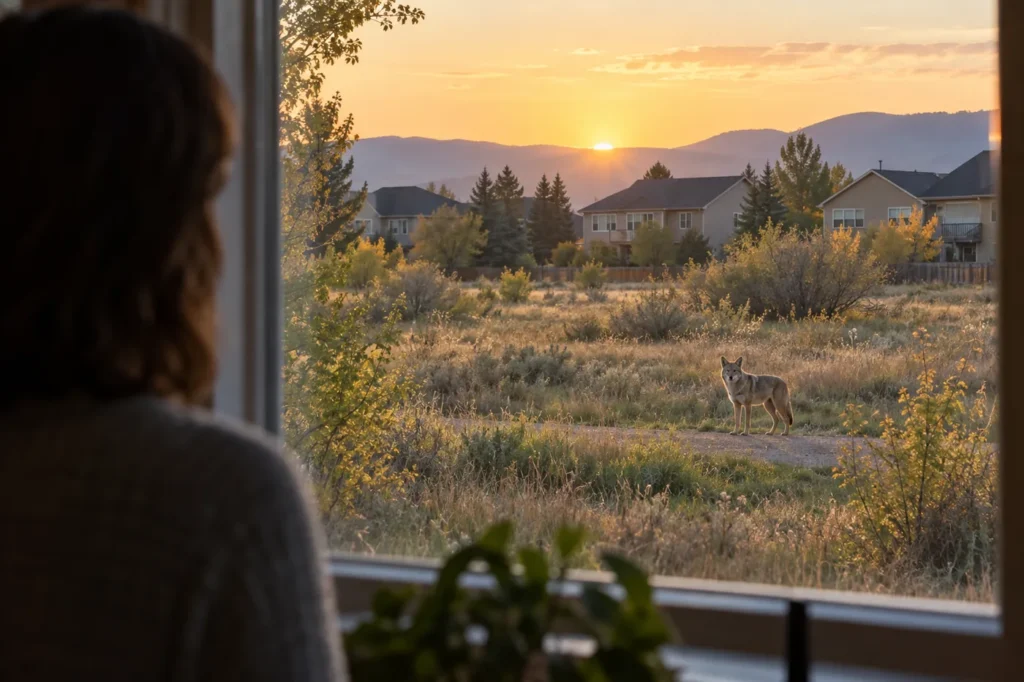
Coyotes live successfully in many urban and suburban landscapes. Seeing one in daylight does not by itself prove aggression or disease. Risk rises when coyotes receive food, lose wariness, defend a den, or encounter an unattended pet. A neighborhood plan should change those conditions rather than promise to remove every coyote.
Immediate safety
Bring children and pets indoors when a coyote is close. Never feed, corner, chase, or approach it. If a person is bitten or scratched, wash the wound and obtain prompt medical care and public-health advice about rabies and other infection risks. For a pet attack, move to safety without putting yourself between fighting animals and contact an emergency veterinarian and the wildlife agency.
What attracts coyotes to your yard and neighborhood?
Four drivers of repeat visits
Food rewards
Pet food, unsecured garbage, compost, fallen fruit, birdseed, outdoor cats, and rodents can support repeat visits.
Pet encounters
Small animals may be viewed as prey, while larger dogs can trigger territorial or defensive behavior.
Shelter and travel routes
Greenbelts, drainage corridors, dense cover, decks, culverts, and fence gaps provide movement or denning opportunities.
Learned tolerance
Feeding, quiet observation at close range, and inconsistent hazing can teach coyotes that people pose no consequence.
Map sightings rather than reacting to rumor. Record time, exact behavior, attractants, pets present, and travel direction. A coyote crossing a road needs a different response from one following a child, entering an occupied patio, attacking a pet, or remaining after repeated attempts to scare it away.
Ways to keep coyotes away: practical priorities
Reduce conflict without false guarantees
- Food and attractant control — Strong. Removing intentional and accidental feeding addresses the reward that can increase tolerance of people.
- Pet supervision and leash control — Strong. Staying close, avoiding retractable distance, and adjusting walk time and route reduces surprise encounters.
- Consistent, agency-approved hazing — Conditional. It may reinforce wariness when the coyote has a clear escape route and is not cornered, injured, den-defending, or already attacking.
- Targeted exclusion — Conditional. Fence-gap repair and removal of den access can help, but coyotes can dig and jump; local design guidance matters.
- Odor repellents, ultrasonic gadgets, poison, or indiscriminate trapping — Avoid. They are unreliable, may be illegal, threaten non-target animals, and do not correct neighborhood food rewards.
Remove food from the whole property
Feed pets indoors and remove bowls after use. Secure garbage, compost, fallen fruit, barbecue residue, and animal feed. Clean spilled birdseed and pause feeding if it attracts rodents or coyotes. Do not leave carcasses, fish waste, or food for feral animals accessible. An intentional feeder can undermine an entire block’s work, so involve property managers and neighbors.

Protect dogs, cats, and children
Keep cats indoors or in a secure enclosure. Supervise small dogs outside, especially around dawn, dusk, dense cover, and known coyote travel routes. Walk dogs on a standard short leash with attention on the surroundings. Avoid headphones and retractable leads that allow the dog to reach brush or an animal before you can respond.

What to do if a coyote approaches
Do not run. Pick up a small child; keep a dog close without bending over near the coyote if that would reduce awareness. Face the animal, stand tall, wave your arms, use a firm voice, and back toward a building or other safe area. If local authorities recommend hazing, use noise or thrown objects directed near—not at close range into—the animal’s escape path, and never pursue it into cover.

Stop and call for professional direction if the coyote does not leave, appears trapped or injured, is near a den, has direct contact with a person or pet, or behaves abnormally. Hazing policy differs by community, and wildlife officers need accurate behavior reports rather than labels such as “aggressive” without context.
Yard exclusion and cover management
Repair openings under decks, sheds, and porches only after confirming no animal is denning inside; maternity-season rules may apply. Close fence gaps and consider a coyote-resistant design recommended locally, recognizing that ordinary fencing is not a guarantee. Remove dense cover immediately beside play areas and keep rodent habitat and food away from structures.

Never use poison. It can violate wildlife and pesticide laws, harm pets and scavengers, and create prolonged suffering. Trapping and lethal control are regulated and should be reserved for authorized agencies or licensed professionals responding to specific conflict behavior; indiscriminate removal does not permanently change a food-rich site.
Protect children when coyotes are nearby
Do not allow a dog to pursue a coyote. During breeding and pup-rearing seasons, coyotes may be more territorial near den or rendezvous areas. Change the route and report the location to the land manager. Teach children not to run from wildlife, to stand together, make noise, and move toward an adult or building.

Neighborhood coyote plan
- Record: document location, time, behavior, and attractants.
- Secure: remove food, waste, bowls, seed spills, and fallen fruit.
- Protect: supervise pets and children and change risky routes or times.
- Deter: follow local hazing guidance only from a safe distance.
- Exclude: repair verified access and den opportunities legally.
- Coordinate: share consistent practices with neighbors and property managers.
- Report: escalate attacks, threats, illness, injury, or repeated approaches.
Myths and facts
Coyote coexistence without folklore
- Myth: seeing a coyote in daylight means it has rabies.
- Fact: coyotes can be active by day; behavior and condition, not time alone, determine concern.
- Myth: leaving food prevents coyotes from hunting pets.
- Fact: feeding reduces wariness and encourages repeat visits near people and animals.
- Myth: a large dog will always chase a coyote away.
- Fact: pursuit can trigger conflict, especially near territorial or denning coyotes.
- Myth: removing one coyote solves an attractant problem.
- Fact: unsecured food and habitat can draw other animals; correct the site conditions.
Frequently asked questions
Should I call police for a coyote?
Use emergency services for an immediate threat or attack. Routine sightings generally go to animal control, the local wildlife agency, park staff, or a municipal reporting system according to local policy.
Will motion lights or sprinklers work?
They may add short-term disturbance in a specific yard, but animals can habituate. Use them as a supplement to attractant removal and supervision, not as a stand-alone guarantee.
How high should a coyote fence be?
There is no universal specification. Coyotes can jump, climb, and dig, and local codes vary. Obtain a design from the responsible wildlife agency or a qualified installer based on the observed route and site.
What about a coyote following me and my dog?
Keep the dog close, do not run, face the coyote, make yourself large and loud, and move toward safety. Report persistent following, especially near a den area or after deterrence.
Identify a coyote and describe its behavior
The coyote, Canis latrans, is an adaptable wild canid with a dog-like outline, pointed ears and a bushy tail. Color and size vary. A distant animal can be confused with a dog or another canid, so take a photograph only when safe and ask the local wildlife agency if identification is uncertain.
A howl is not a reliable count of animals in your yard, and a daylight sighting alone does not diagnose rabies. Describe what you actually saw: crossing a road, feeding at garbage cans, following a leashed dog or approaching people. That gives officials more useful evidence than calling every sighting an attack.
CDFW’s current coyote guidance separates prevention from an encounter in which the animal approaches. Keep distance; don’t go looking for a coyote to test its reaction.
Check the coyote fence at the bottom, gate and surroundings
Fence height is only one part of exclusion. Look for digging beneath the bottom, a gate that does not close securely and nearby objects that compromise the barrier. A coyote roller on the top cannot repair an open corner or a washed-out footing.
Discuss the whole design with a qualified installer and the responsible wildlife agency. An L-shaped footer or buried barrier requires utility clearance and a site-appropriate construction plan. Check drainage and access rules before digging. Do not treat one recommended height or mesh gauge as a guarantee for every yard.
Invisible pet fencing is not a wildlife barrier: it can contain a trained dog while leaving other animals able to enter. Even a fenced yard needs pet supervision. The Urban Coyote Research Project explains that distinction.
Guard dogs and small livestock: don’t create a chase
A household dog is not automatically a trained livestock guardian. Sending it after a coyote can create a confrontation, particularly around territorial animals or pups. Do not buy a large dog as a substitute for secure housing and supervision.
For backyard poultry or other small livestock, inspect the enclosure, gates and stored feed with a qualified local adviser. Protect the animals when unattended, rather than depending on a porch light or a repellent scent. Farm-scale predator management and a suburban dog walk call for different plans.
Coyote repellent sprays, ammonia and ultrasonic devices
Ammonia, human urine and predator-scent products are commonly suggested to repel coyotes. They do not correct food conditioning, an accessible pet or a gap beneath a fence. Do not spread a household cleaner around the property or present a scent as a permanent boundary.
Lights, sprinklers and noise devices can offer disturbance at a particular site, but outcomes vary and familiarity can reduce the effect. There is no reason to surround the house with devices while leaving pet food outdoors. Avoid indiscriminate ultrasonic claims and consider neighbors and non-target animals.
Any proposed registered repellent needs an authorized target and site. Do not confuse a yard product with a personal defense tool or use poison against coyotes. For persistent risky behavior, get agency direction instead of escalating homemade mixtures.
Turn neighborhood reports into a practical follow-up plan
Use one shared log with a date, location, observed behavior, food rewards and pets present. Keep identifiable photographs private when they show neighbors or children. Agree who will contact animal control or the wildlife agency; social-media repetition is not verification of separate incidents.
After securing food and repairing access, compare the same locations and circumstances. A quieter week is useful, but not proof that coyotes no longer live nearby. Persistent approaches or a pet attack require prompt reporting, not waiting for a maintenance experiment to finish.
If professional coyote removal is proposed, ask about the specific conflict, lawful authority, method and prevention afterward. Removing one animal cannot guarantee a permanently coyote-free neighborhood. Manage the rewards and routes as well as the immediate safety concern.
Primary and authoritative sources
- National Park Service: Preventing coyote conflicts — natural history, food conditioning, pets, and encounters.
- USDA APHIS: Coyote ecology and damage management (PDF) — conflict context and professional assistance.
- Urban Coyote Research Project: Avoiding Conflicts — attractants, pets, and hazing.
- California Department of Fish and Wildlife: Keep Me Wild — Coyote — community prevention and reporting.
- CDC: About Rabies — exposure and medical/public-health response.
- California CDFW: Current coyote-conflict guidance
- National Park Service: Coyote identification
HowToRepel.com is an independent educational publisher, not an emergency or wildlife-management agency. This guide was AI-assisted, human-edited, and source-checked. Follow current local wildlife, animal-control, and public-health instructions.
Publishing and affiliate notes
Some product links may be affiliate links. If you buy through them, we may earn a commission at no extra cost to you. Product picks are not lab tests. Read the legal disclaimer.