
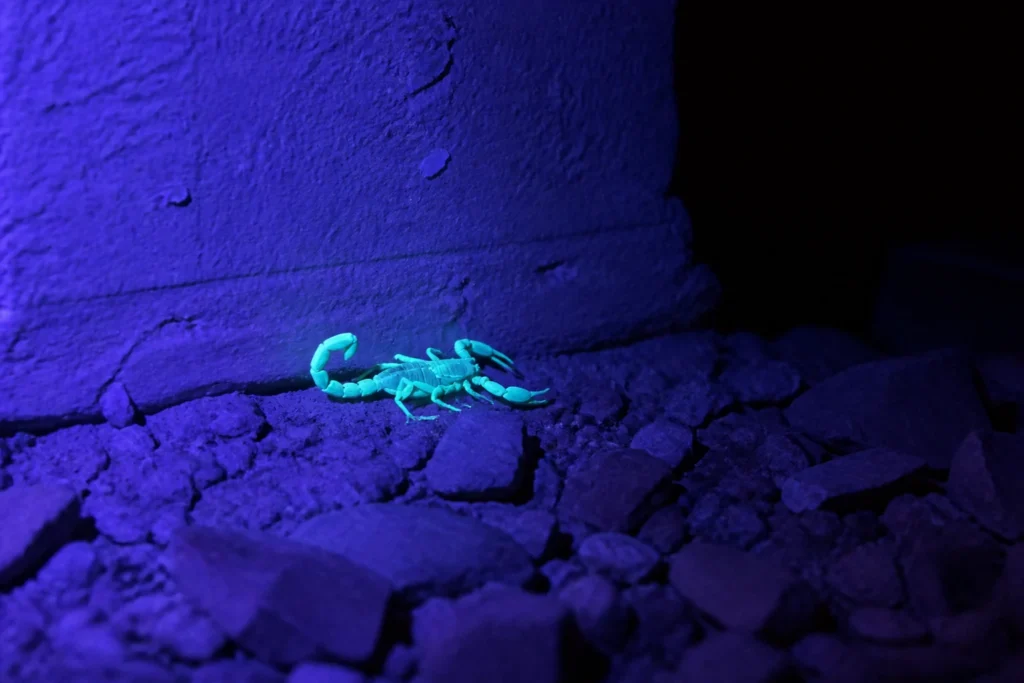
Use UV inspection to gather information about locations and possible entry routes. It does not seal an opening, remove shelter or establish that every scorpion has been found. A clear record can help a professional assess repeated indoor sightings without requiring you to collect an animal.

What a blacklight can reveal
Observe the animal and its surroundings
Fluorescence
Utah State Extension describes a green-blue glow under blacklight.
Nighttime activity
A systematic night inspection can reveal exposed animals that hide during the day.
Possible shelter
Accessible edges around walls and stored materials can help guide later prevention work.
An incomplete view
Animals inside crevices may remain unseen; a negative scan is not proof of absence.
Inspection methods and their roles
Choose a method for the question
UV observation
Useful for finding visible fluorescing scorpions in darkness.
Normal-light inspection
Useful for safe footing and inspecting accessible building defects.
Location records
Useful for comparing repeated sightings and describing the issue to a professional.
Qualified assessment
Useful for inaccessible locations, recurrent indoor activity and a treatment plan.
Step-by-step observation plan
Plan an accessible route
Choose stable walking surfaces you can inspect without climbing or moving stored objects. Stay away from unsafe electrical equipment, traffic and unfamiliar animals. Stop if you cannot see where you are stepping.

Scan visible edges
Use the light according to its instructions and avoid directing UV into anyone’s eyes. Observe visible walls, thresholds and foundation edges. There is no universal required wavelength, LED count, price or 45-minute schedule established by this guide.

Record the location
Note the surface, nearby opening and whether the animal was indoors or outside. A photo taken without approaching can be useful. Do not delay medical care or attempt collection to obtain a species identification.

Arrange appropriate follow-up
Repeated indoor sightings warrant a review of entry defects and surrounding shelter. If using a monitor, follow its directions and keep it inaccessible to children and pets. A monitor is an observation aid, not a percentage-rated replacement for exclusion.

Reassess after observation
Use a sequence instead of a timed promise
Before dark
Identify safe access and prepare normal lighting.
During observation
Scan visible surfaces and record sightings without handling.
Afterward
Review accessible defects and request help where needed.
Later checks
Compare new observations; no fixed clearance time or guarantee follows from UV inspection.
Myths and facts
Keep inspection claims within their limits
Myth: brighter glow means a more dangerous species
Fact: fluorescence alone is not a species or venom assessment.
Myth: tongs make collection safe for everyone
Fact: this guide recommends observation and qualified help.
Myth: a clear scan proves the property is scorpion-free
Fact: concealed animals may be missed.
Myth: blacklight removes the problem
Fact: observation must be followed by appropriate prevention or assessment.
Questions about nighttime inspection
Should I buy a specific wavelength?
The extension guidance supports blacklight inspection but does not establish the old article’s 395 nm purchasing score or price comparison. Choose suitable equipment with clear operating precautions rather than assuming a numerical score proves superiority.
What if the animal is inside?
Keep people and pets away from the area and contact a qualified professional when removal cannot be managed safely. Avoid reaching behind furniture or into dark spaces to search for it.
What should I ask a professional?
Ask about identification, inspection findings, accessible exclusion repairs and proposed products. EPA recommends assessing a provider’s qualifications and obtaining information about the proposed service before hiring.
After the UV inspection: turn the locations you recorded into repairs with the main guide to keeping scorpions out using door sweeps, mesh, monitoring and habitat cleanup.
Why scorpions glow under a UV flashlight
A black light supplies ultraviolet illumination that can reveal fluorescence. Scorpions can appear blue-green against a dark background, which makes exposed animals easier to notice than with ordinary lighting alone. They do not become safe to approach when they glow. Utah State Extension describes this inspection feature.
The useful outcome is a location, not a trophy. Many pages call the activity “scorpion hunting,” but a household inspection should remain observation: look for scorpions on accessible surfaces, record what you can see and arrange appropriate follow-up. Do not chase an animal into a crevice or turn over a rock to improve a photograph.
Fluorescence is not a species-identification test
A bright glow does not measure venom or tell you which animal is the Arizona bark scorpion. Photographs under UV also change the apparent color of surrounding materials. Keep the observation separate from identification; a qualified assessor may need a clear ordinary-light image taken without approaching, along with the geographic location.
Some materials fluoresce too. Do not reach for an unfamiliar blue or green object because it looks interesting through the beam. A false alarm is preferable to investigating by touch. If the location cannot be inspected safely, record that limitation and leave the search to a professional.
Choosing a blacklight without buying unnecessary equipment
Begin with the task: a short inspection of accessible household edges, not long-range wildlife photography. Check that the UV flashlight or torch has clear operating instructions, a working battery, a clean lens and a grip you can use securely. Keep a separate normal flashlight available for walking and for reading your notes.
Listings often emphasize 365 nm, 395 nm, filters or LED counts. Those specifications alone do not tell you whether a device will reveal every concealed animal, how suitable it is for your setting or what eye precautions it needs. Read the manufacturer’s instructions rather than assuming a more expensive light creates a complete inspection.
UV light safety comes before a brighter beam
Do not aim the beam at anyone’s eyes or use it as a toy for children or pets. Follow the equipment’s exposure and protective-equipment directions. Ultraviolet radiation can harm eyes and skin; ordinary brightness is not a reliable guide to exposure. FDA explains UV exposure risks.
If the device is labeled waterproof, that still does not make a wet walkway, irrigation equipment or pool edge a safe search route. Cancel or shorten the inspection when footing, visibility or access is poor. Use the normal light to leave safely rather than trying to finish the planned route.
Turn a nighttime search into a useful inspection record
Before dark, identify the places you can observe without moving materials: a threshold, a visible wall edge and an accessible patio border. Assign each place a simple name. That makes subsequent records comparable without a rigid number of minutes or a promise that a particular route will find every scorpion.
For each sighting, note the date, location and whether it was indoors or outdoors. Add the surface and nearby visible defect if relevant, but label an entry route as suspected rather than proven. An animal on a wall is not evidence that the nearest pipe gap was its route into the house.
Use negative scans carefully
Write “no visible scorpion on the inspected surfaces,” not “no scorpions on the property.” Concealed animals and inaccessible areas were not cleared by the beam. Note those uninspected areas so a later assessor knows the scope of the observation instead of treating a blank record as comprehensive.
Repeat inspections should have a practical purpose: comparing sightings after a repair or providing information about recurrent indoor activity. If the same inaccessible area causes concern, arranging an assessment is more useful than repeatedly searching it from an unsafe position.
After detection: observation, exclusion and removal are separate tasks
What if a scorpion disappears during the scan?
Do not pursue it by reaching beneath furniture or opening concealed building spaces. Keep others away from the immediate area and request appropriate assistance when needed. Record where it was last visible; that information is useful without requiring capture.
Can I use UV indoors before going to bed?
An accessible scan is not a clearance certificate for a bedroom. Avoid moving belongings in darkness, and follow the light’s directions. For recurrent indoor sightings, address safe storage and entry repairs and ask for a professional assessment rather than relying on a nightly beam alone.
What should the professional receive?
Share the sighting locations, ordinary repair history and any safely obtained photographs. Ask which defects were actually found and what follow-up is proposed. UV detection supplies evidence for a prevention plan; it neither seals your home nor replaces advice after a sting.
Publishing and affiliate notes
Some product links may be affiliate links. If you buy through them, we may earn a commission at no extra cost to you. Product picks are not lab tests. Read the legal disclaimer.