
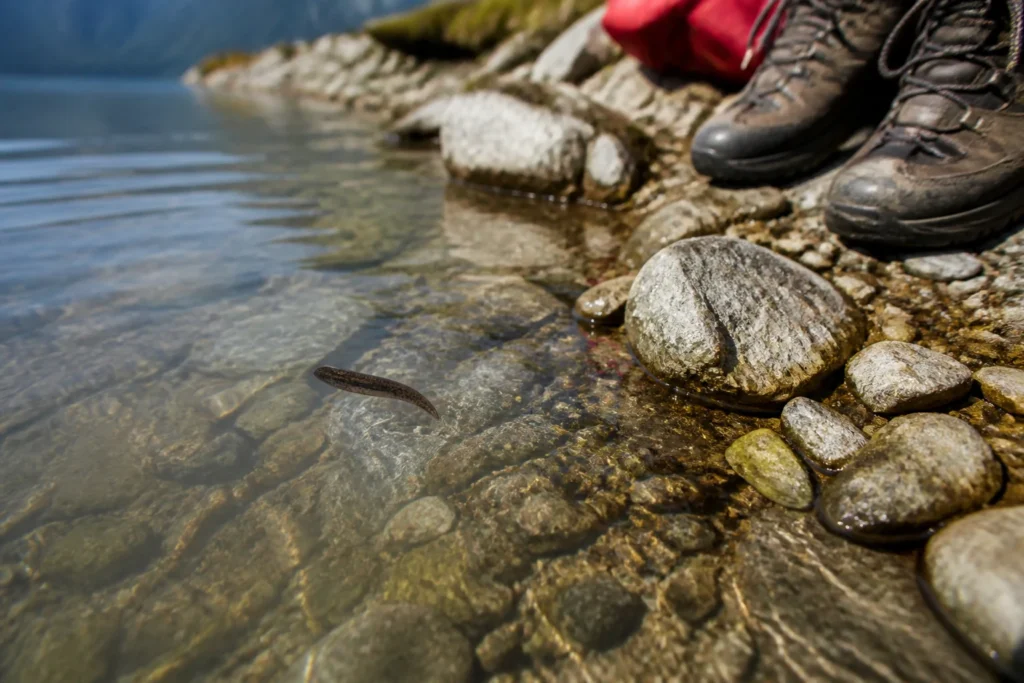
Natural waters contain wildlife and other hazards. Leech avoidance must not override drowning prevention, water-quality notices or local access rules. Clothing and observation may help limit contact, but no fixed route or depth guarantees that a swimmer will avoid leeches.

Identification and conditions
Identify the conditions before choosing a response
Local notices
Check access, water quality and wildlife advice.
Swimming safety
Use a suitable designated area and supervision.
Exposure
Observe accessible skin after exiting safely.
Symptoms
Separate a minor skin bite from urgent complications.
Methods ranked by their role
Match each method to its purpose
Safe location choice
Follow official access and swimming advice.
Suitable clothing
Use activity-appropriate coverage without impairing swimming.
Post-swim observation
Check accessible skin from a stable place.
Qualified first aid
Use health guidance and escalate concerning symptoms.
Inspection and prevention steps
Read the swimming noticeboard
Check current warnings and permitted access before entering. Do not ignore closures or water-quality concerns because the water appears clear.

Use a suitable designated entry
Stay within the safe permitted swimming area, supervise children and follow local guidance. Do not recommend deep open water, an unsupervised dock or an unfamiliar route as a leech-avoidance technique.

Check skin after leaving the water
From stable footing, inspect accessible skin without scraping an attached animal with a card or fingernail. If uncertain, contact local health advice. Avoid forceful pulling and heat; this page does not prescribe an improvised chemical-detachment recipe.

Clean the site after detachment
Wash with soap and water and use clean pressure if bleeding. Obtain urgent care if it continues despite pressure, or for dizziness or suspected internal attachment. Ask a clinician about infection signs or individual bleeding risks rather than assuming hours of bleeding are normal for everyone.

Sequence and reassessment
Check, prevent and reassess
Identify
Confirm the concern and relevant conditions.
Prevent
Address suitable access or exposure conditions.
Respond
Follow specific product or health guidance.
Reassess
Seek suitable help when the concern persists.
Myths and facts
Avoid unsupported shortcuts
Myth: deeper water is always safer
Fact: prioritize designated swimming and drowning prevention.
Myth: a card is a universal removal tool
Fact: seek appropriate health guidance when uncertain.
Myth: every bite needs pesticide
Fact: environmental insecticides are not first aid.
Myth: wait hours despite ongoing bleeding
Fact: persistent bleeding and systemic symptoms need urgent care.
Plan for the site, not just the swimmer
Using a designated entry, protective footwear where appropriate, and a post-swim skin check can reduce exposure. These steps do not make an unassessed waterbody safe or establish water quality.
Follow posted warnings and local health guidance. Persistent bleeding, infection signs, severe allergy, or attachment to the eye, mouth, or another sensitive site needs prompt medical care.
Leeches in freshwater: habitat clues are not a swimming-safety test
Leeches are segmented worms, not insects, and different species use different habitats and hosts. Many live in freshwater; others are terrestrial or marine. Some feed on blood, while others eat small invertebrates. An animal’s presence in a lake therefore does not establish that every leech there will attach to a swimmer. The Australian Museum explains their biology and feeding differences.
Freshwater leeches occur in still or slowly flowing water, but they have also been collected from fast-flowing streams. Changing to a river current is not a reliable escape strategy, and it can introduce a much more serious swimming hazard. Likewise, clear water is not proof that leeches, germs or submerged obstacles are absent.
A shoreline walk and a swim require different clothing
Advice about leech socks or gaiters generally concerns land exposure, not the ability to swim safely while wearing hiking gear. Keep those activities separate. If you walk through wet vegetation to reach the swimming site, inspect your gear on a stable surface before changing into appropriate swimwear.
For water exposure, use well-fitting clothing designed for the activity and conditions. A suitable wetsuit or swim layer covers some skin but does not create a guaranteed leech-proof seal at every opening. Avoid improvising tightly tied cuffs or loose heavy clothing that could interfere with movement. Children and weaker swimmers still need the appropriate supervision and flotation arrangements.
Before swimming: choose the site, access and equipment first
Check the swimming authority’s notices before leaving home and again at the site. Ask whether the area is designated for swimming, what access is permitted and whether any current warning applies. A report from another visitor can be useful context, but it does not override a closure or tell you the current water quality.
Pack normal water-safety equipment, a towel, clean clothing and a basic first-aid kit. Know where assistance is available. Do not make leech avoidance the reason to swim alone, take a shortcut across unfamiliar water or remain in the water after you are tired.
CDC guidance for oceans, lakes and rivers emphasizes designated swimming areas, local warnings and water-quality conditions. These precautions address risks a visual leech check cannot assess.
Protective footwear has limits
Use water shoes only where they are appropriate for the chosen activity and site. They cover part of the foot, but their openings are not certified leech barriers. Check inside after leaving the water, and do not keep walking over a slippery bank while trying to inspect an ankle.
Keep towels and dry clothing on a clean, stable surface instead of beside wet vegetation where you cannot inspect them easily. Before dressing, check the folds, shoes and accessible skin. These are practical observation steps, not evidence that a particular fabric or color repels leeches.
Do insect repellents, salt or essential oils prevent swimming leeches?
Do not transfer a mosquito-repellent claim to leeches in water. The pest named on the product and its permitted use matter. A repellent used on a land walk is not automatically suitable for aquatic exposure, and water contact does not establish that its protective effect continues.
The Australian Museum describes several popular leech-protection ideas as unproven. That is not a reason to publish a dependable dose, protection time or guarantee for tobacco, eucalyptus oil, soap or lemon juice. The same caution applies to a saltwater coating applied before a freshwater swim.
Do not turn the swimming area into a treatment site
Do not pour salt, insecticide, bleach or household mixtures into the lake. Do not leave baited cans or remove shoreline vegetation to treat a public swimming area yourself. The site operator or relevant environmental authority should assess management; visitors should follow access advice and report concerns.
If leech encounters repeatedly spoil a visit, choosing another approved swimming location or a maintained swimming pool is more practical than experimenting with a homemade skin barrier. Confirm that the alternative site is suitable rather than trading one concern for an unassessed water hazard.
After the swim: checks, bleeding and when to seek help
What if I notice an attached leech while still in the water?
Exit safely first. Do not twist around, dive deeper or attempt removal while you need your hands for swimming. From stable footing, assess the situation and seek appropriate first-aid advice if uncertain. Do not use flame or forceful pulling.
Why can a bite continue to ooze after detachment?
Blood-feeding leeches produce substances that affect clotting. That explains why a bite can ooze, but it is not permission to dismiss ongoing bleeding for every person. Apply clean pressure and seek medical help for persistent bleeding, dizziness or other concerning symptoms. Healthdirect gives leech bite and first-aid guidance.
Should a child go straight back into the water?
Address the attachment or wound and obtain suitable advice before resuming the activity. Check whether the child is comfortable, whether bleeding has stopped and whether the swimming conditions remain suitable. A child’s distress is a reason to end the swim, not to rush an improvised removal.
What should I tell the site operator or clinician?
Give the location, approximate time, activity and symptoms. A safely obtained photograph may help, but do not collect an animal or delay care to identify its species. Report eye, mouth, nose or suspected internal attachment urgently; it is not a routine skin-check task.
Publishing and affiliate notes
Some product links may be affiliate links. If you buy through them, we may earn a commission at no extra cost to you. Product picks are not lab tests. Read the legal disclaimer.