
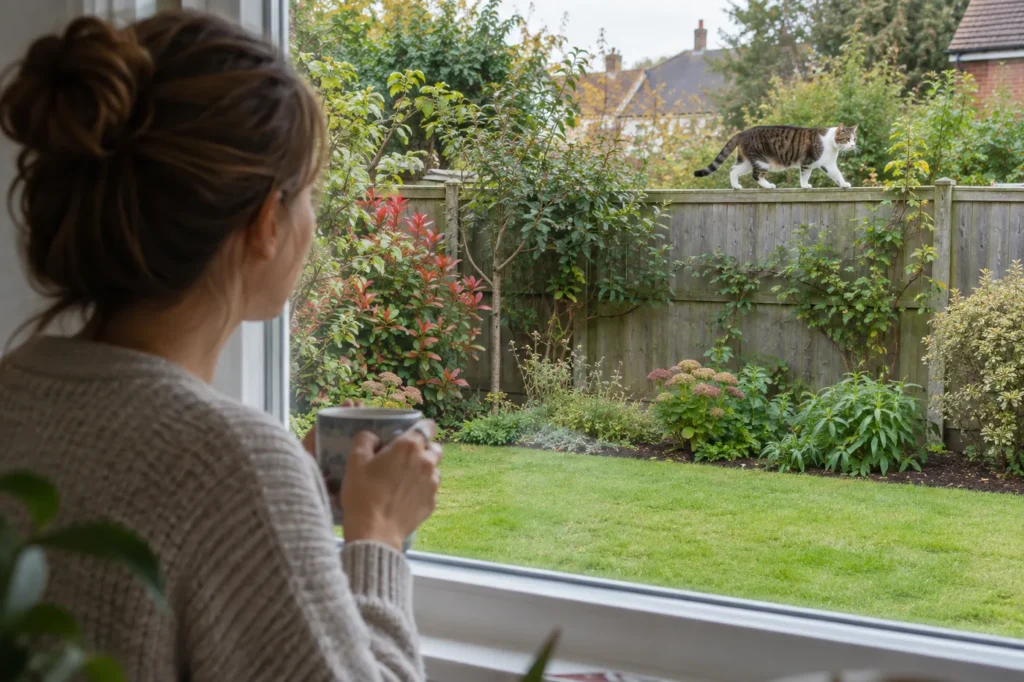
“Stray cat” can describe several different situations: a lost indoor pet, an owned outdoor cat, a socialized abandoned cat, or an unsocialized community cat. The right response depends on which animal you are seeing. Start with observation and identification, then make the specific part of your property unrewarding without injuring the cat.
Handle contact and illness cautiously
Do not corner or grab an unfamiliar cat. Keep children and pets away from a cat that is injured, disoriented, unusually aggressive, unable to walk normally, or drooling, and call animal control or public health. Wash bites and scratches immediately with soap and water and seek prompt medical advice; rabies decisions depend on the exposure and local epidemiology. Pregnant or immunocompromised people should avoid handling cat feces and contaminated soil.
Why a free-roaming cat keeps visiting
Four reasons a yard becomes part of the route
Food and water
Pet bowls, intentional feeding, open garbage, compost, rodents, birdseed, and accessible ponds reward visits.
Loose soil and sand
Garden beds, mulch, and uncovered sandboxes offer easy digging and toileting sites.
Shelter
Decks, sheds, crawlspaces, dense shrubs, and unused structures provide cover or kitten-rearing space.
Established territory
Regular travel paths, scent marks, mates, and a familiar feeder can keep cats moving through multiple properties.
A clipped or “ear-tipped” ear often indicates a sterilized community cat, but practices vary. A collar does not prove current ownership, and no collar does not prove abandonment. Photograph the cat, check neighborhood lost-pet listings, speak with neighbors, and ask a shelter or veterinary clinic about a microchip scan when the cat can be handled safely.
Humane deterrents ranked
Match the control to the attraction
- Remove food and secure waste — Preferred. This removes the repeat reward and also reduces rodents and wildlife.
- Cover or exclude vulnerable areas — Preferred. A fitted sandbox lid, garden mesh, and verified closure beneath structures solve a specific access problem.
- Motion-activated water — Useful where appropriate. A brief surprise can redirect travel without pursuit, but placement must avoid roads, freezing weather, neighbors, and people.
- Owner, shelter, and community-cat coordination — Essential for persistent populations. Identification, sterilization, vaccination, adoption assessment, and lawful management require local partners.
- Essential oils, pepper, mothballs, poison, glue, or relocation — Avoid. These can injure animals, violate pesticide or cruelty laws, affect children and wildlife, and leave the underlying population or food source unchanged.
Step 1: remove the reward
Feed your own pets indoors. If outdoor feeding is part of an authorized community-cat program, use scheduled portions, remove leftovers promptly, clean the station, and locate it away from the property you need to protect. Secure garbage and compost, clean grill residue, stop spilled birdseed from supporting rodents, and repair leaking outdoor faucets.

Step 2: protect garden beds and sand
Use a rigid fitted cover on a sandbox whenever it is unattended. Protect freshly worked soil with flexible garden mesh, closely spaced plantings, or a raised-bed cover that does not entangle paws, birds, or other wildlife. Keep sharp spikes, broken materials, and adhesive products out of the yard. Check every barrier after wind and garden work.

Wear gloves when removing feces, place waste in a bag according to local disposal rules, and wash hands. Do not compost cat feces for food gardens. CDC notes that the parasite Toxoplasma gondii can be shed in cat feces; daily removal reduces the time available for oocysts to become infectious, but high-risk people should delegate the task.
Step 3: use motion water selectively
A motion sprinkler can interrupt a predictable route or garden-bed visit. Aim it across the protected area rather than toward a road, public path, nest, feeding station, or neighbor’s property. Use a low, appropriate setting and test the detection zone. Shut it down in freezing conditions and move it periodically if the cat simply learns the boundary.

Step 4: close shelter access safely
Look beneath decks, sheds, porches, and crawlspaces for tracks, hair, odor, food, and repeated entry. Before sealing, confirm that no cat or kitten remains inside. Kittens can be silent and hidden. A community-cat organization, shelter, or wildlife-exclusion professional can help plan a safe one-way or delayed closure when occupancy is uncertain.

Step 5: identify and coordinate
A friendly cat may be lost. Ask a veterinary clinic, shelter, or animal-control agency to scan for a microchip; there should not be a fee to the finder for a basic scan in many communities, but local practice varies. Share a clear photograph through established lost-pet channels without disclosing every identifying feature, so a claimant can verify ownership.

For an unsocialized colony, ask what local animal control and community-cat programs permit. Trap-neuter-return programs sterilize and often vaccinate cats before return to a managed site, while socialized cats and kittens may be assessed for adoption. Outcomes, laws, capacity, and ecological policy differ. Do not trap unless a receiving program and a safe plan are already confirmed.
Seven-day yard response
- Observe: record appearance, behavior, route, timing, and possible ownership.
- Check: search lost-pet notices and speak with immediate neighbors.
- Remove: bring in bowls and secure waste, compost, seed, and feed.
- Protect: cover sand and loose soil; clean feces with appropriate precautions.
- Redirect: test humane motion water or a route barrier where safe.
- Inspect: check shelter openings carefully for adults and kittens.
- Coordinate: contact a shelter, animal control, veterinarian, or community-cat program.
Myths and facts
Humane cat deterrence without hazardous recipes
- Myth: mothballs are a safe outdoor cat repellent.
- Fact: mothballs are pesticides labelled for specific enclosed uses; scattering them can expose people, pets, wildlife, soil, and water.
- Myth: relocating a cat solves the problem.
- Fact: abandonment may be illegal and dangerous, and another cat can use the same food and shelter unless those conditions change.
- Myth: every outdoor cat is feral.
- Fact: lost and owned socialized cats also roam; checking identity comes before population management.
- Myth: trap-neuter-return instantly stops every nuisance.
- Fact: sterilization addresses reproduction and some mating behavior, while feeding, sanitation, shelter, and site management still matter.
Frequently asked questions
Can I use citrus or essential oils?
Do not apply concentrated oils, pepper, or irritating mixtures where cats, children, pets, or wildlife can contact or ingest them. “Natural” does not establish safety or legal pesticide use.
What if the cat is spraying?
Clean the surface with a product intended for pet urine and remove repeat visual and territorial triggers where practical. Sterilization programs may reduce mating-related marking, but owned cats need veterinary and owner involvement.
Should I stop feeding community cats?
Coordinate with the feeder and local program. Abrupt unmanaged changes can scatter activity without addressing the animals. A scheduled, cleaned, strategically located station plus sterilization is different from leaving food out continuously.
When should animal control be called?
Call for an injured, trapped, sick, threatening, or bite-involved cat, kittens in immediate danger, or a situation governed by local nuisance rules. Ask about intake and community-cat policy before trapping a healthy animal.
Keep stray cats away from the specific area they use
A deterrent works best when you can describe the problem precisely: digging in a raised bed, resting on patio cushions or entering beneath a shed. Trying to make an entire neighborhood cat-free is a different and much larger task. Start with the vulnerable part of your property and retain a safe route for the animal to leave.
Will a fence keep outdoor cats out of the yard?
A conventional garden fence may be climbed or bypassed, so do not buy one on the assumption that height alone guarantees exclusion. Inspect the actual route from a distance. For a purpose-designed barrier, ask about fit, gates, maintenance and escape arrangements; avoid improvised wires, sharp edges or a structure that can trap a paw or head.
Small-area protection can be more practical than rebuilding the boundary. A sound sandbox lid or a secure raised-bed cover addresses the digging site directly. Check that any mesh cannot entangle wildlife and that people can still use the area safely.
What about cats sleeping on patio furniture?
Store cushions indoors when practical or use a securely fitted furniture cover that does not create a hiding pocket. Check underneath before moving or fastening it. Do not apply concentrated oils or irritating powders to a cushion where a person, pet or cat will later make contact.
If the same sheltered corner attracts repeat visits, rearrange accessible storage while the area is unoccupied. Keep the exit open and do not chase an animal out with a hose. Use the property’s layout to reduce an attractive resting place, not to corner a visitor.
Why is the motion sprinkler not deterring cats anymore?
Check the device before buying another: power or battery, water supply, detection zone and whether the cat now uses another route. Test the system without an animal present. Reset it only where the spray will not affect a public path, traffic, neighboring property or freezing surfaces.
A cat that avoids one garden bed but passes through elsewhere does not necessarily mean the device failed. Judge the specific goal you set. Alley Cat Allies discusses site-specific humane deterrents; its advice is not a guarantee that every product suits every yard.
Should I keep trying citrus peels or coffee grounds?
Do not let repeated scent experiments delay a usable cover, waste correction or owner/program coordination. Citrus, lavender or eucalyptus references in online lists do not establish a reliable exposure-safe recipe. Concentrated essential oils, cayenne pepper and mothballs are not interchangeable with a fitted physical cover.
Record visits to the protected area, not just the presence of any cat outside. Compare after maintenance and weather changes. If the problem persists, share the actual route and ownership observations with the relevant local partner rather than escalating to trapping or relocation without a receiving plan.
Primary and authoritative sources
- CDC: Cats — Healthy Pets, Healthy People — bites, scratches, feces, and health precautions.
- CDC: About Toxoplasmosis — transmission and higher-risk groups.
- US EPA: Avoid Illegal Household Pesticide Products — label and exposure principles.
- ASPCA: A Closer Look at Community Cats — identification, management, and local programs.
- Alley Cat Allies: Living With Cats in Your Neighborhood — site-specific humane deterrents and coordination.
HowToRepel.com is an independent educational publisher, not a veterinary, public-health, shelter, or animal-control agency. This guide was AI-assisted, human-edited, and source-checked. Follow local laws and confirm a receiving plan before trapping any cat.
Publishing and affiliate notes
Some product links may be affiliate links. If you buy through them, we may earn a commission at no extra cost to you. Product picks are not lab tests. Read the legal disclaimer.