
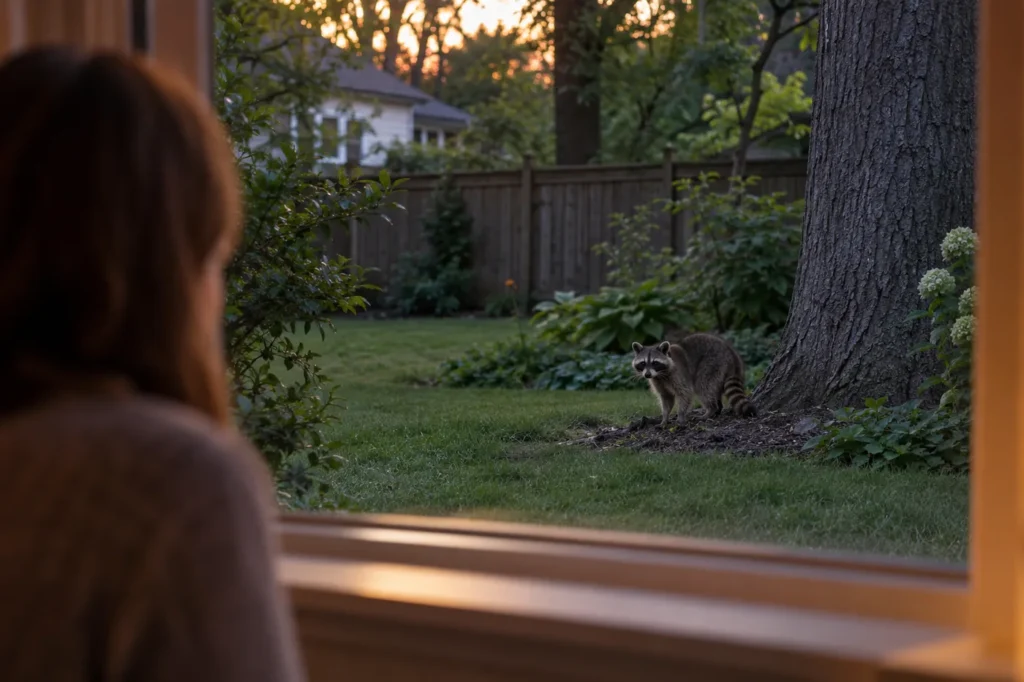
Raccoons are skilled climbers and opportunistic feeders. A yard with accessible waste or an attic with a weak soffit can reward repeat visits. Humane control begins by separating ordinary nighttime foraging from a public-health emergency or an occupied den, then solving the food and shelter conditions without trapping young inside.
Rabies and direct-contact safety
Do not approach, handle, feed, corner, or attempt to test a raccoon’s temperament. If a person is bitten or scratched, wash the wound immediately with soap and water and contact a healthcare professional and local public-health authority promptly. Keep pets away; after direct contact, call a veterinarian and animal control even when vaccination is current. A daytime sighting alone does not prove rabies, but disorientation, paralysis, unprovoked aggression, repeated falling, or unusual vocalization needs professional response.
Choose your situation: Start with the signs below, then use the yard-visit response, the attic, chimney or crawlspace assessment, or the latrine-cleanup precautions. A passing visitor, an occupied den and contaminated material need different plans.
Confirm raccoon signs before choosing yard or attic removal
A tipped bin or lawn damage is a clue, not a complete identification. UC IPM describes raccoon damage to newly laid turf, crops and building entry points. Raccoons may roll back turf while searching for food; small conical lawn holes can instead suggest skunk foraging. Do not buy a grub treatment solely because soil was disturbed.
- Yard visits: record which bin, crop, feeder or turf patch is affected and whether activity repeats.
- Roof or attic access: photograph displaced vents, damaged fascia or a suspected opening from stable ground.
- Chimney activity: report sounds and timing without lighting a fire to drive an animal out.
- Uncertain evidence: ask a wildlife professional to confirm species and occupancy before any repair closes a route.
Use an existing camera from a safe location if it helps distinguish visitors. Do not place food as a lure or approach an animal for a better photograph. A documented entry route helps the professional price an exclusion job; an isolated yard visit needs a different response.
Why raccoons keep returning
Four repeat-visit rewards
Food
Garbage, pet bowls, birdseed, compost, fruit, grubs, poultry feed, fish ponds, and outdoor freezers can reward foraging.
Water
Ponds, fountains, leaking irrigation, and accessible containers support a reliable route.
Den shelter
Attics, chimneys, soffits, crawlspaces, sheds, decks, and tree cavities can provide protected resting or maternity sites.
Easy access
Overhanging branches, downspouts, weak vents, open pet doors, and damaged roof edges create entry routes.
A single animal passing through at night is different from repeated roof noise, torn soffit, tracks entering a crawlspace, or a female using a chimney with young. Record dates, entry points, sounds, damage, and food sources. Do not crawl into a confined area to confirm occupancy.
Raccoon controls ranked
Remove rewards before adding deterrents
- Secure food and waste — Strong. Locking the reward changes why raccoons remain on the property.
- Professional, occupancy-verified exclusion — Strong for structures. Inspection, humane eviction where lawful, dependent-young safeguards, and durable repairs address the den and entry route.
- Targeted electric fencing — Strong for selected attractants. Properly designed systems can protect poultry, gardens, apiaries, ponds, and compost, subject to local codes.
- Motion water or light — Conditional supplement. It may interrupt a route but animals can habituate; use it with attractant removal.
- Ammonia, mothballs, poison, glue traps, or casual relocation — Avoid. These create exposure, welfare, and legal problems without repairing access or removing food.
Step 1: lock down food before dusk
Use carts with secure latches or store ordinary bins inside a robust locked structure until collection time. Rinse residue, bag waste, and avoid overflow. Feed dogs and cats indoors. Remove outdoor bowls, spilled seed, fallen fruit, greasy grill residue, fish food, and livestock feed. Use a compost system recommended for local wildlife conditions.

Pause bird feeding if seed or suet draws raccoons or the rodents they eat. Protect chicken coops and runs with durable construction and an agency-recommended electric-fence design where legal. A lightweight latch or chicken wire is not enough for a determined raccoon.
Protect ripening garden crops, not just the trash cans
Locking garbage will not protect an accessible crop. UC IPM identifies sweet corn as a frequent raccoon target just before harvest; raccoons can climb and pull down stalks. Check ripening produce for fresh damage and collect fallen fruit. An ordinary garden fence can be climbed or undermined, so ask about a crop-specific barrier rather than assuming a tall boundary fence solves the problem.
Where local rules and the site allow electric fencing, use an appropriate purpose-built energizer, professional installation advice and warning signs. Low electrified wires can be unsuitable around children, pets or public access. Keep the installation separate from a yard-visit response: do not approach a raccoon to drive it toward a fence.
When feeder raids or coop visits continue
Use the remaining reward to guide the next correction. UC IPM recommends restricting raccoon access to food and vulnerable structures; a device does not replace that work.
- Bird feeders: remove the feeder overnight where practical, clean fallen seed and secure stored seed. Check whether nearby branches or structures bypass a feeder guard.
- Chicken coops: inspect door latches, vent screening, loose panels and evidence of digging. Ask for a design suited to raccoons; do not assume light chicken wire or a simple hook is enough.
- Waste storage: confirm the latch is actually engaged, the lid is intact and overflow is not leaving food beside the container.
Step 2: respond safely to a raccoon in the yard
Bring children and pets indoors without approaching the animal. Close pet doors and give the raccoon an unobstructed route away. From a secure indoor position, noise or an exterior light may encourage departure, but do not surround, chase, spray at close range, or release a dog. Call local animal control for an animal that appears sick, injured, trapped, threatening, or unable to leave.

If a raccoon is inside a kitchen or living room
An accidental indoor visitor needs a different response from an established attic den. Humane World distinguishes entry through a pet door or other opening from raccoons living in structural spaces.
- Move people and pets away without approaching or passing close to the raccoon.
- Close access to other rooms only where you can do so safely. If an exterior exit can be opened without close contact, leave it available and withdraw.
- Do not grab the animal, corner it, follow it with a broom or place food around the room.
- Call animal control or a qualified wildlife service if it cannot leave safely, hides in an inaccessible space or shows concerning behavior. Do not wait through a close-contact risk.
After departure is confirmed, identify the opening and correct it. Keep the exposure response above separate: a bite, scratch or direct pet contact requires the appropriate health or veterinary advice, not simply a repaired pet door.
Step 3: inspect an attic, chimney, or crawlspace
Look from safe exterior locations for damaged soffit, displaced vents, rub marks, tracks, droppings, and repeated travel. Listen for movement patterns. Females may use structures for dependent young, so season and vocalizations matter. Closing the only opening without a full occupancy check can trap animals inside, cause structural damage, and separate a mother from kits. If the signs point to squirrels rather than raccoons, see how to get squirrels out of the attic.

Hire a wildlife-control operator who follows local law, explains how dependent young will be handled, and provides a written exclusion and repair plan. Trapping, relocation, and euthanasia rules vary; moving a raccoon yourself can be illegal, spread disease, or leave young behind.
Step 4: repair after confirmed vacancy
Once the professional confirms all animals are out, repair soffits, vents, fascia, roof intersections, and crawlspace openings with durable building-compatible materials. Install an appropriate chimney cap and protect vents without blocking required airflow. Trim access branches where arboricultural practice and local rules allow.

Close under-deck routes with durable exclusion materials
After a professional confirms vacancy and checks for dependent young, secure deck or shed openings with sturdy galvanized hardware mesh and a ground-edge design that resists digging. Fasten it securely and address loose boards as well as the obvious opening. UC IPM recommends screening these spaces; the repair still must preserve ventilation and safe building access. Flimsy netting is not a lasting structural repair.
Step 5: manage raccoon latrines carefully
Raccoons often reuse sites for feces. Their droppings can contain Baylisascaris procyonis eggs, which can cause severe disease if swallowed. Keep children and pets away and consult CDC guidance or a qualified remediation professional, especially for attics, decks, soil, playgrounds, or extensive contamination.

Do not sweep or vacuum dry droppings. CDC advises special cleanup precautions because common disinfectants do not reliably kill roundworm eggs. Large indoor or porous-material contamination is a professional job. Wash hands and contaminated clothing as directed, and discuss possible ingestion exposure with a healthcare professional.
Raccoon conflict checklist
- Separate: move people and pets indoors and preserve an exit route.
- Record: note behavior, time, damage, entry, and food sources.
- Secure: lock waste, bowls, feed, seed, compost, grills, and fruit.
- Report: escalate direct contact, illness, injury, or threatening behavior.
- Inspect: use a qualified professional for occupied structures and dependent young.
- Exclude: repair openings only after confirmed vacancy.
- Remediate: handle latrines under CDC guidance or professional control.
Myths and facts
Raccoon control without dangerous shortcuts
- Myth: any raccoon seen in daylight has rabies.
- Fact: mothers, displaced animals, and food-conditioned raccoons may be active by day; abnormal behavior and exposure require professional assessment.
- Myth: mothballs or ammonia will clear an attic safely.
- Fact: vapors and off-label pesticide use can harm occupants and may drive an animal deeper into the structure.
- Myth: seal the hole as soon as the raccoon leaves.
- Fact: dependent young or another animal may remain; confirm vacancy first.
- Myth: trapping one raccoon fixes the property.
- Fact: accessible food and unrepaired openings will remain attractive to other animals.
Check for young before closing a den
Raccoons may use attics, chimneys and crawl spaces as maternal dens. Never seal an opening simply because the adult left after dark. Listen for young, inspect from a safe distance and use a qualified humane wildlife professional when maternity status is uncertain. A one-way door can separate a mother from dependent young if timing and placement are wrong.
After confirmed vacancy, repair the primary opening and nearby weak points with materials suited to the structure. Do not block vents, drainage or combustion-air openings. Chimney caps and roof work should be installed by someone who can work safely at height.
Match the deterrent to the reward
| Reward | First correction | Useful follow-up |
|---|---|---|
| Garbage or compost | Use a tight, secured container and correct collection timing | Clean residue and observe the route |
| Pet food or bird seed | Bring food in before dusk and clean spillage | Review feeder placement and fallen seed |
| Pond, pool or water bowl | Remove optional water overnight where practical | Use a fitted cover or barrier appropriate to the site |
| Attic or chimney shelter | Confirm occupants and young before exclusion | Repair after vacancy |
| Garden or turf food | Protect the specific crop or area | Do not treat an entire lawn for grubs without diagnosing turf damage |
Use motion deterrents as support, not a cure
A motion-activated sprinkler or light may interrupt a familiar route, but habituation is possible. Place devices where they do not spray pedestrians, neighboring property or public paths. Rotate positioning only after food and shelter rewards are corrected. Never corner or chase a raccoon.
Raccoon latrines require a separate safety plan
Raccoons may repeatedly defecate at communal latrines on decks, roofs, woodpiles, attics or the bases of trees. Keep children and pets away. Do not dry sweep, blow or vacuum feces. CDC guidance recommends protective clothing and careful removal; confined spaces add respiratory hazards and are strong candidates for professional cleanup.
Ordinary chemical disinfectants do not reliably destroy raccoon roundworm eggs. Cleanup method depends on the contaminated material and fire or burn risk. Do not use a flame indoors, and do not improvise high heat on combustible or damage-prone surfaces.
After a pet encounter
Bring the pet away without touching the raccoon or saliva, then contact a veterinarian promptly. Follow local public-health or animal-control instructions for possible rabies exposure and vaccination status. Do not attempt to capture the raccoon yourself. Human bites, scratches or saliva contact with broken skin, eyes, nose or mouth require prompt medical and public-health advice.
Evaluate a wildlife-control proposal
Ask how the company confirmed species and occupancy, how it checks for young, what exclusion materials it uses, how traps or one-way devices are monitored, and who repairs the structure. The proposal should address attractants and cleanup, not merely remove one animal. Relocation, trapping and euthanasia rules vary by jurisdiction.
If raccoon activity returns after exclusion
Record new noise, fresh damage or repeat camera sightings rather than treating old marks as proof of another occupant. Check whether the same opening has failed, another weakness remains or outdoor food still rewards a visit. Observe from stable ground; do not enter an attic to investigate.
Send the evidence to the operator and ask for an occupancy recheck, inspection of primary and secondary repairs, and clarification of the repair warranty. Do not add a one-way door or reseal a suspicious opening yourself: the young-animal check still applies to a return visit.
Frequently asked questions
Should I call police about a raccoon?
Use emergency services for an immediate threat to people. Routine nuisance, injury, confinement, or suspected rabies generally goes to animal control, public health, or the wildlife agency under local policy.
Can a raccoon get through a cat door?
Yes. Lock pet doors at night and whenever wildlife activity is present. Electronic doors reduce some access but do not replace supervision and food control.
Will bright lights keep raccoons away?
They may interrupt a visit temporarily, but habituation is common. Remove rewards and close verified shelter access for durable control.
What if my dog fought a raccoon?
Separate without placing your hands between the animals, move the dog to safety, and contact a veterinarian and animal control promptly. Do not handle the raccoon, alive or dead.
Frequently asked questions about raccoon deterrence
Can I seal an attic opening during the day?
Not until vacancy and the absence of young are confirmed. An adult may be resting inside or dependent kits may remain after the mother leaves.
Do ammonia or mothballs evict raccoons?
Do not use mothballs outside their pesticide label, and do not rely on concentrated chemical odors in occupied structures. Professional exclusion is safer when a den is established.
Will grub treatment stop lawn digging?
Only treat a confirmed turf-pest problem according to local guidance. Raccoons eat many foods, so grub treatment is not a general deterrent.
Primary and authoritative sources
- CDC: About Rabies — exposure and public-health response.
- CDC: About Raccoon Roundworm — latrine exposure and disease.
- CDC: Preventing Raccoon Roundworm — cleanup precautions.
- National Park Service: Raccoon biology and food access — food, distance, and coexistence.
- UC IPM: Raccoon identification and management — wildlife-damage management context.
HowToRepel.com is an independent educational publisher, not a public-health, veterinary, or wildlife-control agency. This guide was AI-assisted, human-edited, and source-checked. Follow local animal-control, health, and wildlife laws.
Publishing and affiliate notes
Some product links may be affiliate links. If you buy through them, we may earn a commission at no extra cost to you. Product picks are not lab tests. Read the legal disclaimer.