
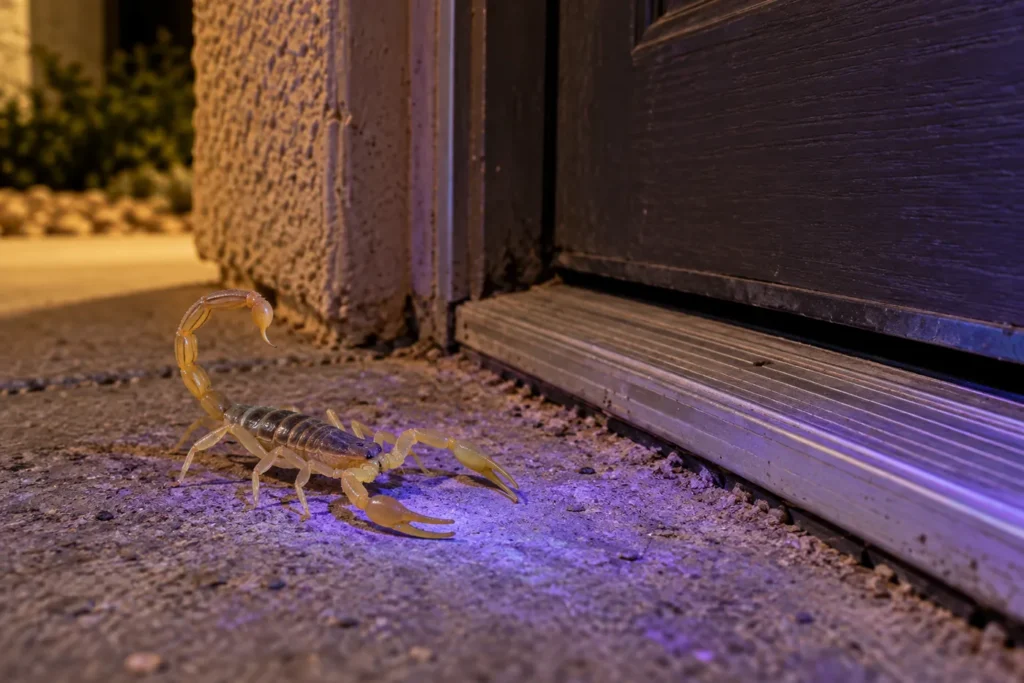
Exclusion works through suitable repairs to the actual building defect. Scorpions can use concealed shelter and enter accidentally, so observation helps prioritize maintenance without making handling necessary. Choose materials and repairs that suit the assembly instead of stuffing every drainage opening with mesh.
What attracts scorpions around your home?
Inspect access, shelter and moisture
Door seals
Check worn sweeps and jamb defects.
Screens
Inspect frames and tears.
Stored shelter
Look at manageable debris or firewood near the wall.
Building joints
Assess suitable utility gaps while preserving required functions.
Scorpion control methods ranked by their role
Prioritize appropriate maintenance
Repair identified entry defects
Use compatible seals for the actual opening.
Reduce accessible shelter
Manage safe stored materials without handling animals.
Correct leaks
Arrange suitable plumbing or irrigation repair.
Qualified recurrent-activity assessment
Use identification and site-specific advice rather than blanket treatment.
Natural ways to prevent scorpions from entering
Inspect safely with a UV flashlight
Scan accessible garage and wall edges from a distance after dark. Record sightings, wear closed shoes and never look directly into the ultraviolet beam.

Fit a door sweep and weather stripping
Inspect the threshold and corners, then fit a compatible sweep that closes the visible gap while allowing the door to operate normally.

Seal suitable utility penetrations
Assess the pipe-to-wall joint and choose compatible mesh or sealant where appropriate. Preserve drainage and ventilation and leave electrical work to a qualified provider.

Reduce shelter outside your home
Move manageable wood piles and debris away from walls. Keep storage inspectable, repair irrigation leaks and avoid reaching into concealed shelter.

Monitor scorpions in your home after repairs
Inspect, repair and compare sightings
Inspect
Record accessible defects and sightings.
Repair
Make compatible changes without obstructing building functions.
Maintain
Keep suitable storage and moisture management in place.
Reassess
Review continuing indoor activity with a qualified provider.
Scorpion repellent myths and facts
Avoid blanket sealing and treatment claims
Myth: every opening should be filled
Fact: preserve drainage, ventilation and assembly functions.
Myth: every house needs dust inside walls
Fact: products and concealed work require site-specific assessment.
Myth: pesticides cannot ever affect scorpions
Fact: choose treatment only through suitable labeled guidance.
Myth: one clear UV scan proves absence
Fact: concealed animals can remain unseen.
Use sightings to narrow the inspection
One scorpion carried indoors with stored material differs from repeated sightings near the same door, utility route, or damp shelter. Glue boards can help map activity but should be placed where children and pets cannot reach them.
Record location and time, reduce accessible shelter, and repair compatible gaps. Repeated indoor sightings, medically significant species, or inaccessible wall activity warrants local identification and professional assessment.
Why scorpions enter houses
Bark scorpions in the genus Centruroides seek shelter, moisture and prey insects. They enter through worn door sweeps, garage corners, utility penetrations, cracks in block or stucco, and openings around vents. Outdoor firewood, stacked tile, dense groundcover and irrigation leaks create hiding places close to those routes.
One indoor scorpion does not prove a large infestation, but repeated sightings deserve a structured inspection. Record the room, time and nearby wall edge instead of spraying every baseboard.
Scorpion-control products compared
Affiliate disclosure: Product links may earn a commission at no extra cost to you. Measure openings and confirm building requirements before buying exclusion materials.
| Product | Best use | Buyer check | Caution |
|---|---|---|---|
| UV flashlight | Night inspection | UV wavelength, beam width, runtime and grip | Wear closed shoes; never handle a scorpion |
| Door sweep | Gap below an exterior or garage door | Door width, threshold profile and material | A poor fit leaves corner gaps |
| Weatherstripping | Door and window perimeters | Gap size and compression | Replace when cracked or flattened |
| Metal mesh plus sealant | Suitable irregular penetrations | Surface, temperature and movement | Do not block drainage or ventilation |
| Sticky monitor | Mapping wall-edge activity | Protected placement and inspection window | Keep away from children and pets |
Step-by-step scorpion exclusion plan
1. Inspect safely with a UV flashlight
After dark, wear closed shoes, long pants and gloves. Scan wall-floor edges, garage corners and the outdoor foundation from a distance. Ultraviolet light makes many scorpions fluoresce, but it does not make handling safe.
2. Fit door sweeps and weatherstripping
Close visible light beneath exterior doors and pay attention to both bottom corners. Replace compressed perimeter seals. Test the door several times so the repair does not prevent safe closing or latching.
3. Seal suitable wall penetrations
Use compatible sealant for small stable joints and metal mesh as backing where appropriate. Purpose-made weep protectors can reduce access while preserving masonry drainage. Never fill a required weep opening with ordinary caulk.
4. Remove shelter and reduce prey
Raise firewood on a rack away from the wall, move stored tile and boxes, trim vegetation, and repair irrigation leaks. Manage crickets and cockroaches with sanitation and exclusion because they are scorpion food.
5. Monitor and escalate based on evidence
Place sticky monitors along protected wall edges in garages or utility areas, label the date and location, and compare catches weekly. Frequent indoor sightings, medically significant local species, or inaccessible construction gaps justify licensed pest control.
Frequently asked questions
What smell keeps scorpions away?
No household smell reliably seals a house. Essential oils can irritate people or pets and do not replace door sweeps, screens and gap repair.
Do scorpions come up through drains?
They are more often using gaps around plumbing than traveling through a water-filled trap. Check that traps contain water and seal suitable pipe penetrations.
Where should sticky monitors go?
Place them flush to wall edges in protected, low-traffic locations near suspected routes. Keep them inaccessible to children and animals.
What should I do after a sting?
Follow local poison-control or medical advice, especially for a child, severe pain, breathing trouble, muscle symptoms or an uncertain species. Do not rely on a home remedy for serious symptoms.
Get rid of scorpions by tracing entry and shelter
A single scorpion may have entered with firewood or through an open door. Repeated sightings near the same wall, utility penetration or ceiling edge point to a route or nearby harbourage. Record the room, time, weather and location instead of treating every baseboard.
Scorpions are nocturnal predators. Outdoor shelter, prey insects and moisture can raise pressure around a structure, but no single condition proves why one entered. In the desert Southwest, summer heat and monsoon conditions can change movement patterns.
| Evidence | Inspection priority | Practical response |
|---|---|---|
| Scorpion beside an exterior door | Door sweep, threshold corners and weather stripping | Fit the repair while preserving door operation |
| Captures along one interior wall | Pipe, cable, baseboard and adjoining exterior joints | Map gaps before applying a compatible sealant |
| Sightings after carrying firewood | Wood storage and transport route | Store wood away from the structure and bring in only what is needed |
| Activity near wet or cluttered areas | Leaks, irrigation, debris and prey insects | Correct the confirmed condition rather than spraying blindly |
| Several rooms or upper levels | Wall voids, roofline, vents and construction gaps | Arrange a systematic professional inspection |
Inspect scorpions inside your home with a UV flashlight
Scorpions fluoresce under ultraviolet light, so a portable UV flashlight can help map activity after dark. Wear closed shoes, use eye protection appropriate to the light and never stare into the beam. Scan from a distance; do not put hands beneath rocks, boards, furniture or boxes. Leather gloves reduce risk when exterior debris must be moved, but they are not permission to handle a scorpion.
Mark sightings on a simple floor plan and place sticky monitors along wall edges where children and pets cannot reach them. A dated pattern tells you which repairs matter. Random nighttime hunting alone does not prevent another entry.
Seal in an order that preserves the building
- Correct door sweeps and threshold corners.
- Repair torn screens and gaps around frames.
- Seal suitable utility penetrations with a material compatible with the joint.
- Inspect exterior wall-to-roof transitions, weep details and vents without blocking required airflow or drainage.
- Move boards, dense debris and firewood away from the foundation; trim vegetation that creates a direct bridge where appropriate.
Blanket caulking is a bad plan. Drainage openings, combustion air and designed ventilation must remain functional. A contractor should assess unfamiliar building details or elevated work.
When professional pest control and scorpion spray fit
Habitat modification and exclusion provide the durable foundation; pesticides alone do not correct entry routes. When sightings continue, a product labeled for scorpions and the exact indoor or outdoor site may support the plan. Prefer targeted crack-and-crevice or harbourage treatment where the label allows it over routine room-wide spraying.
Ask a professional to identify the treatment zone, active ingredient, EPA registration number, preparation, re-entry directions and follow-up method. Essential oils, cedar, cinnamon and ultrasonic devices are not substitutes for repaired entry points and monitoring.
Scorpion sting response
Wash the site with soap and water and contact Poison Control in the United States at 1-800-222-1222 or use its online guidance. Do not apply a tourniquet. Seek emergency care for breathing or swallowing difficulty, abnormal eye or muscle movements, widespread symptoms or a rapidly worsening reaction. Young children deserve prompt expert guidance because severe effects can develop quickly.
Scorpions eat prey: reduce the conditions supporting it
Scorpions feed on other arthropods, including insects such as crickets, cockroaches and spiders. A recurring cockroach or cricket problem can support predators near a building. Confirm the prey pest, secure food and waste, correct moisture, and use an appropriate management plan.
Do not spray every ant or spider simply because you saw a scorpion. Outdoor predators are part of the local ecosystem, and an unnecessary treatment adds exposure. For a confirmed indoor cockroach problem, our German cockroach guide explains inspection and targeted control.
Do lavender, essential oils or dusts repel scorpions?
A lavender essential oil spray or another homemade repellent does not repair a door gap or remove shelter. Evidence for dependable household scorpion exclusion with scented oils is limited. Avoid calling an oil safe for pets simply because it comes from a plant.
Diatomaceous earth and boric acid also need care. A pesticide label must authorize the pest, location and application. Do not scatter dust across floors, bedding or pet areas or copy a food-bait recipe intended for a different insect. Scorpions are predators; the presence of a powder does not show that an animal will ingest a useful dose.
Natural ways to deter scorpions are most useful when they change access and habitat: repair screens, reduce accessible shelter and keep suitable areas dry and free of leaks. UC IPM describes habitat management and pesticide limitations.
What to ask a scorpion pest control service
- Which species and entry routes were found?
- Which repairs around the perimeter of your home are included?
- Will the technician inspect storage, utility gaps and accessible crawl spaces?
- If treatment is proposed, where will it go and what does the product label permit?
- How will follow-up sightings and monitor catches be compared?
A pest control company should explain the inspection findings before recommending a recurring spray schedule. Ask for the product name, EPA registration number and re-entry instructions. Compare service scope and repairs using our scorpion pest control quote guide.
Make bedrooms and stored items harder to hide in
Scorpions can hide in dark places beneath stored items, folded fabric and loose boards. Keep floors accessible for inspection, lift piles of clothes into closed storage, and check shoes, gloves and bedding when indoor sightings have occurred. Wear protective clothing and closed shoes during cleanup.
Do not reach into a suspected hiding place. Moving manageable clutter improves visibility, but inaccessible voids and frequent sightings still need professional assessment. The Arizona bark scorpion, Centruroides sculpturatus, deserves particular attention in its local range.
Frequently asked questions about scorpion prevention
Does seeing one scorpion mean there are many?
No. Treat it as evidence worth recording, then inspect likely routes and use monitors to learn whether activity is isolated or recurring.
Should I seal every exterior opening?
No. Seal unintended gaps, but preserve weep openings, vents, drainage and combustion-air requirements.
Will perimeter spray keep every scorpion out?
No treatment creates a perfect barrier. Exclusion, habitat correction, prey management and monitoring remain necessary.
Publishing and affiliate notes
Production note: AI assisted with drafting and original instructional images. A human editor checked claims against the cited primary sources.
Some product links may be affiliate links. If you buy through them, we may earn a commission at no extra cost to you. Product picks are not lab tests. Read the legal disclaimer.