
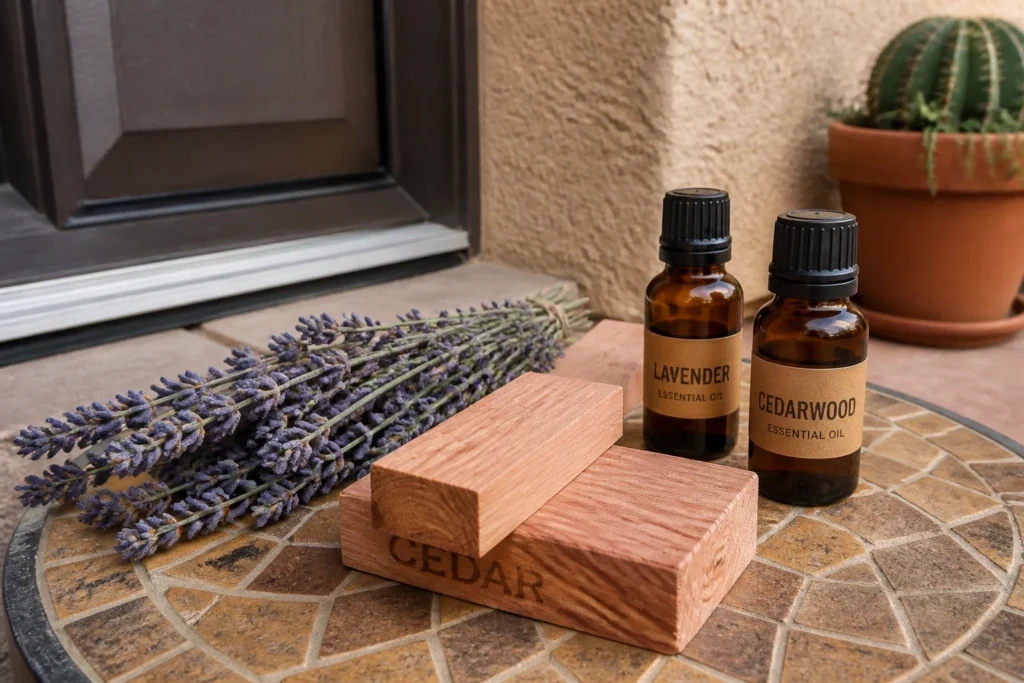
The useful question is whether a scented product prevents entry after application, under the conditions around your home. A strong smell or an animal moving away during a demonstration does not establish lasting protection. This guide does not rank oils by an invented number of hours or give a homemade pesticide recipe.

Understand the problem before choosing a method
A scent does not remove the entry route
Outdoor shelter
Check loose debris and stored items near the building.
Moisture
Inspect accessible outdoor leaks and irrigation wetting the perimeter.
An open joint
Look for damaged seals and screen gaps instead of painting a scented line across them.
Indoor exposure
Keep shoes and clothing out of outdoor hiding places. UC IPM
Methods ranked by practical priority
What to prioritize instead of scent sprays
Entry repair — prevention guidance
Fix suitable gaps and worn weather stripping. Utah State Extension
Shelter reduction — prevention guidance
Clear accessible debris without handling scorpions. UC IPM
Inspection — monitoring
Use observations to locate repair priorities; a clear inspection does not guarantee absence.
Pesticide — conditional use
A product must be labeled for the pest, site and method. A pleasant or natural smell is not a safety standard. EPA
Practical steps
Inspect the door and screen edges
Check accessible door bottoms, jamb corners and screen frames. Record an opening before repairing it. Keep ventilation and drainage functional.

Reduce the hiding places near the house
Move loose leaf litter and stored materials away from accessible building edges. Wear gloves and closed shoes; avoid putting hands beneath objects where a scorpion may be concealed.

Check moisture and utility gaps
Look for an accessible leak or an unsealed stationary gap. Do not disturb electrical, gas or hot equipment. Have a qualified professional specify repairs at unfamiliar building details.

Protect items you will wear
Store footwear indoors and check shoes or clothing left outside before use. Keep children and pets away from a sighting.

When to check progress
Use checkpoints rather than an elimination promise
Before any product
Identify the animal and the location of sightings.
During the inspection
Photograph openings, shelter and moisture problems.
After repairs
Recheck door operation and the completed work once repair materials have cured.
If sightings continue
Ask for a professional inspection of missed or inaccessible routes; do not simply increase a spray concentration.
Myths and facts
Check the claim before acting
Myth: the strongest smell is the best barrier
Fact: odor intensity is not a measured exclusion result.
Myth: natural oils are automatically safe
Fact: suitability depends on the ingredients, use directions and exposure; keep unapproved mixtures away from children and pets.
Myth: homemade recipes replace labels
Fact: do not improvise a pesticide treatment from a generic recipe. EPA
Myth: a scent means a gap can stay open
Fact: a fragrance does not repair a torn screen or missing weather strip.
When to get professional help
For repeated indoor sightings, request an inspection and a written prevention plan. Ask what opening repairs, habitat changes and any labeled treatment are included. After a sting, contact poison control or a clinician; severe symptoms need urgent medical assistance. EPA service-selection guidance.
Frequently asked questions
Which oil keeps scorpions out permanently?
The sources below do not establish a permanent oil barrier. Use the identified repair and habitat priorities.
Should I spray oil directly on a scorpion?
Do not approach or handle the animal for an experiment. Keep people and pets away and seek appropriate help.
Can I use perfume or mothballs instead?
Do not substitute household fragrances or off-label products for a scorpion-control plan.
Will exclusion remove every scorpion in the yard?
No. The aim is reducing entry and encounters; outdoor scorpions may still be present.
Related guides
Home-sealing checklist · UV inspection guide
Skip the scent experiment. Use the complete scorpion exclusion and prevention plan for door gaps, utility penetrations, shelter and prey.
Essential oils and scorpion repellents: what the claim needs to prove
A lavender-scented patio is not the same thing as an effective scorpion barrier. To justify an entry-prevention claim, evidence must concern the actual formulation, how it is applied, the surface and the length of protection. A video of a single scorpion moving away from a drop answers a much narrower question. It does not show that animals cannot cross a dried residue beside your door.
This distinction matters when comparing lavender oil, peppermint oil and cedar oil. An ingredient name alone tells you neither the concentration in a commercial product nor whether that product is suitable for your house. Read the entire use directions, rather than transferring claims from another bottle or a homemade essential-oil mixture.
Lavender and peppermint: separate fragrance from prevention
Planting lavender or spraying peppermint does not close a gap around exterior doors. If a scented product is advertised to repel scorpions, look for evidence about scorpions and that exact use—not about mosquitoes, spiders or a different insect. Scorpions are arachnids. Results involving another pest should not be presented as proof that a fragrance will keep them away.
There is no reason to leave damaged weather stripping unrepaired while testing a stronger scent. Put the repair first. If you already use a fragrance for another purpose, keep its ordinary use separate from your scorpion-control record so that a temporary change in sightings is not mistaken for a proven repellent effect.
Cedar products: a material and a pesticide are different purchases
Cedar furniture, cedar mulch and a formulated cedar-oil pesticide are not interchangeable. A product sold for pest control may have directions and restrictions that do not apply to a wood furnishing. Conversely, a furniture label does not authorize mixing the wood’s scent with water and spraying it as a treatment.
Ask the seller which pests and sites the actual product covers, and read any restrictions for occupied spaces, pets and treated surfaces. Do not assume the word “natural” establishes that repeated indoor application is safe. EPA explains how pesticide labels govern use.
Scorpion prevention tips that address the conditions around your house
Walk the accessible perimeter in daylight and make a short list: damaged screens, worn door seals, loose stored materials and a visible leak. These are observations you can act on. A scent line around the perimeter of your home may smell strong while every one of those conditions remains unchanged.
Scorpions feed on other small animals, including insects. Pest activity and shelter therefore deserve attention alongside the entry points. Use appropriate guidance for any identified cockroach or cricket problem; do not spray broadly just because an insect might be prey. Utah State Extension discusses habitat, exclusion and scorpion management.
Keep the cleanup manageable and safe
Choose one accessible work area rather than turning over an entire woodpile. Arrange qualified help for hidden spaces or places where you cannot maintain safe footing. Wear suitable clothing, and do not put your hands into cracks and crevices to check whether an animal is there. Outdoor clutter is a maintenance task, not an invitation to handle wildlife.
Separate a necessary repair from a cosmetic change. A sound screen is a physical barrier; replacing one fragrance with another is not. Once repairs are complete, keep inspecting their condition and record indoor versus outdoor sightings. These records help identify a recurring problem without promising a scorpion-free yard.
Questions to ask before buying a natural scorpion repellent
Will a repellent get rid of scorpions already inside?
Do not infer that from an exterior deterrence claim. An indoor sighting calls for keeping people and pets away, safe assessment and a review of possible entry defects. Spraying behind furniture to chase an unseen animal can create exposure without locating it. Contact a qualified pest control professional for repeated indoor activity.
Are powders a better substitute for essential oils?
Diatomaceous earth or another dust is a different treatment, not simply a stronger fragrance. Avoid loose household powders around shoes, bedding or air vents. Use a pesticide only where its exact label permits it; the phrase “food-grade” does not supply scorpion-control directions or remove inhalation concerns.
How should I judge a service that promises a scent barrier?
Request a written description of inspections, repairs, products and follow-up. Ask what happens if indoor sightings continue and which work is excluded from the quote. Evaluate the proposal on those details, not on an unsupported assurance that scorpions hate a particular smell. Your first line of defense should remain identifiable repairs and safer exposure prevention.
Publishing and affiliate notes
Some product links may be affiliate links. If you buy through them, we may earn a commission at no extra cost to you. Product picks are not lab tests. Read the legal disclaimer.