
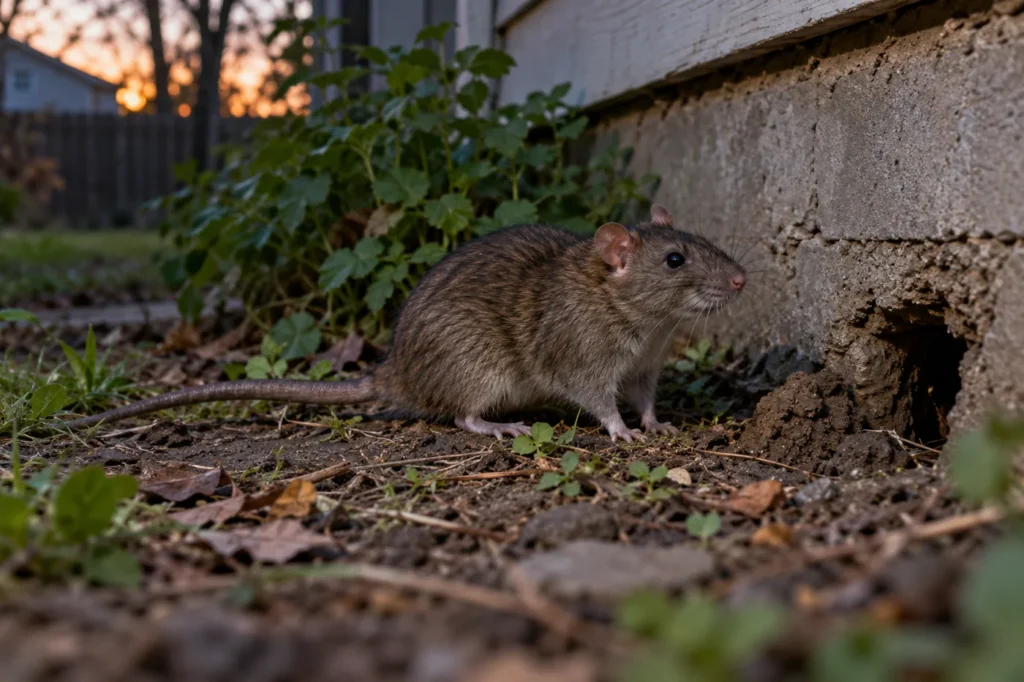
Finding droppings or hearing movement in a wall calls for a plan, not a stronger-smelling repellent. Norway rats and roof rats thrive where a building gives them food, water, shelter, and a route inside. Fix those conditions while reducing the current population and the result is more durable than chasing one animal at a time.
Safety first
Keep every trap and rodenticide inaccessible to children, pets, and wildlife. If poison is being considered, use only a product and placement allowed by its current EPA label; household bait products should be used in the specified tamper-resistant station. For a large infestation, inaccessible wall or ceiling activity, damaged wiring, or a setting where safe trap placement is not possible, use a licensed pest-management professional.
Start with the rat and the route
The two widespread commensal species use homes differently. Norway rats are stockier and usually burrow or travel near ground level. Roof rats are slimmer, agile climbers that often use vegetation, fences, pipes, and overhead spaces. Both can gnaw, climb, and exploit openings around utilities, vents, doors, and damaged building materials.
Do not identify a species from one sign alone. Look at where activity occurs, the pattern and size of droppings, grease marks along travel routes, gnawing, burrows, and nighttime noise. UC Integrated Pest Management notes that young rats can be confused with adult mice, and that using the wrong trap size can lead to failure.
What keeps a rat problem going
Food
Pet food, bird seed, fallen fruit, unsecured rubbish, compost, and pantry spills.
Water
Leaks, condensation, pet bowls, irrigation, and standing water.
Shelter
Clutter, dense vegetation, wood piles, wall voids, attics, and crawlspaces.
Access
Utility gaps, vents, damaged screens, loose doors, roofline openings, and drains.
Rat control methods ranked by evidence
Use several controls together
- Structural exclusion — Strong. Long-lasting when every active route is found and repaired with durable, gnaw-resistant material.
- Sanitation and habitat reduction — Strong. Essential for removing the resources that sustain rats and for preventing reinvasion.
- Rat-size snap traps — Strong. UC IPM describes snap traps as a safe, effective, economical option when they are correctly sized, placed, and protected from non-target contact.
- Professionally managed rodenticide — Conditional. May be appropriate in some infestations, but it adds exposure risks and must follow the label and local requirements.
- Odor repellents and ultrasonic devices — Limited or unsupported. They do not repair access points or remove the food and shelter supporting the infestation.
Evidence labels describe the overall support and practical limits of each approach; they are not percentages. Site conditions still determine the safest placement and how long control takes.
Rat control steps: resources, entry repairs, traps and cleanup
Step 1: Remove food, water, and shelter
Place pet food, livestock feed, bird seed, and dry pantry goods in hard-sided containers with tight lids. Feed outdoor pets only what they will finish, clean spills, remove fallen fruit and nuts, and keep rubbish and compost containers closed and free of food residue. Repair plumbing or irrigation leaks and empty unnecessary standing water.
Reduce sheltered travel by moving stored materials off the floor, removing debris, thinning dense vegetation, and separating plants from the building. For roof-rat pressure, inspect branches and climbing plants that touch or overhang the structure. Never approach overhead utility lines yourself; contact the utility or a qualified professional.

Step 2: Find and repair entry points
Inspect the foundation, roofline, doors, vents, crawlspace, garage, and every pipe or cable penetration. UC IPM advises sealing openings larger than one-quarter inch when the goal is to exclude both rats and mice. Depending on the opening, durable repairs may include metal screening, sheet metal, mortar, escutcheon plates, door sweeps, or other building-appropriate materials.
Do not rely on foam, plastic, wood, or caulk alone where rodents can reach and gnaw the repair. Before closing an active opening, determine whether animals could be trapped inside. A professional can plan one-way exclusion or coordinated trapping when an occupied void is involved.

Step 3: Place traps on active runways
Use traps designed for rats. For Norway rats, focus on ground-level travel next to walls, behind objects, near burrows, and where you see droppings or rub marks. For roof rats, secure protected traps on the elevated routes they actually use. A trap placed at random in open space is easy to avoid.
Place the trigger end near the wall when setting a snap trap at a right angle to a runway. On a parallel route, paired traps can intercept travel from either direction. Use enough traps for the amount of activity, inspect them frequently, and follow the trap maker’s instructions. Where children, pets, birds, or other wildlife may enter, put traps in an appropriate protective station or hire a professional.
Rats can be wary of unfamiliar objects. If bait disappears from unset traps while the traps remain undisturbed, pre-baiting until feeding is consistent may reduce trap avoidance. It is a response to observed behavior, not a fixed five-day rule.

Clean droppings without stirring up dust
Do not dry sweep or vacuum rodent urine, droppings, or nesting material. CDC recommends wearing rubber or plastic gloves, thoroughly wetting the material with a disinfectant or a fresh bleach solution prepared as directed, allowing the required contact time, then wiping it up with paper towels. Clean the surrounding hard surface, dispose of waste as directed, wash gloved hands before removing gloves, and wash bare hands afterward.
Ventilate enclosed spaces before cleanup and use the CDC’s additional precautions for heavy infestations, vehicles, ducts, or occupied buildings. If illness follows a rodent exposure, tell a healthcare professional about that exposure.

Action checklist
- Inspect: map droppings, rub marks, gnawing, burrows, sounds, and likely entry routes.
- Remove resources: secure food and rubbish, fix leaks, and reduce clutter and dense cover.
- Exclude: repair accessible openings with durable, gnaw-resistant materials without trapping animals inside.
- Trap: use rat-size devices along confirmed runways, protected from children and non-target animals.
- Monitor: inspect traps and signs regularly; continue until fresh signs stop, then keep prevention in place.
- Escalate: call a licensed professional for inaccessible activity, repeated failure, wiring damage, or unsafe placement.
Rodenticides: know the trade-offs
Rodenticides can harm people, pets, and wildlife if they are stored, placed, or used incorrectly. EPA advises consumers to use tamper-resistant bait stations for household rodent baits and to keep traps and baits where children and pets cannot reach them. The label defines the allowed site, station, placement, protective measures, and disposal method.
Do not scatter bait, transfer it into an unlabelled container, or assume a product is safe because it is sold as “natural.” Local rules and product registrations change. A licensed professional is the better choice when the infestation cannot be handled without exposing non-target animals or when repeated trapping and exclusion have not worked.
Rat-control myths and facts
Common shortcuts that fail
- Myth: one strong smell will drive every rat away.
- Fact: an odor does not remove food, shelter, or entry routes, and rats can continue using untreated spaces.
- Myth: any small trap works for rats.
- Fact: trap size and placement matter; juvenile rats can also be confused with mice.
- Myth: sealing one visible hole solves the infestation.
- Fact: a full inspection is needed, including roofline and utility penetrations, and active animals must not be sealed inside.
- Myth: poisoned rats always leave the building to die.
- Fact: their final location cannot be controlled, which is one reason inaccessible carcasses are a practical concern.
Norway rats, roof rats and attic activity
Species and location change the inspection. Norway rats commonly use ground-level burrows, foundations and lower building areas, while roof rats are stronger climbers and may use trees, roof lines and attics. Droppings, gnaw marks and rub marks are useful signs, but photographs or a qualified inspection are safer than handling an animal. UC IPM compares rat biology and control.
Check compost, bird feed, pet food and fallen fruit as possible food sources. For attic activity, inspect accessible exterior routes from the ground and leave roof, electrical and confined-space work to a qualified professional. Exclusion should follow a plan for rats already indoors so they are not trapped inside the structure.
Read signs by location, not by one dropping
Rat evidence is most useful when several signs point to the same route. Fresh droppings, greasy rub marks along repeated travel edges, gnawing, disturbed insulation, tracks in dust, burrow openings and sounds after dark can help map activity. Do not handle a carcass or corner a live animal to confirm the species. Photograph signs from a safe distance and use a professional inspection when the route enters an inaccessible wall, ceiling, duct or sewer connection.
Norway rats (Rattus norvegicus) often use ground-level burrows, foundations and lower building areas. Roof rats (Rattus rattus) are agile climbers and more often exploit trees, fences, overhead utilities, roof lines and attics. House mice are smaller and can use narrower openings. Location and travel pattern should guide the inspection, but identification should not rest on a single dropping measurement.
Inspect the property by control zone
Kitchen, pantry and utility areas
Check behind accessible appliances, beneath sinks, around pipe penetrations and near stored food. Protect pantry goods and animal feed in hard-sided containers, clean spills and repair leaks. Gnawed packaging tells you where food is available; it does not show the only entry route. Avoid pulling out heavy appliances or opening electrical equipment without appropriate help.
Garage, crawlspace and foundation
Inspect door bottoms, damaged vents, foundation penetrations and cluttered edges. Use durable, building-appropriate materials for repairs rather than relying on foam alone. Before closing a suspected active opening, determine whether animals are inside and whether another exit remains. Sealing the wrong route at the wrong time can move activity deeper into the structure.
Attic, roofline and vegetation
For elevated activity, inspect from safe accessible locations. Look for branches touching the roof, damaged screening, gaps at utility lines and evidence along beams or stored items. Do not climb an unsafe ladder or place an unsecured trap overhead. Trim vegetation where appropriate and have roof, electrical or structural defects repaired by someone qualified for that work.
Yard, compost and waste storage
Collect fallen fruit and nuts, secure rubbish and feed, and manage compost so food scraps are not exposed. Move dense stored material away from walls when it can be done safely. Burrows near a foundation, repeated travel beneath cover or activity around a waste area can point to the outdoor source that must be addressed alongside indoor trapping.
When trapping stalls, change the diagnosis before adding devices
Rats can avoid unfamiliar objects, so a newly placed trap may not be accepted immediately. Confirm that the device is rat-sized, stable, protected from children and non-target animals, and positioned on a documented runway rather than in open floor space. If bait is repeatedly taken without a catch, reassess the trigger orientation, device condition and species. If nothing approaches, the route may be wrong or competing food may still be easier to obtain.
Do not keep shifting every trap each night; that makes the monitoring record difficult to interpret. Mark locations, inspect them consistently and change one factor at a time. UC IPM’s rat management guidance describes pre-baiting unset traps as one option for cautious rats. Use it only where an unset device and its bait can be protected safely.
Verify control before closing the job
After catches and noises stop, continue checking for fresh droppings, new gnawing, disturbed bait or food, reopened gaps and renewed monitor activity. Clean contaminated areas using the current CDC rodent-cleanup procedure, which says not to sweep or vacuum dry droppings. Reinspect repaired entry points after weather, construction or utility work. A quiet week is encouraging, but lasting control depends on food management, exclusion and continued observation.
Frequently asked questions
How long does it take to get rid of rats?
There is no honest universal deadline. A small, accessible problem can improve quickly after the right routes are trapped and sealed; an established infestation with several entry points can take longer. Monitor fresh droppings, trap activity, sounds, and feeding signs rather than relying on a fixed number of days.
Should traps be baited before they are set?
It can help when rats avoid a newly placed trap. UC IPM describes leaving traps baited but unset until bait has been taken several times, then setting enough traps together. If rats already interact with properly placed traps, an extended pre-baiting period may not be necessary.
Can a cat solve a rat infestation?
A pet is not an exclusion or population-control program, and contact with rodents can expose the pet to bites, parasites, pathogens, or toxic bait. Keep pets away from traps, bait, droppings, and carcasses, and use the sanitation–exclusion–trapping plan instead.
When should I call a professional?
Get professional help for activity in inaccessible walls, ceilings, ducts, or sewers; a heavy or recurring infestation; damaged wiring; unsafe trap placement; uncertainty about structural repairs; or any situation involving commercial food handling, multi-unit housing, or sensitive occupants.
Rat bait versus mouse traps: match the device to the animal
Young rats can be confused with mice, so confirm identification before selecting the device. A mouse-size snap trap is not a substitute for a rat trap. Inspect the manufacturer’s instructions for setup, securing the device and protected placement. More bait does not correct a poor runway location.
UC IPM discusses securing bait to the trigger and protecting trap placements. Observe whether bait is being approached, removed or left untouched before changing the arrangement. Use gloves for handling devices and contaminated materials; avoid handling a live rat.
Rats in the garden: compost, bird feed and recurring resources
Check what becomes available overnight. Spilled bird seed, accessible animal feed, uncovered kitchen scraps and fallen fruit can support activity even after indoor food is secured. Look beneath nearby cover from a safe position and record which resource lies along the observed route.
Secure or remove the specific resource rather than treating the whole garden. Maintain compost in an appropriate closed system and check for gaps or spilled food around the base. Don’t dismantle an active burrow or add household chemicals, fuel or improvised gas treatments to it.
Do ultrasonic repellers, peppermint or cats keep rats away?
None should be used as evidence that a route is sealed or an indoor population is gone. UC IPM does not support ultrasonic devices as a dependable rat-management method. A strong odor also leaves the building opening and food supply unchanged.
Cats cannot inspect wall voids or repair utility gaps, and hunting is not a safe household treatment strategy. Keep pets separated from rats, traps and bait. If activity continues, compare the new signs with the inspection map rather than adding another repellent.
Rodenticide bait stations reduce access, not every risk
A station is a protective container, not a harmless version of rat poison. It does not control where a poisoned rodent travels or dies. When a provider proposes bait, ask about non-target access, carcass retrieval, inspection frequency and the product’s actual label restrictions.
Ask for exclusion repairs and indoor control to be itemized separately. A plan that only replenishes bait while leaving openings unrepaired can allow continued entry. Keep dated photographs of repairs and reinspect after utility work or weather damage.
Primary and authoritative sources
- University of California IPM: Rats — identification, sanitation, exclusion, trapping, and pesticide precautions.
- UC IPM Pest Notes: Rats — peer-reviewed management detail and trap placement.
- US EPA: Options for Dealing With Rodent Infestations — traps, bait stations, and household safety.
- CDC: How to Clean Up After Rodents — current droppings and nesting-material cleanup steps.
HowToRepel.com is an independent educational publisher, not a pest-control company or public-health agency. This guide was AI-assisted, human-edited, and source-checked. Follow product labels and local rules, and use a qualified professional when the site cannot be treated safely.
Publishing and affiliate notes
Some product links may be affiliate links. If you buy through them, we may earn a commission at no extra cost to you. Product picks are not lab tests. Read the legal disclaimer.