
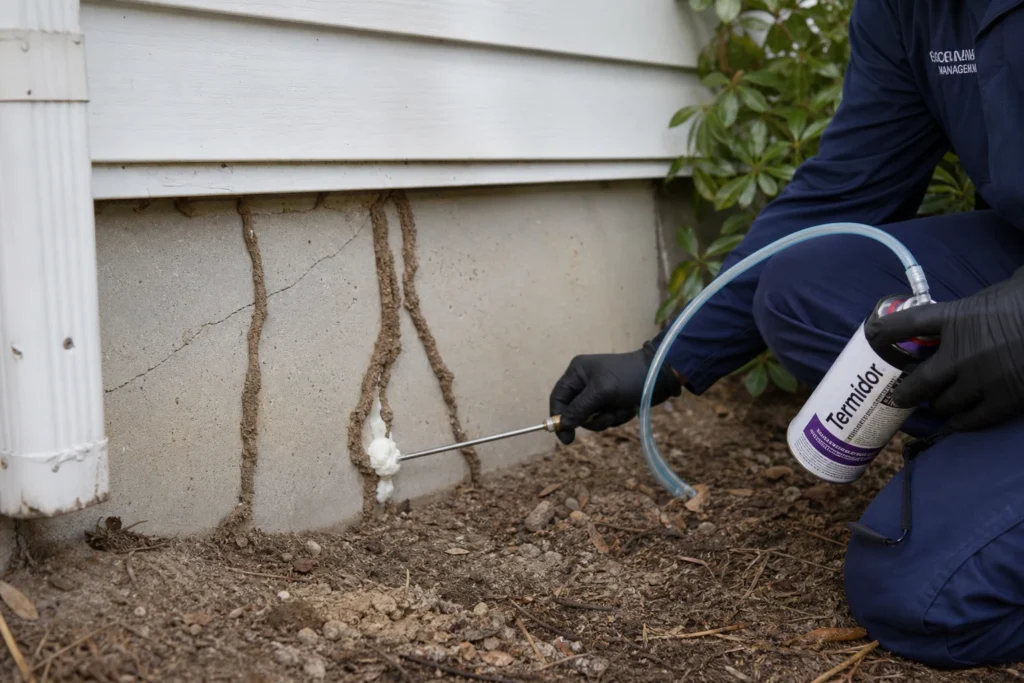
The useful question is what infestation the proposed treatment can reach and how success will be checked. A treatment that kills exposed insects may not protect the structure. Ask the inspector to explain species, evidence, inaccessible areas and why a localized or broader method is appropriate.

Termite inspection: species, extent and access
Identify the conditions that shape the plan
Species
Different termite types can require different inspection and treatment approaches.
Extent and access
Hidden or widespread activity can exceed a localized treatment’s scope.
Moisture and wood contact
Accessible leaks and wood debris beside a building deserve correction.
Structural condition
An inspection may need a separate building assessment for suspected damage.
Termite treatment without tenting: match the method to the evidence
Match each method to the inspection findings
Qualified inspection
Identify species, activity, damage concerns and inaccessible areas.
Site-specific treatment scope
Compare appropriate soil, bait or wood-treatment methods for the findings.
Prevention maintenance
Correct accessible leaks and problematic wood storage alongside control.
Follow-up and written terms
Check monitoring, retreatment conditions and exclusions rather than assume permanent protection.
Step-by-step assessment and maintenance
Document visible evidence without disturbing it
Have a qualified inspector assess a visible shelter tube or suspicious material. Do not break tubes or probe important structural members as a substitute for inspection. Record the location and ask what the evidence establishes.

Repair an accessible exterior water leak
Check the hose connection from stable ground and use a suitable ordinary repair. Arrange help for hidden leakage or damage. Preserve required drainage and ventilation around the building.

Move manageable firewood storage
Avoid storing wood or debris directly against the house. Move only safe loads, wear appropriate gloves and leave suspected hazardous animals undisturbed. This prevention step does not treat an established colony.

Review a written treatment proposal
Ask which species and areas the method targets, what remains inaccessible, which products are proposed and how follow-up works. Review label precautions, reentry instructions, warranties and exclusions before hiring.

Sequence and follow-up
Check progress against the agreed scope
Inspect
Confirm the species and scope of evidence.
Compare options
Understand which areas each proposed method can address.
Treat and maintain
Follow the qualified plan and repair identified contributing conditions.
Follow up
Check activity and written retreatment terms; no universal clearance date applies.
Myths and facts
Avoid universal dose and elimination promises
Myth: subterranean termites never need broader assessment
Fact: inspect the specific building and activity.
Myth: a product that kills termites protects every structure
Fact: structural-protection claims and directions must fit the intended treatment.
Myth: fixing a leak removes the colony
Fact: prevention maintenance accompanies infestation control.
Myth: laboratory nematode success proves home elimination
Fact: do not transfer laboratory results into a field guarantee.
Questions before treatment
Request identification, inspection findings and a written description of the proposed work. Ask what preparation is required, which occupants or pets need arrangements, and how continuing activity will be assessed. Compare qualified providers using the scope and follow-up terms rather than an unsupported success percentage or a nationally fixed price.
Compare treatment proposals by scope
Baits, localized treatments, and structural fumigation address different evidence and building conditions. A proposal should identify the termite, affected areas, treatment limits, inspection plan, and warranty terms.
Ask how inaccessible areas and neighboring activity will be evaluated. Structural damage, widespread drywood activity, or uncertain identification requires a licensed inspection rather than a do-it-yourself product sequence.
First identify the termite and the extent of damage
“No-tent termite treatment” is not one method. Subterranean termites live in soil and commonly build mud tubes; drywood termites live inside sound wood and may leave hard, pellet-like frass; dampwood termites are associated with persistently wet wood. The correct treatment depends on the species, construction and how far the colony extends.
Winged swarmers alone do not locate every colony. A licensed termite inspection should map evidence, moisture conditions and inaccessible areas before a treatment is sold. Structural damage should be assessed separately by an appropriately qualified building professional.
No-tent termite treatments compared
| Option | Typical fit | Strength | Main limit |
|---|---|---|---|
| Liquid soil termiticide | Subterranean termites | Creates a treated zone around or beneath the structure | Application access and label requirements are critical |
| Bait stations | Subterranean colony management | Low-volume, monitored approach | Needs ongoing inspection and may act gradually |
| Wood or borate treatment | Accessible, suitable wood | Protects or treats the contacted material | Paint, finishes and inaccessible wood can limit penetration |
| Localized foam or injection | Confirmed, limited drywood galleries | Treats a defined area without whole-building fumigation | Hidden colonies can be missed |
| Structural heat | Some drywood infestations | No fumigant residue | Cold spots, heat-sensitive contents and monitoring matter |
| Whole-structure fumigation | Widespread or inaccessible drywood termites | Reaches broadly through the structure | Requires vacancy and does not prevent reinfestation |
When termite treatment without tenting makes sense
Localized drywood treatment can make sense when all colonies are confidently located and reachable. Heat can suit some buildings when the contractor can verify lethal temperatures throughout treated wood. Subterranean termites are normally addressed with a soil-applied system, baiting, or a combination—not tent fumigation—along with correction of leaks and wood-to-soil contact.
A no-tent claim is less convincing when inspection access is poor, evidence appears in several distant rooms, or the proposal does not explain how hidden colonies will be found. In those cases, ask why a whole-structure method was rejected and what happens if activity returns.
Orange oil and other tentless termite treatments
Orange-oil products are marketed as a tentless termite treatment, but they are localized wood treatments rather than a substitute for whole-structure coverage. They can be appropriate only when a drywood termite colony and its galleries are accurately located and the product is labeled for that use. Hidden colonies outside the treated wood can survive.
Ask the contractor to show exactly where the product will be injected, what inspection supports those locations, and how retreatment is handled. “No tent” describes how the treatment is delivered; it does not prove that the infestation is limited.
How to compare termite quotes
- Ask for the termite species and evidence in writing.
- Request a diagram showing active areas, inaccessible areas and proposed treatment points.
- Confirm the product name, EPA registration, application method and licensed applicator.
- Separate treatment, monitoring, repairs and moisture correction in the price.
- Read the warranty for exclusions, renewal fees, reinspections and retreatment versus damage repair.
The lowest price is not necessarily the lowest total cost if it covers only one visible gallery or excludes follow-up monitoring.
Safety and realistic expectations
Do not drill structural members, inject unknown chemicals or apply agricultural products indoors. Termiticides are regulated pesticides and must be used exactly according to their labels. Most structural termite work is best handled by trained, licensed professionals. Treatment stops active infestation; it does not restore weakened wood or guarantee that future termites cannot enter.
Can you stay home during tentless termite treatment?
Do not assume so from the phrase no tent. Ask for written preparation and re-entry instructions for the actual product and method, including arrangements for pets. A localized application may restrict a work area; a professional heat treatment can require vacancy and protection of heat-sensitive belongings. No chemical residue does not mean no disruption.
UC IPM distinguishes whole-structure heat from localized treatment. Ask whether the contractor is treating the entire structure, a room or individual wood members, and how inaccessible wood and heat sinks are handled. Those are different service scopes even when none uses a fumigation tent.
Do new termite pellets prove a spot treatment failed?
Not by themselves. Old drywood termite pellets can fall after vibration or building movement. Preserve a photograph, date and exact location, then ask the inspector how to distinguish displaced material from continuing termite activity. Pellets alone cannot show how many colonies remain or how far they extend. Keep follow-up inspection separate from assumptions based on one pile of debris.
Frequently asked questions
Can termites be eliminated without tenting?
Often, yes, but only when the species, infestation extent and building support an appropriate alternative. “No tent” is a delivery choice, not evidence that every hidden colony will be reached.
Are bait stations better than liquid treatment?
Neither is universally better. Soil, foundation design, infestation pressure, access, monitoring and the chosen product affect the decision. Ask why the proposed system fits your building.
Does spot treatment work for drywood termites?
It can control a well-defined accessible colony. Its weakness is detection: an untreated hidden colony can survive elsewhere in the structure.
How long does no-tent termite treatment last?
It varies by method, product, exposure, site conditions and monitoring. Use the product label and written warranty—not a generic online number—to judge the service interval.
The termite type and infestation map determine whether no-tent treatment fits
“No tenting” describes how a treatment is delivered, not whether it can eliminate every colony. Subterranean termites usually enter from soil and may require a continuous soil treatment, monitored bait program or a combination. Drywood termites live within wood; a small, accessible infestation may suit localized treatment, while widespread or hidden colonies can make whole-structure fumigation the more dependable option. Dampwood termites point first to persistently wet or decayed wood.
Ask the inspector to mark active evidence, conducive moisture, damaged members, inaccessible voids and every area that was not inspected. A quote that names a product but does not define the infestation’s extent is difficult to compare and easy to misunderstand.
| Approach | Where it can fit | Main limitation to clarify |
|---|---|---|
| Monitored bait system | Subterranean termites and ongoing colony suppression | Requires inspection, replenishment and time; stations do not repair damage |
| Liquid soil treatment | Creating a labeled treatment zone for subterranean termites | Slabs, wells, drains and construction details affect application |
| Localized foam, dust or injection | Accessible, well-mapped galleries or voids | Untreated hidden colonies may remain |
| Borate wood treatment | Accessible unfinished wood in appropriate construction stages or repairs | Paint, finishes and inaccessible framing can limit penetration |
| Whole-structure fumigation | Widespread drywood termite activity | Requires vacancy and preparation; it does not leave residual protection |
Compare termite proposals on scope, not the phrase “no tent”
Request the inspection diagram, termite identification, treatment locations, product labels, drilling or access plan, exclusions, repair responsibility and follow-up schedule. Ask what happens if activity appears outside the mapped area and whether retreatment, annual inspection or a transferable warranty is included. Confirm licensing and read the contract before relying on a verbal guarantee.
No-tent does not mean nonchemical, low-toxicity or disruption-free. Conversely, fumigation is not automatically necessary for every drywood finding. The defensible choice is the least disruptive method that can reach the documented infestation with a realistic monitoring and retreatment plan.
What a post-treatment record should contain
Keep the inspection diagram, photographs, product names and EPA registration numbers, application dates, invoice, warranty terms and moisture or repair recommendations. Record any new swarmers, mud tubes, pellets or damaged wood with dates and locations. Do not break a suspicious tube merely to “test” it unless the inspector asks; undisturbed evidence can help establish whether activity is current.
Avoid false certainty from spot treatments and home remedies
Orange oil, heat, foam, dust or wood injections may kill termites they actually reach, but a visible exit hole is not a complete colony map. Vinegar, essential oils, cardboard traps and over-the-counter surface sprays do not substitute for species identification and structural inspection. Drilling or injecting blindly can damage wiring, plumbing, finishes and structural members while leaving hidden activity untreated.
Have damaged framing evaluated before cosmetic repairs conceal it. Correct plumbing, drainage and wood-to-soil contact issues where present, but remember that moisture correction alone does not prove an established colony is gone.
Publishing and affiliate notes
Some product links may be affiliate links. If you buy through them, we may earn a commission at no extra cost to you. Product picks are not lab tests. Read the legal disclaimer.