
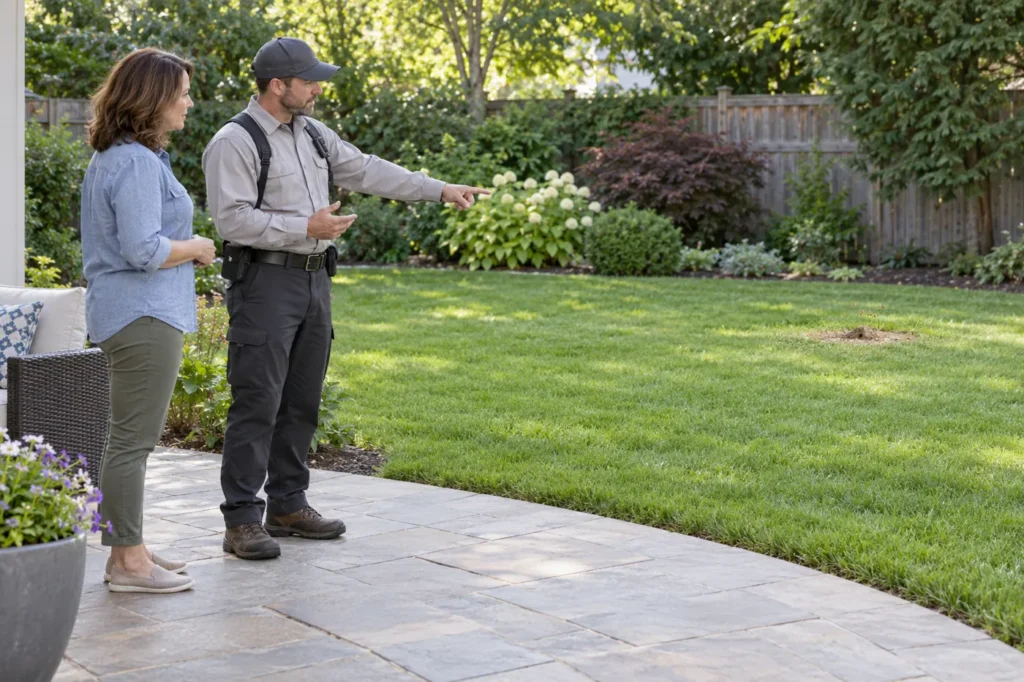
A ground opening and flying insects are not enough to identify yellowjackets. Some solitary bees and wasps also use soil. Observe from a safe distance, avoid vibration and disturbance, and choose the response according to the insect and the location rather than a universal elimination recipe.
Identify a yellow jacket nest in the ground
Identify the insect and the exposure
Ground opening
Different insects can use soil; confirm identification.
Flight route
Repeated traffic can guide a qualified assessment.
People and equipment
Paths, play areas and mowing can create a nest conflict.
Hidden extent
The entrance does not reveal the whole nest or safe treatment access.
Ways to get rid of yellow jackets: response priorities
Rank responses by safety and purpose
Avoid disturbance
Keep people and equipment clear.
Qualified identification
Distinguish social wasps from solitary insects.
Site-specific professional control
Use help for a nest conflicting with daily activity.
Later repair
Repair appropriate defects only after inactivity is established.
Yellow jacket control: avoid, identify and arrange help
Observe from outside the affected area
Use a safe distant location to note the flight route. Do not move closer for a close-up or test the hole by tapping it. Stop if observation would expose you to stings.

Warn others from a safe route
Use a notice at a safe path or tell other occupants to avoid the area. Any marker belongs outside the suspected activity zone, not beside the entrance. Arrange a different route for children, pets and maintenance staff.

Secure outdoor waste
Away from the nest, close food-waste containers and remove accessible spills. This reduces foraging attractions but does not establish that the ground colony has been treated.

Discuss the site with a qualified provider
Explain the location, observations, occupant concerns and access limitations from a safe place. Ask about identification, preparation, reentry precautions and follow-up. Do not substitute a fixed 10 PM approach or 48-hour silence rule for their assessment.

Reassess yellow jacket activity before ground repair
Keep the entrance intact until assessed
Avoid
Keep clear and stop disturbance.
Identify
Arrange qualified assessment.
Respond
Follow the appropriate site-specific plan.
Recheck
Confirm the outcome before any repair; no universal clearance time.
Ground yellowjacket nest myths and facts
Replace hazardous ground-nest recipes
Myth: boiling water is a safe universal treatment
Fact: burns and nest disturbance can cause serious harm.
Myth: a red light makes an approach safe
Fact: timing and light do not eliminate exposure.
Myth: every lawn hole needs treatment
Fact: solitary insects can need a different response.
Myth: capping the hole confirms success
Fact: leave active entrances undisturbed and obtain assessment.
Treat the flight path as a hazard zone
A steady stream of yellowjackets entering the ground identifies a route that should remain undisturbed. Mowing, digging, pouring liquids, or covering the opening can trigger defensive activity without resolving the colony.
Mark a generous avoidance route and keep children and pets away. A nest near essential access, known sting allergy, or uncertainty about the insect requires a qualified provider.
Nest attached to a wall? Tubular mud cells on siding, brick or garage surfaces are not a ground yellowjacket nest. Use the mud dauber identification and removal guide.
Yellow jackets, bees and other ground-nesting insects
Yellow jackets are social wasps, not bees. Many have compact black and yellow bodies with relatively little hair, but coloring alone does not identify them. The eastern yellowjacket, Vespula maculifrons, is one ground-nesting species in much of the eastern United States; other species and nest locations occur elsewhere.
Repeated workers using one entrance can suggest a social colony. Several small holes in exposed soil may instead belong to solitary bees or wasps. Do not probe the opening, disturb the ground or move closer to settle the identification. A pest control professional or extension office can help from a safe observation or photograph.
Paper wasps often have a more slender outline and exposed comb nests. Yellowjackets can also use building cavities or enclosed aerial nests, so the treatment for a hanging wasp nest is not automatically appropriate for an underground nest. Penn State describes eastern yellowjacket biology.
Locate the nest without following wasps into a hazard
Observe only from outside the affected area. Note the general flight direction and the part of the property receiving repeated traffic. Do not follow the yellow jackets through shrubs or stand over the entrance hole. A safe report of the approximate location is useful even if you cannot get a close photograph.
Tell a provider whether the opening is near a walkway, play area, gate, foundation or mower route. Those details affect access and the urgency of control. A nest tucked into an unused corner presents a different decision from one beside the only door.
If you can’t find the nest, start by reducing food attractions and explaining the activity pattern to a professional. Randomly spraying holes is not a search method. Foragers visiting a picnic can come from a colony beyond your property.
When leaving a ground nest alone is reasonable
Yellowjackets hunt other insects and play a role outdoors. A confirmed nest away from ordinary activity may be tolerated if people and animals can reliably avoid it. That choice should account for children, pets, lawn care and anyone with a known sting allergy.
In regions with cold winters, colonies usually decline with sustained cold weather, while new queens survive to establish colonies in another season. Do not assume a single frost or a November date makes every nest safe. Climate and species differ, and unusually persistent colonies can occur.
Do not inspect or fill the cavity just because the forecast turns cold. Confirm inactivity with appropriate local guidance before returning the area to use. Where a nest creates an immediate conflict, waiting for winter may not be an acceptable plan. Maryland Extension explains seasonal social-wasp biology.
How exterminators get rid of yellow jackets in ground nests
A competent pest control provider first identifies the insect and evaluates the nest location, public access and nearby structures. Treatment selection depends on the actual site, not simply the color of the wasp. A ground opening can connect to a concealed cavity that is not visible from the surface.
A labelled insecticide can have a role in yellow jacket nest treatment. Some aerosol spray products are intended for specific exposed nests; dust or other formulations have different permitted uses. The package must authorize the pest, site and method. Do not transfer a recipe for an aerial nest to soil or assume a product sold as wasp spray treats every underground situation.
Ask the provider to wear protective clothing suited to the work and explain how people and pets must stay clear. Ordinary long sleeves are not a guarantee against stings. Lower activity in late evening does not make a nighttime approach inherently safe.
- What insect and nest type were identified?
- Does the treatment cover the whole assessed site, or only visible workers?
- What product will be used, and what does its label permit?
- What are the preparation and re-entry instructions?
- What activity should be reported afterward, and is follow-up included?
Request site-specific advice before restoring mowing or access. The Penn State stinging-insect guidance discusses nest assessment, and EPA guidance supports label-aware pest-control choices.
Can yellow jacket traps remove the ground colony?
Yellow jacket traps can collect some foraging workers, with results varying by species, lure and timing. They are not proof that a ground nest is eliminated. A low trap count can also mean a poor lure match or changing foraging behavior.
Follow trap instructions and place them away from gathering areas rather than beside a picnic table or active entrance. Keep children and pets from handling them. Do not approach a nest to position a trap or use food bait mixed with pet medication or another off-label pesticide.
Clean up food residue, keep outdoor waste covered and put pet food away. These steps reduce the food source drawing workers to people, but they do not treat the colony. Our wasp prevention guide separates foraging attractions from nest decisions.
Why soap, boiling water and other home remedies are poor nest treatments
A spray bottle of soap and water may affect an exposed individual, but that does not establish control of workers, brood and queen inside an underground nest. Trying to saturate the nest with soapy water requires disturbing the very location the colony defends.
Do not pour boiling water into the nest opening. Carrying hot liquid over uneven ground creates a burn and spill hazard. Gasoline, kerosene, fire and improvised chemical mixtures add unacceptable fire, contamination and exposure risks. Dry ice is also not a practical household substitute for a site-specific treatment plan.
Do not block an active entrance with soil, a rock, foam or a container. A blocked opening does not demonstrate that the colony is dead, and concealed nests near buildings need particular care. The appropriate next step is assessment, not a stronger homemade mixture.
After treatment: observe before restoring access
Ask the provider what follow-up activity is expected and how to report it from a safe location. Note continued workers entering and leaving, new flight routes or insects appearing indoors. Do not walk close to the hole to test whether they respond.
Some workers may have been away from the nest during treatment. An initial reduction is encouraging, but it does not give a universal all-clear time. Follow the product’s access precautions and the provider’s clearance plan. Keep mowing, digging and foot traffic restricted until the outcome is established.
Repair an appropriate ground defect only after the nest is confirmed inactive and the site is safe. That maintenance can remove a future shelter opportunity; it is not a promise that yellow jackets will never nest elsewhere.
Frequently asked questions about yellow jackets in the ground
How deep is a yellow jacket ground nest?
Depth varies with species, available cavity and soil conditions. The entrance does not reveal the whole layout, and a fixed two-to-four-foot depth is not a reliable treatment guide. Do not dig to measure it.
Can a nest have more than one entrance?
A concealed cavity may have other access routes. One visible opening is not a complete map. Report observed traffic to the provider without approaching the site or trying to block every hole.
Do yellow jackets reuse the same nest?
In many temperate regions, old colonies die and new queens establish new nests. A favorable cavity can still matter in future seasons. Do not treat seasonal nest turnover as permanent prevention or fill an active opening.
What if someone is stung near the nest?
Leave the nest area promptly and get to a safe place. Seek emergency medical care for severe symptoms, especially breathing difficulty or signs of a serious allergic reaction. Do not return to retrieve equipment while defensive activity continues. UC IPM provides social-wasp precautions.
Publishing and affiliate notes
Some product links may be affiliate links. If you buy through them, we may earn a commission at no extra cost to you. Product picks are not lab tests. Read the legal disclaimer.