
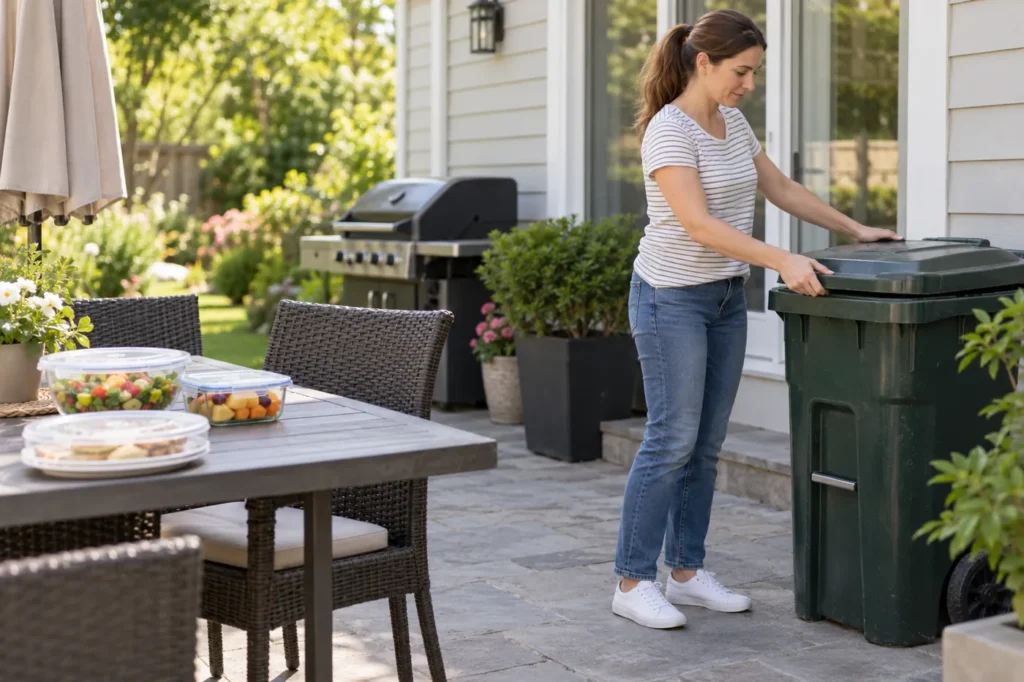
Foraging wasps and an active nest near a doorway are different problems. Food and waste hygiene can reduce a patio attraction; it does not remove a concealed colony. Many wasps also prey on garden pests, so assess the actual conflict instead of treating every visitor.
What attracts wasps around your home?
Separate foraging from nesting
Food and drinks
Accessible sweet liquids and food can attract foragers.
Waste
Residue and open lids create continuing resources.
Nest location
An entry near daily activity warrants assessment.
Insect identity
Social wasps, solitary wasps and bees need different responses.
Ways to keep wasps away, ranked by practical role
Match prevention to the actual conflict
Food containment
Cover food and drinks during outdoor use.
Waste hygiene
Maintain clean bins with fitting lids.
Screens and later repairs
Maintain barriers without blocking an active colony.
Qualified nest assessment
Use appropriate help when nesting poses a conflict.
Natural wasp control: food, waste and screens
Close and maintain the waste container
Work away from any active nest. Remove residue using ordinary suitable cleaning and keep the lid fitted. Avoid reaching into a bin with active insects until it can be managed safely.

Observe a roof edge from the ground
Use binoculars from outside the flight route. Record suspected activity without a ladder, close approach or probing the gap. Concealed nests and unsafe access are reasons to obtain qualified help.

Check an intact screen
Repair an ordinary damaged screen when no nest activity makes the work unsafe. Preserve ventilation and egress. Do not seal a wall entrance while an active colony is using it.

Cover sweet drinks and food
Use closed containers and remove leftovers promptly. Check before drinking from a container left outdoors. These steps reduce accessible resources but do not promise all wasps will leave.

Prevent wasps without disturbing an active nest
Maintain prevention and assess nest conflicts
Observe
Distinguish visitors from a suspected nest.
Contain
Protect food and waste away from activity.
Assess
Obtain identification and qualified nest advice.
Maintain
Repair suitable defects when safe and monitor recurrence.
Natural wasp repellent myths and facts
Avoid unsupported natural deterrent claims
Myth: oils create a proven permanent barrier
Fact: use resource management and appropriate repairs.
Myth: soap spray makes nest removal safe
Fact: close treatment can expose the person to stings.
Myth: every garden wasp is a colony problem
Fact: identify the insect and the actual conflict.
Myth: sealing an active gap solves the nest
Fact: avoid blocking an occupied concealed entry.
Foraging wasps and nest traffic are different problems
Wasps visiting drinks or ripe fruit can often be reduced through food and waste management. Repeated direct flight into a wall, soffit, or ground opening suggests a nest conflict that should not be sealed blindly.
Keep people away from the route and avoid striking or flooding the opening. Allergy risk, a nest beside an entrance, or an unidentified species calls for prompt professional assessment.
Seeing narrow mud tubes instead of a paper nest? That points to a solitary mud dauber. Follow the separate guide to identify and remove an inactive mud dauber nest safely.
Identify paper wasps, yellow jackets and solitary wasps
Wasps are not one pest with one treatment. Paper wasps, including species of Polistes, often make an open comb beneath a sheltered overhang. Yellow jackets, including Vespula species, can occupy ground cavities, building voids or enclosed nests. A mud dauber makes mud cells rather than the same paper colony.
Bees have different biology and management needs. Do not spray a cluster of honey bees because you assumed it was a wasp nest. Color alone is not enough for identification. A photograph taken without entering the flight path can help an extension office or qualified provider assess the insect.
A few wasps hunting among plants are also different from repeated workers using a single opening. Many wasps help control other insects. Avoiding an out-of-the-way nest can be a reasonable choice when people and pets can reliably stay clear. Maryland Extension’s predatory-wasp guide distinguishes social and solitary species.
Keep wasps away from outdoor food and drinks
Start with the resource the wasps are visiting. At a picnic, that may be an open drink or food scraps rather than a nest on your porch. Close drink containers between uses and check an unattended container before drinking. Use covered serving dishes instead of leaving the whole meal exposed.
Keep pet food indoors when practical and remove leftovers. Clean an accessible grill drip tray according to the equipment instructions after it has cooled. Wasps can forage for different foods, so don’t assume that removing sweets alone addresses meat scraps or another attraction.
- Keep a fitting lid on outdoor waste containers.
- Remove ordinary food spills promptly, away from active nest traffic.
- Collect fallen fruit when it is safe to do so.
- Store recyclables without accessible drink residue.
- Ask building management to address shared overflowing bins.
These habits reduce opportunities for foraging wasps. They do not guarantee a wasp-free yard, and you should not reach into a bin crowded with insects to prove the lid works. Let hazardous activity be assessed first.
Can peppermint oil or vinegar repel wasps?
Essential oils are often marketed as a natural wasp repellent. Research or product claims about a particular formulation do not establish that a homemade blend will keep every species away under outdoor conditions. Rain, surface type, concentration and the insect’s activity can change the result.
Do not treat a strong smell as proof of protection. Peppermint oil, clove oil and other concentrated oils can affect people, pets and finishes. Never spray them into light fittings, outlets or occupied nests. A plant-derived ingredient is still a chemical, and a commercial product’s directions matter.
White vinegar is not a dependable way to clear a wasp colony. A vinegar-containing trap mixture also does not guarantee that bees or other insects will be excluded. Avoid experimenting with spray bottle recipes near a nest while workers are defending it.
When choosing a product, check whether the exact formulation is intended for the insect, site and use. The EPA pesticide-label guidance is a better starting point than a recipe that promises permanent repellency. Food containment and a working screen remain useful even when a scent product disappoints.
Do fake nests, herbs or decoys deter wasps?
A fake nest or brown paper bag is not an established nest-control plan. Wasp species differ in nesting behavior; a decoy does not create a reliable protected radius around a patio. It cannot remove an existing wasp nest in a wall or tell you whether a cavity is occupied.
Mint, thyme and other garden plants are not dependable barriers against nesting. Flowers can also attract insects that feed on nectar. Grow herbs because you want the plants, not because their presence guarantees that wasps will avoid the seating area.
Changing a sheltered opening can be useful once it is confirmed safe and unoccupied. That is physical maintenance, not a scent trick. Keep drainage, ventilation and emergency exits functional when selecting a screen or repair. No universal mesh size fits every building detail.
Wasp traps: foragers are not the whole colony
A wasp trap collects insects that respond to its lure. That response varies by species and local conditions. A trap full of workers does not prove that the queen, brood and remaining workers have been controlled, while an empty trap does not rule out a nearby nest.
Choose a purpose-built trap with directions for the target insect. Keep it away from normal seating and walkways as the instructions require. Don’t place it beside an active entrance or climb a ladder to hang it near a roof nest. Keep children and pets from handling captured insects.
A homemade wasp trap is not automatically more selective or safer. Do not add pet medication, insecticide or another off-label poison to food bait. Keep your goal clear: reducing a local foraging nuisance is different from treating a colony.
UC IPM’s social-wasp guide explains species-dependent trapping and nest decisions. For a confirmed underground conflict, see our ground yellow-jacket guide rather than improvising a nest drench.
How to keep wasps from building nests around the house
Check accessible screens, doors and sheltered exterior details before local nesting activity begins where practical. Look from stable ground. An ordinary damaged screen is a maintenance task; repeated insects passing through a siding gap calls for a nest assessment before anyone closes it.
Do not seal an opening being used by an active concealed colony. Do not insert foam, poke a stick into the gap or remove trim to find the nest. Wasps appearing indoors near that area should be reported to a qualified provider with the room and entry location.
In temperate regions, many social-wasp colonies are seasonal, but that does not give every home a universal safe-removal date. Species and climate matter, and some paper-wasp nest reuse occurs. Verify inactivity before cleaning or repairing a former nesting site. Minnesota Extension describes different nest types and seasonal patterns.
When natural prevention isn’t enough
An active wasp nest beside the only doorway, a play area or a frequently used path is not just a housekeeping problem. Contact a qualified pest-management provider when avoidance is impractical, the nest is concealed or high, or someone is allergic to stings. Don’t use the small size of a nest as your only safety test.
A labelled insecticide can be appropriate for an assessed nest conflict. Ask what wasp species and nest type were found, what product is proposed, what the label permits and how people and pets must stay clear. Chemical treatment should have a defined target and follow-up plan, not become an automatic whole-yard spray.
Do not pour boiling water or fuel into a ground nest, cover the entrance with a heavy pot, or knock down an active nest with a broom or hose. A homemade dish soap mixture is not a guarantee of instant safe control. Lower evening activity doesn’t make an approach risk-free.
Frequently asked questions about repelling wasps naturally
Why do wasps keep returning to the same spot?
The spot may offer food, a sheltered nest site or a route to a concealed nest. Record what you see without approaching it: a wasp visiting a drink and repeated workers entering trim suggest different problems. Correct an accessible attraction, but obtain help before working on an occupied opening.
Can I remove a wasp nest without killing wasps?
Leaving a safely isolated nest undisturbed is one option. Moving an active social-wasp nest is not a routine DIY alternative and can expose you to defensive insects. Ask a qualified provider whether avoidance or another site-specific option fits the location.
Will a fan keep all wasps away from a table?
A fan can make outdoor seating more comfortable, but it is not a reliable barrier against wasps or a treatment for an established nest. Continue covering drinks and food. Don’t let a comfort measure replace assessment of repeated nest traffic nearby.
What should I do if a wasp is indoors?
Keep people and pets clear and avoid grabbing it. An isolated visitor is different from insects repeatedly emerging from a wall or ceiling. Report a recurring pattern and don’t spray unknown openings. Seek emergency medical care for severe symptoms following a sting.
Publishing and affiliate notes
Some product links may be affiliate links. If you buy through them, we may earn a commission at no extra cost to you. Product picks are not lab tests. Read the legal disclaimer.