
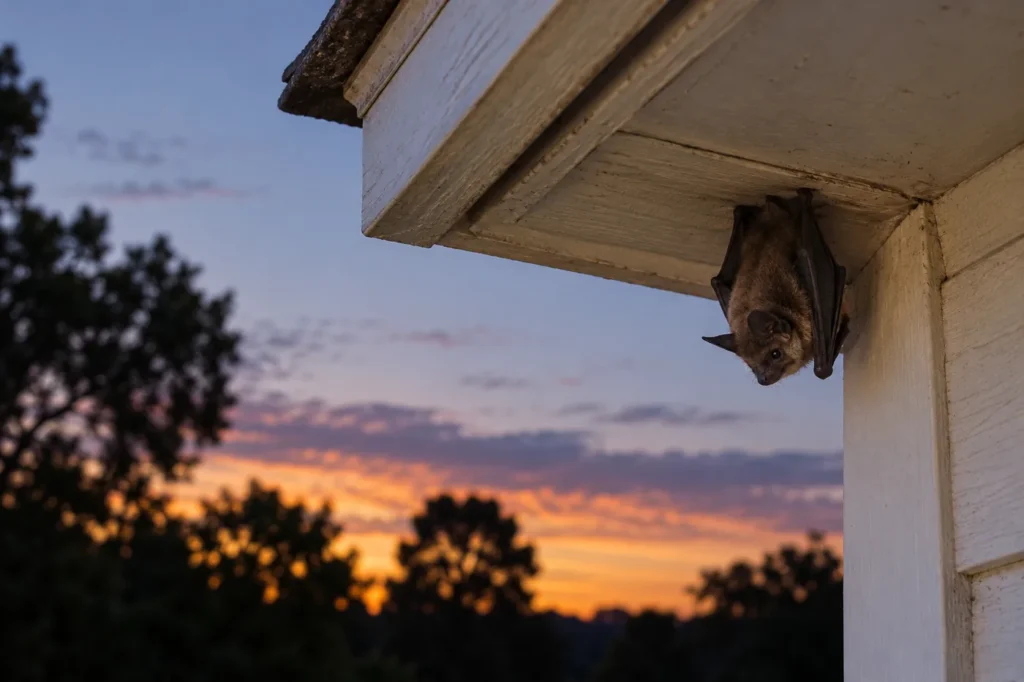
Bats eat night-flying insects and are valuable wildlife, but a porch roost can become a safety concern when people can reach the animal or when droppings accumulate. The right response depends on what you actually have: a single bat resting on an exterior surface, a bat loose inside a living space, or a colony using a building void. Humane control starts by identifying that situation before trying to make the bat move.
Possible bat contact needs prompt advice
Never touch a bat with bare hands. Bat teeth can leave marks that are difficult to see. Wash a known bite or scratch thoroughly with soap and water, then contact a healthcare professional and local or state public-health authority promptly. Seek the same advice if a bat was found in a room with a sleeping person, unattended child, or someone unable to reliably describe contact. Keep the bat contained if that can be done without handling it, and do not release it until public health or animal control advises you whether testing is needed. Call a veterinarian promptly after possible pet contact.
First identify the bat situation
Four situations require different responses
Exterior rest stop
One bat hangs on a porch wall, beam, shutter, or eave without entering a gap. It may simply be resting during migration or between feeding periods.
Building entry
Bats repeatedly emerge from fascia, soffit, siding, roof intersections, vents, or a chimney. That pattern suggests access to a protected void.
Indoor bat
A bat is flying or resting in a living space. Possible human or pet contact must be assessed before release.
Guano accumulation
Droppings below a roost or inside a void require exposure control; a large, dusty, or enclosed accumulation is not a routine sweeping job.
Watch from indoors or from well outside the bat’s flight path around sunset. Note where it emerges, whether more bats follow, and whether droppings collect beneath a specific gap. Do not climb a ladder in darkness, insert a hand into a crevice, or stand under the exit. A wildlife professional can inspect roof edges and concealed voids more safely.

Bat controls ranked
Repair access instead of chasing symptoms
- Professional inspection and timed structural exclusion — Strong. Finding active and secondary openings, protecting dependent young, using one-way devices correctly, and making durable repairs addresses a building colony.
- Removing porch attractions and contact opportunities — Useful. Reduce insect-attracting light where practical, close unscreened openings, and move seating away from droppings or low resting places.
- Temporary light or airflow changes — Conditional. A fan or lighting change may make an open resting spot less comfortable, but results vary and these measures do not solve entry into a wall or attic.
- Bat house placement — Conservation option, not an eviction device. A well-sited bat house may provide habitat, but installing one does not guarantee bats will leave a building.
- Poison, glue traps, fumigants, mothballs, ammonia, essential oils, or ultrasonic devices — Avoid. They can harm bats or occupants, may violate pesticide or wildlife law, and do not close the entry route.
Step 1: let an exterior resting bat leave safely
If one bat is hanging high on an open porch and no contact occurred, bring children and pets indoors, stop activity below it, and leave an unobstructed route outdoors. It may depart after dusk. Do not poke, spray, swat, net, or illuminate it at close range. If it remains in an unsafe, reachable position, appears injured, or cannot fly, call animal control, a wildlife rehabilitator, or the state wildlife agency.
Once the bat is gone, reduce repeated contact without claiming a guaranteed repellent. Repair a torn screen, close gaps into living space, move chairs from directly below the site, and consider a downward-shielded, warmer porch light that attracts fewer insects. A securely mounted fan may create airflow across an open perch when nobody can contact its blades or cord, but never aim equipment into a crevice containing bats.
Step 2: inspect repeated building entry
Repeated emergence from one point indicates more than a porch visitor. A qualified bat-exclusion professional should observe the structure at dusk, inspect in daylight, and map primary exits plus cracks that could become replacement entrances. Ask for photographs, the proposed materials, a plan for dependent young, and confirmation that work follows state and local wildlife rules.

Bats can use narrow construction gaps, so sealing only the obvious hole often fails. Potential routes include fascia joints, roof returns, warped siding, flashing, uncapped chimneys, and gaps around vents. Screens must preserve required ventilation and combustion safety. Never block an active opening until occupancy, season, and exit timing have been assessed.
Step 3: time exclusion around dependent young
Many bat species form maternity colonies. Young bats cannot fly for part of the season, and one-way exclusion during that period can separate mothers from pups and leave animals to die inside. The exact maternity window varies by species, climate, and jurisdiction. A local wildlife agency or experienced bat professional should determine appropriate timing; protected-species and permit rules may also apply.
Winter work can also be inappropriate where bats hibernate inside a structure and are not able to leave. An inspection should produce a timing decision, not a universal calendar promise. Temporary separation from the porch may be necessary until lawful humane work can proceed.
Step 4: use one-way exclusion, then seal
During a suitable season, the professional first seals secondary gaps while leaving confirmed primary exits available. A species- and opening-appropriate one-way device or netting arrangement then allows bats to depart but prevents re-entry. It must be installed without entangling animals, monitored through suitable weather and activity, and removed only after the professional confirms vacancy.

After confirmed departure, close the primary opening with durable, building-compatible materials. Caulk alone is often unsuitable for large or moving joints. Metal flashing, appropriate mesh, backer materials, vent covers, and sound trim repair may be needed. The finished work must not trap an animal, block drainage or airflow, or create a fire hazard.

If a bat gets inside the house
First decide whether contact may have occurred. If it may have, keep people and pets away, close the bat into the smallest safe room without touching it, and call public health or animal control before release. Their instructions take priority because capture and testing may be appropriate. Do not attempt bare-handed capture.
If everyone was awake, reliably observed the bat, and public-health guidance indicates there was no exposure, isolate the room from the rest of the home. Turn off ceiling fans, close interior doors, keep people and pets out, and open an exterior window or door if it is safe to do so. Dim the room and wait quietly for the bat to orient and leave. Local guidance differs, so contact animal control when uncertain or when the bat does not exit.

Clean droppings without creating dust
Bat droppings can support Histoplasma in areas where the fungus occurs, especially when material accumulates and becomes airborne during disturbance. Keep people and pets away. Do not dry sweep, brush, or use an ordinary household vacuum on accumulated guano. Small exterior deposits still require gloves, dust control, careful collection, and handwashing under current public-health guidance.
Large accumulations, enclosed spaces, contaminated insulation, or any job likely to generate airborne dust should be assessed by a trained remediation professional. CDC and NIOSH guidance addresses work practices and respiratory protection; a disposable dust mask is not a substitute for a site-specific professional plan.
Porch bat response checklist
- Separate: bring people and pets indoors and do not touch the bat.
- Assess contact: escalate any bite, scratch, direct contact, uncertain sleeping-room event, or pet encounter.
- Identify: distinguish a single exterior rest from repeated entry into a building gap.
- Observe: record dusk emergence from a safe location; do not probe crevices.
- Check timing: account for maternity, hibernation, species protection, and local rules.
- Exclude: seal secondary gaps, use a monitored one-way exit, and confirm vacancy.
- Finish: remove the device, repair the primary entry, and remediate contamination safely.
Myths and facts
Bat control without harmful shortcuts
- Myth: every bat on a porch means there is a colony in the attic.
- Fact: a lone exterior roost may be temporary; repeated emergence from a construction gap is stronger evidence of building use.
- Myth: seal the gap while the bats are out feeding.
- Fact: other adults or flightless young may remain inside. A timed, monitored one-way exclusion is safer.
- Myth: ultrasonic devices or essential oils permanently repel bats.
- Fact: they do not repair access and may expose occupants or displace bats unpredictably.
- Myth: a bat house will make a colony move immediately.
- Fact: a bat house can provide habitat but is not a guaranteed substitute roost or exclusion method.
Frequently asked questions
Will leaving the porch light on keep bats away?
Not reliably. Light can alter bat activity, but it can also attract insects, and bats may use darker sections of the same structure. Treat lighting as a site-specific supplement, not structural exclusion.
Can I remove a bat during maternity season?
Do not start one-way exclusion until a knowledgeable local professional or wildlife agency confirms the timing is appropriate. Flightless young could otherwise be trapped inside.
Are bats legally protected?
Rules vary by species and location, and some bats have special protection. Wildlife agencies can explain timing restrictions, permits, prohibited methods, and qualified operators.
What should I do if my cat catches a bat?
Keep your hands away from both animals, confine the pet safely, and call a veterinarian and public-health or animal-control authority promptly. Vaccination does not eliminate the need for professional advice.
Primary and authoritative sources
- CDC: Preventing rabies from bats — possible exposure and prevention.
- CDC: Preventing Rabies from Bats — household contact response.
- CDC/NIOSH: Histoplasmosis — exposure risks and work practices.
- U.S. Fish and Wildlife Service: Why bats matter — conservation and coexistence context.
- Bat Conservation International: Bats in Homes and Buildings — humane exclusion principles.
- National Park Service: Observing bats without disturbing them — safe wildlife response.
HowToRepel.com is an independent educational publisher, not a public-health, medical, veterinary, or wildlife-control agency. This guide was AI-assisted, human-edited, and source-checked. Follow current local public-health and wildlife guidance.
Publishing and affiliate notes
Some product links may be affiliate links. If you buy through them, we may earn a commission at no extra cost to you. Product picks are not lab tests. Read the legal disclaimer.