
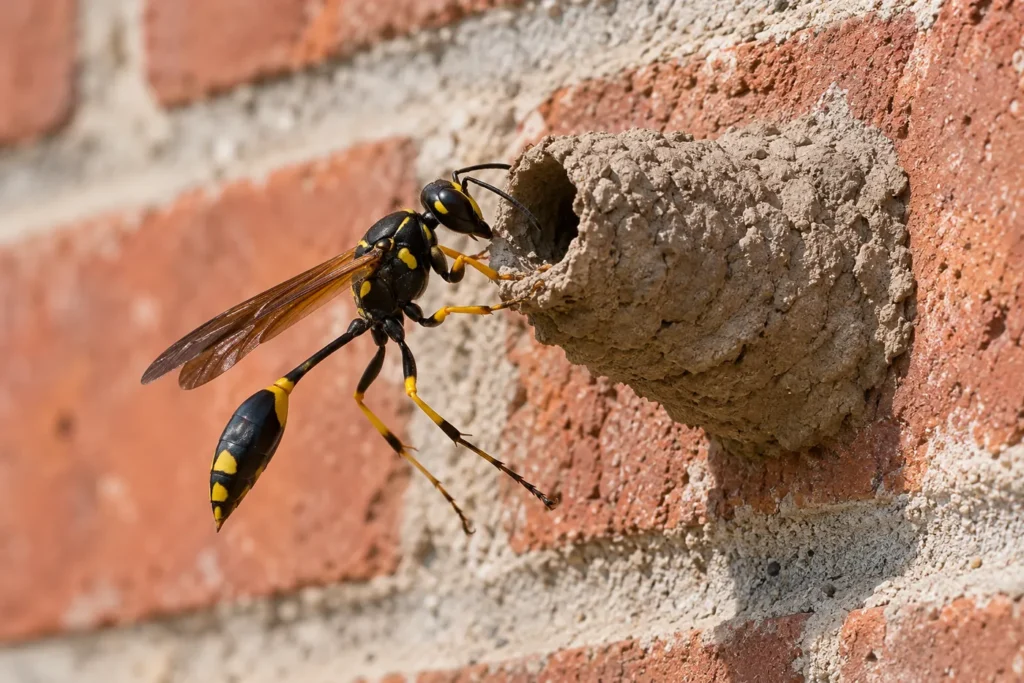
A dried mud structure differs from a social wasp’s paper nest, and identification matters. Old mud structures may also be reused by other insects. Removing a visible structure is not proof that all future activity is prevented, and reaching under a roofline creates risks beyond insects.
Mud dauber nests: identify the structure and access
Assess the structure and access
Mud structure
Confirm it is a mud-dauber structure, not a social nest.
Activity
Observe without probing; exit holes do not prove every cell empty.
Beneficial role
Solitary wasps can prey on other insects.
Site access
Rooflines or equipment may require qualified maintenance.
Mud dauber control: removal versus prevention
Choose proportionate management
Identification
Obtain help if the insect or structure is uncertain.
Leave suitable sites
Retain beneficial activity where there is no conflict.
Safe later maintenance
Discuss cleaning only after inactivity is established.
Qualified access
Use help for unsafe heights, equipment or recurring conflicts.
Observe mud daubers and maintain safe nesting barriers
Document the structure without touching it
Take an overview only where safe and remain outside activity. Do not scrape to test occupancy. A single exit hole cannot establish that every chamber is inactive.

Lift a confirmed inactive mud nest carefully
Work from stable ground after identity and inactivity are established. Use a compatible scraper at a shallow angle and test a hidden part of the surface. Stop if the coating chips or access is unsafe.

Clean mud residue with a compatible mild cleaner
Brush loose material away, then spot-test mild detergent and water with a soft brush. Protect electrical openings and unfinished joints. A remaining shadow is not a reason to gouge the finish.

Maintain screens and appropriate trim gaps
Repair ordinary defects when the area is inactive and safe to access. Keep ventilation and emergency exits usable. Screen maintenance is prevention, not proof that an occupied mud structure was treated.

Observe garden visitors respectfully
A solitary wasp visiting a flower does not create a need to remove all nearby insects. Avoid handling or close inspection. Qualified identification can clarify whether a nest conflict exists.
Ask about inaccessible roofline maintenance
Use a qualified provider for unsafe access or a structure near sensitive equipment. Explain activity and location. Do not apply pesticides or scrape material from equipment openings without appropriate assessment.
When to inspect and remove a mud dauber nest
Establish identification and inactivity first
Identify
Check the insect and structure.
Observe
Leave the site undisturbed and record activity safely.
Decide
Retain harmless sites or obtain qualified conflict advice.
Maintain
Clean or repair only where inactivity and safe access are established.
Mud dauber wasp myths and facts
Avoid absolute claims about solitary wasps
Myth: mud daubers never sting
Fact: avoid handling and disturbance.
Myth: one hole proves the whole nest is empty
Fact: occupancy can differ among cells.
Myth: removing mud prevents every future nest
Fact: monitor suitable sites and maintain appropriate barriers.
Myth: any porch structure is safe to scrape
Fact: identification, occupancy and access must be assessed.
Confirm inactivity before touching a nest
Mud tubes or cells can remain after the adult has left, and other wasps can use different nest structures. A photograph from a safe distance helps identification without testing the nest by touch.
Leave active or uncertain nests alone. Inaccessible roofline structures, allergy risk, repeated nesting in occupied areas, or uncertainty about the species warrants a qualified pest assessment.
Identify a mud dauber nest before removing it
Mud daubers are solitary wasps in several genera, including Sceliphron and Chalybion. They build narrow mud tubes or rounded mud cells under eaves, inside garages and sheds, and on sheltered brick or siding. Paper wasps build an exposed paper comb; hornets build a paper envelope. If the structure is papery or many wasps defend it, stop and identify it correctly.
A female provisions each cell with spiders, lays an egg and seals the chamber. Fresh damp mud, a smooth new cap, or a wasp making repeated trips suggests activity. Neat round holes often indicate emergence. Watch from a safe distance at different times before touching the nest.
Mud-dauber removal and prevention products compared
Affiliate disclosure: Product links may earn a commission at no extra cost to you. Simple hand tools usually beat routine pesticide use for an inactive nest.
| Tool | Best use | Check first | Limit |
|---|---|---|---|
| Plastic putty knife | Inactive nests on painted or delicate finishes | Surface hardness and a hidden spot test | May not lift old residue |
| Metal scraper | Durable masonry | Risk of scratches and chips | Aggressive on siding or paint |
| Soft brush and mild detergent | Final mud film | Finish compatibility | Porous brick may retain a shadow |
| Exterior caulk or screen | Suitable gaps and openings | Ventilation and drainage requirements | Does not remove an active nest |
| Labeled wasp product | Specific active-nest situations allowed by the label | Site, species, distance and exposure directions | Often unnecessary for solitary mud daubers |
How to remove an inactive mud dauber nest
1. Confirm the nest type and inactivity
Observe without tapping or spraying. If you cannot identify the wasp, the nest is high, or anyone nearby has a serious sting allergy, hire a pest professional.
2. Protect the surface and yourself
Wear eye protection and gloves. Put a drop cloth below the nest. Work from stable ground; rooflines and tall ladders are not worth the fall risk.
3. Lift the dry mud slowly
Slide a plastic scraper nearly flat against painted wood or siding. On sound brick, a firmer scraper may help, but test first. Never use fire, gasoline or a pressure washer on fragile finishes.
4. Clean the remaining stain
Brush loose dust away, then use mild detergent and water. Keep moisture out of electrical equipment and unfinished wall cavities. Allow the surface to dry before sealing nearby cracks.
5. Reduce repeat nesting
Repair screens, close appropriate trim gaps, fix small leaks and store equipment under covers. Mud daubers also hunt spiders, so regular web removal in garages can make the area less useful.
Frequently asked questions
Do mud daubers sting?
They can sting, but they are usually less defensive than social wasps. Don’t handle a live wasp or an active nest.
Should I remove every mud dauber nest?
No. An out-of-the-way nest can be left alone. Removal makes sense near doors, equipment, finished surfaces or areas where identification and access are safe.
Does peppermint oil keep mud daubers away?
There is not strong evidence that a household scent provides lasting control. Physical maintenance is more dependable.
Will mud daubers return to an old nest?
Some species may reuse or modify cells, and the same sheltered site can attract new builders. Remove inactive material and correct the site condition.
Common mud dauber wasps and the nests they build
“Mud wasp” and “dirt dauber” are common names, not a single species. Black-and-yellow mud daubers, including Sceliphron caementarium, have a slender waist and yellow markings. Blue mud daubers such as Chalybion californicum have a metallic blue-black appearance and can renovate existing mud cells.
Organ pipe mud daubers build rows of tube-like cells, while other mud nests look like rounded clumps. Shape helps, but it does not establish the identity of every insect using an old structure. UMD’s nest and species examples are a useful comparison before choosing control.
Why are there spiders inside the mud nest?
A female stocks a brood chamber with paralyzed spiders for the developing larva. Spider remains in removed mud are not evidence that the nest was a spider colony. Adults and larvae have different feeding roles; do not infer that a flower-visiting wasp is attacking the garden.
Mud daubers are solitary hunting wasps rather than a social colony defending one shared nest. That makes an identified mud structure different from a paper-wasp comb or enclosed hornet nest. It does not make handling a live wasp sensible.
Where to look for mud dauber nests without disturbing them
Inspect accessible sheltered surfaces under eaves, garage corners, shed walls and stored outdoor objects. Record the location and any repeated wasp trips from a safe position. Fresh construction and sealed cells deserve attention even when an older cell has an exit hole.
Check equipment visually before use after storage, but do not probe its openings. Mud chambers can occur in machinery housings. A technician should assess an obstructed vent, motor enclosure or sensitive device; scraping, water or aerosol inside it can create a separate maintenance hazard.
Correct a small leak that supplies an unnecessary puddle, and keep screens sound. You don’t need to drain natural habitat or remove every spider outdoors. The goal is a less accessible conflict site, not a wasp-free ecosystem.
Do mud dauber sprays, scents or fake nests work?
Mechanical cleanup is usually enough for an inactive nest, and an out-of-the-way structure can be left alone. A labeled wasp insecticide has a limited role where its directions cover the actual pest, location and method. It is not a substitute for identification or safe access.
- Essential oils and vinegar: don’t present a household scent as lasting nest prevention.
- Fake wasp nests: a territorial decoy claim about another wasp does not establish control of solitary mud daubers.
- Bright lights: don’t promise that lighting up every eave will stop daytime nest building.
- Routine spider spraying: identify a separate spider problem before treating beneficial outdoor predators.
If a chemical treatment is proposed, ask why physical maintenance is insufficient and whether the label permits use near that surface or equipment. Don’t inject spray into vents, use gasoline or combine cleaners. More product does not mean more prevention.
Mud dauber nest stains on stucco, brick and painted siding
Surface care begins after identification and inactivity are established. Painted wood and textured stucco are not interchangeable with durable masonry. Choose the gentlest compatible tool, test a hidden area and keep the scraper shallow instead of digging into the finish.
Lift loose material, then spot-test a mild cleaner and soft brush according to the surface manufacturer’s instructions. Porous masonry can retain a shadow; chasing the last mark with a sharp blade or high-pressure jet can do more damage than the nest.
Keep runoff out of electrical openings and unfinished joints. Let the area dry before an appropriate repair. If the coating crumbles, the stain persists or access requires climbing, arrange surface maintenance rather than escalating household chemicals.
What should pest control check for recurring mud nests?
Ask the provider to identify the insect, inspect activity, explain whether leaving the site is reasonable and assess roofline access. A useful plan separates nest removal, finish cleaning, equipment maintenance and repairs. These tasks may need different trades.
Keep a dated photograph of the cleaned area and note new mud construction. New material at the same shelter does not prove that cleaning failed: the location may remain available to a different female or species. Repair suitable access and reconsider the specific conflict, without expecting one scent application to prevent every future nest.
Publishing and affiliate notes
Production note: AI assisted with drafting and original instructional images. A human editor checked claims against the cited primary sources.
Some product links may be affiliate links. If you buy through them, we may earn a commission at no extra cost to you. Product picks are not lab tests. Read the legal disclaimer.