
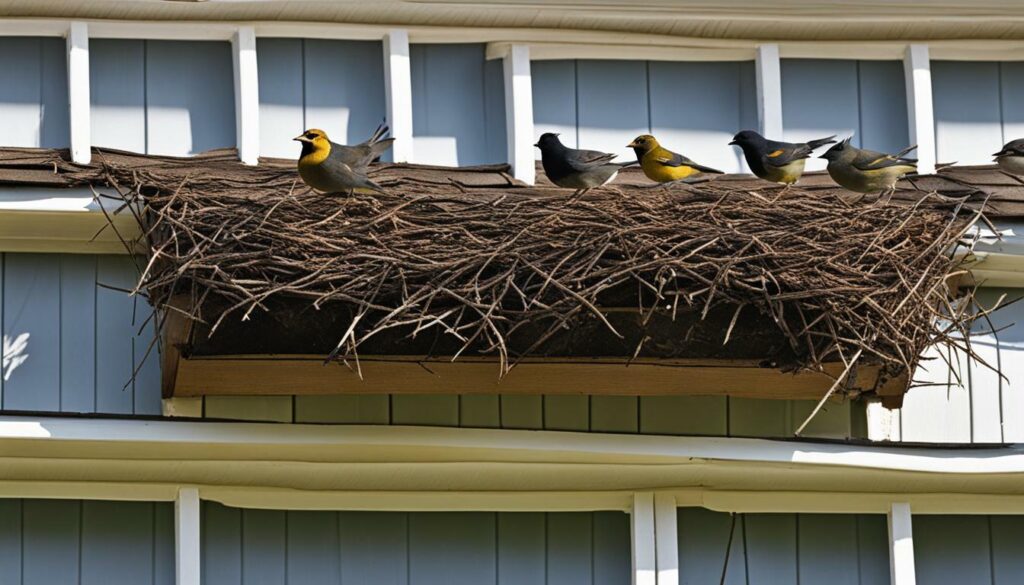
A bird visiting an eave, an active nest and an empty old structure require different responses. U.S. federal protections depend on species and circumstances, and state or local rules may also apply. This guide does not replace that identification or give a blanket permission to remove every empty-looking nest.

Identification and conditions
Separate the nesting concern from the building defect
Species
Identify the bird before applying protection rules.
Occupancy
Account for eggs, young and concealed activity.
Access detail
Assess how a barrier can preserve ventilation and drainage.
Cleanup
Accumulated droppings need appropriate exposure precautions.
Methods ranked by their role
Prioritize lawful, vacancy-dependent prevention
Safe observation
Record activity without approaching the nest.
Authority or qualified advice
Resolve identification and lawful timing.
Compatible exclusion
Close suitable access only after occupancy is resolved.
Maintenance
Inspect barrier condition and necessary airflow.
Inspection and prevention steps
Observe eaves from stable ground
Use binoculars from outside the flight route. Do not use silence alone to infer vacancy, climb toward a nest or collect eggs or nest material. Document the location for a qualified assessment.

Assess a suitable vent cover
The illustration shows an empty opening. Install appropriate exclusion only after occupancy and lawful timing are established. Preserve airflow, drainage and maintenance access; do not blanket-cover a functioning vent.

Have an empty soffit inspected safely
Use an appropriate building or wildlife provider for inaccessible or uncertain spaces. An empty inspection illustration does not establish that your soffit is vacant. Ask about concealed young and compatible repair details.

Check the relevant official guidance
Contact the wildlife authority for the actual location and species if uncertain. In the U.S., USFWS explains federal nest protection, but other restrictions can also apply. Obtain permission or qualified advice where required before work.

Sequence and reassessment
Resolve occupancy and rules before installing barriers
Identify
Confirm species and access.
Assess
Determine occupancy and applicable requirements.
Install when appropriate
Use compatible exclusion without trapping occupants.
Maintain
Inspect the repaired area and barrier condition.
Myths and facts
Avoid blanket nest-removal rules
Myth: silence proves an empty nest
Fact: concealed eggs or young require assessment.
Myth: every bird has identical legal status
Fact: species and jurisdiction matter.
Myth: an empty nest is always free to remove
Fact: check applicable protections and circumstances.
Myth: netting is safe regardless of fit
Fact: prevent entanglement and preserve building functions.
Time repairs around actual occupancy
A gap under an eave may be both a building defect and an active nest site. Removing material or installing mesh before confirming vacancy can trap adults or dependent young.
Observe from stable ground and check current species and nesting rules. Once lawful vacancy is established, repair the construction defect with a durable, wildlife-safe material.
Birds nesting under eaves: identify the nest and the building detail
“Under the eaves” can mean a nest attached to an exterior surface, nesting material on a ledge or birds entering a damaged soffit. Those situations require different repair planning. Describe the location from stable ground and note whether birds enter a cavity rather than simply perch on the roof edge.
A mud nest may suggest swallows; another structure or opening may involve a different species. Do not identify the bird solely by nest shape, and do not poke into a cavity to look for eggs. Species, occupancy and location determine the appropriate advice.
A quiet nest is not a vacant nest
Adults can be away foraging while eggs or dependent young remain. A short observation without movement therefore cannot establish clearance for repair. Record what you observed, including the limits of the view, and ask for qualified assessment where the cavity or nest contents are concealed.
U.S. Fish and Wildlife Service explains nest protections, including eggs, chicks and young still dependent on a nest. An apparently empty structure should not be treated as a universal exemption: other species protections and state or local requirements can apply.
Plan exclusion after occupancy and lawful timing are resolved
A damaged vent and a nesting bird are two issues to coordinate, not an invitation to cover the opening immediately. Ask the provider how vacancy will be established and how the chosen barrier fits the building. An inaccessible roof edge is not routine ladder work for the homeowner.
For a suitable vent cover, the repair must preserve necessary airflow, drainage and maintenance access. For a ledge or exterior nesting surface, a different compatible detail may be needed. A contractor should specify the installation rather than applying the same mesh to every part of the eave.
Netting needs a design and maintenance plan
Loose or poorly fitted netting can create an entanglement hazard. Ask how it will be secured, whether birds can become trapped behind it and who will inspect it after installation. Do not stretch a household net over an occupied nest or leave a gap that admits an animal but prevents its exit.
Physical exclusion has a different role from an owl decoy or reflective item. A deterrent may change activity temporarily, but it does not repair a soffit or prove that an active nest can be disturbed. UC IPM’s cliff-swallow guidance explains species-specific building conflicts; it is not permission to apply one method to every bird.
Roof work, droppings and household access
Tell the roofer or building provider about suspected nesting before the appointment. Supply a ground-level photo and explain which opening appears in use. Request a timing plan that accounts for wildlife advice instead of assuming maintenance work automatically overrides nest requirements.
For a nest beside a doorway, arrange a safe alternative route where possible while obtaining advice. Do not install a barrier next to occupied birds to force them to change their flight path. Children, pets and workers should not approach the nest for identification photographs.
Do not combine exclusion with uncontrolled dusty cleanup
Dropping accumulations can require their own exposure assessment. Avoid dry sweeping or using an ordinary household vacuum on substantial contamination. Describe its extent, location and access to a suitable cleanup provider; ask how dust and occupied spaces will be controlled.
A written quote should distinguish wildlife assessment, exclusion materials, building repairs and contamination cleanup. Without that distinction, two apparently similar prices may cover quite different work.
Questions about removing nests and preventing repeat nesting
Does the same rule apply outside the United States?
No. The U.S. federal guidance is not a worldwide removal permission. Contact the competent wildlife authority for the actual location and species. Use its current instructions rather than a generic internet claim that nests may be removed after a certain month.
Can I keep an old nest as a souvenir?
Do not assume that finding a nest allows possession. USFWS explains that keeping protected migratory bird nests generally requires a permit. Seek appropriate advice before collecting or transferring material; the nest being apparently unused does not settle that question.
Will the birds return next year?
A favored site may receive future interest, but an exact return date or guaranteed permanent absence is not established by one repair. Once lawful vacancy is resolved, inspect the compatible exclusion and surrounding defects periodically. Correct a detached barrier or new access opening instead of relying on a decoy’s continued presence.
What if the nest creates an urgent safety concern?
Contact the relevant authority and a qualified provider promptly. Describe the specific hazard and occupancy without attempting removal yourself. An urgent concern calls for a directed response, not a blanket exemption or an improvised nest-destruction method.
Publishing and affiliate notes
Some product links may be affiliate links. If you buy through them, we may earn a commission at no extra cost to you. Product picks are not lab tests. Read the legal disclaimer.