
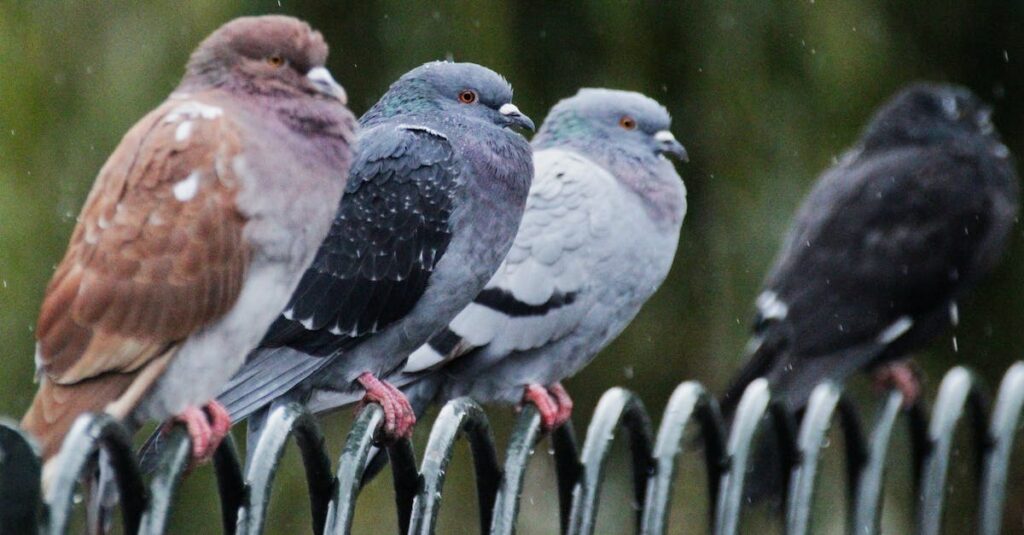
Food, accessible ledges and openings can sustain a recurring building conflict. A wildlife provider can distinguish species, occupancy and feasible barrier designs. A generic statement that all pigeons are federally protected, or that none have legal protections anywhere, is inappropriate.

Why pigeons return to feeders and roosts
Inspect resources, shelter and contamination
Food residue
Spilled seed and waste can attract feeding.
Building opening
Assess occupancy before fitting a barrier.
Ledge access
Use a suitable non-entangling design.
Droppings
Contamination needs exposure-specific cleanup precautions.
Ways to keep pigeons away while considering other birds
Prioritize resource management and appropriate exclusion
Identification and occupancy
Determine species and whether nesting is involved.
Food and waste hygiene
Remove ordinary accessible food while birds are absent.
Qualified fitted exclusion
Protect unoccupied openings without entanglement.
Appropriate cleanup
Use suitable precautions for contaminated sites.
Pigeon prevention: food, occupancy and building checks
Remove ordinary spilled seed
The illustration depicts food seed on an otherwise unoccupied balcony. Do not treat it as a method for sweeping droppings. Significant accumulated bird waste needs a separate exposure assessment and suitable cleanup approach.

Fit a screen only to a confirmed unoccupied opening
Use an appropriate provider where access or fit is uncertain. Keep intended airflow and drainage functional. Check for other birds or young before sealing and maintain the barrier afterward.

Keep outdoor waste contained
When birds are away, maintain a fitting lid and remove food residue appropriately. Do not feed pigeons or attempt to push them away while closing a bin. Hygiene reduces resources but does not guarantee every bird leaves.

Observe a ledge from the ground
Use safe observations to describe repeated activity and nesting concerns. Ask local wildlife guidance about species and permissible methods. Do not approach, collect a nest or install a barrier based on silence alone.

Check pigeon activity after exclusion and feeding changes
Inspect occupancy and contamination before work
Identify
Confirm species, access and the actual conflict.
Assess
Check nesting and cleanup requirements.
Prevent
Reduce food and fit appropriate exclusion when permitted.
Maintain
Recheck barriers and recurring resources.
Pigeon deterrent myths and facts
Avoid blanket legal and cleanup advice
Myth: all pigeons have identical federal status
Fact: identify the species and check local requirements.
Myth: seed sweeping also fits bird droppings
Fact: contamination requires separate precautions.
Myth: any netting is harmless
Fact: fit and maintain barriers to avoid entanglement.
Myth: waste hygiene guarantees permanent departure
Fact: access and nesting can also matter.
Resolve food and occupancy before installing exclusion
Spilled feed and open waste can keep pigeons returning after ledges are treated. Exclusion installed around an active nest or fitted loosely can harm birds and create an entanglement hazard.
Document roosting, nesting, and contamination from the ground. Large accumulations, inaccessible ledges, or uncertain legal status should be handled with appropriate wildlife and contamination-control advice.
Start with the pigeon problem you actually have
Pigeons feeding beneath a bird feeder and pigeons nesting on a balcony need different responses. Record where they land, whether they are eating, and whether they repeatedly use a sheltered ledge or opening. A flock crossing your yard doesn’t establish a building infestation.
The familiar feral rock pigeon is Columba livia, but not every pigeon or dove has the same status. Photograph the birds without disturbing a nest and obtain identification when uncertain. Size, plumage and behavior help distinguish them from other local birds.
Define your aim before buying a deterrent: protect a feeder, keep one ledge clear, prevent entry into an unoccupied opening, or manage a contaminated roost. Trying to remove every bird from the garden conflicts with the promise of preserving access for other birds.
How to stop pigeons eating bird food
Pigeons can take food from an open bird table or the ground below a hanging feeder. A small feeding port doesn’t solve the problem if loose seed continues to collect underneath. Check both the feeder and the landing area after normal use.
A purpose-built caged feeder can restrict access by larger birds while smaller species enter. Weight-sensitive or short-perch designs can also limit some larger visitors, depending on the model. Select for the birds you want to feed and follow the manufacturer’s setup instructions; no design admits every small bird while excluding every pigeon.
- Use manageable quantities rather than keeping an exposed tray overflowing.
- Reduce spillage with a suitable feeder and its compatible fittings.
- Clean ordinary scattered seed from safe, uncontaminated areas.
- Keep feeders clean and remove wet or spoiled food.
- Check whether pigeons have shifted to another nearby food source.
Don’t build a feeder cage from loose fishing line or sharp improvised wire. Birds can become trapped in unsafe openings. A feeder designed for small birds is more selective than frightening everything in the garden.
Feeding guidance also changes with local disease concerns and season. The RSPB’s current bird-feeding guidance discusses hygiene and feeding choices in the UK; readers elsewhere should check their local bird-conservation advice. Don’t assume a long-standing feeding routine is appropriate year-round.
Can you pigeon-proof a bird table?
An open platform provides landing space for pigeons as well as other birds. Switching to a purpose-built feeder may be simpler than modifying the table. If a compatible guard is available, confirm its intended species and inspect it for damage during routine cleaning.
Size restriction has a trade-off: larger garden birds you enjoy may also be excluded. Decide which species the feeding station is intended to serve. Calling a guard pigeon-proof shouldn’t imply that it allows every other bird through.
Food choice alone is unreliable. Pigeons can use several foods and collect leftovers from mixed feeding stations. Don’t depend on one supposedly disliked seed, chili powder or a repellent coating to make an exposed table selective.
Bird spikes, netting and ledge exclusion compared
Bird spikes discourage landing on a treated ledge
A correctly selected and installed anti-roosting system can make a particular surface less available to pigeons. It does not remove a flock from the neighborhood, and an untreated gap or adjacent ledge can remain attractive.
Don’t improvise spikes with sharp nails or assume every product is harmless in every placement. Existing nests, trapped debris, maintenance access and the birds using the site all affect the choice. Have high ledges and rooflines assessed by a qualified installer.
Bird netting blocks access to a defined space
Netting is an exclusion barrier, not a species-recognition system. It can keep other birds out of the same space and can entangle wildlife when loose, torn or badly installed. Mesh and fitting must suit the target animals, location and maintenance plan.
Check that the space is unoccupied before installation. Preserve necessary airflow, drainage and emergency access. Don’t leave a gap that allows a bird inside an enclosure but prevents an easy exit. Routine inspection is part of the system, not an optional extra.
Screens protect suitable unoccupied openings
A correctly fitted screen or other compatible barrier can protect a building opening once nesting and occupancy have been checked. Don’t block a chimney, vent or service opening with arbitrary mesh. Ask the relevant building or bird-control professional what is safe for that detail.
Penn State’s building bird-control guide describes physical roost management. Its farm examples aren’t universal specifications for a balcony. Site assessment matters more than copying one net size.
Do fake owls, reflective tape or sound devices scare pigeons away?
A scare device can change bird behavior temporarily, but pigeons can become accustomed to a stationary object. An owl decoy is not a guarantee of permanent control. Moving it around doesn’t make it automatically selective for pigeons.
Reflective tape, movement and audible devices can also affect the smaller birds you want to retain. Check neighboring homes, noise rules and safe attachment before using anything outside. Avoid bright reflections directed into roads or windows.
Ultrasonic marketing claims shouldn’t replace a practical plan for food and roost access. Keep observations of the actual treated area: are pigeons landing less, shifting to the next ledge or continuing to feed below the same feeder? A device being switched on is not evidence of success.
If your main goal is to allow small birds to feed, begin with selective feeder design and spill control. Broad scare tactics work against that goal.
Why sprays, sticky gels and poison need a different assessment
A strong-smelling household spray is not a dependable pigeon-control method. Essential oils and pepper mixtures can affect surfaces and expose wildlife without removing the attraction. Do not coat bird food, water or nesting material with a homemade deterrent.
Commercial repellent gels and other chemical options have product-specific uses and limitations. A product must be appropriate for the site and assessed for effects on non-target birds. Don’t treat a sticky coating as automatically humane or suitable near a feeder.
Poisoned food is incompatible with the goal of protecting other birds. It can be eaten by non-target animals and is not a casual DIY option. Population-management products used in organized programs are also different from household bait recipes. Seek specialist advice rather than adding chemicals to seed.
Nests and legal limits before removing pigeons
Do not remove an occupied nest or seal birds into a cavity while installing exclusion. Eggs, dependent young and the species present change the work. Ask a qualified bird-control provider or wildlife authority how occupancy must be assessed.
U.S. federal migratory-bird rules do not cover every species in the same way; state, local and animal-welfare rules can still matter. Other countries have different requirements. Avoid blanket claims that all pigeons are protected everywhere or that none are protected anywhere.
The U.S. Fish and Wildlife Service’s Migratory Bird Treaty Act overview explains the federal framework. Identification and location-specific advice are necessary before deciding whether a particular nest or bird can be managed.
Pigeon droppings: don’t confuse seed cleanup with waste removal
Sweeping ordinary spilled seed from an otherwise clean surface is not the same as disturbing accumulated bird waste. Don’t dry-brush, scrape or pressure-wash a substantial contaminated roost as an unassessed household task.
Health risk depends on the material, accumulation, exposure and people involved. A few visible droppings are not a diagnosis of disease, but dusty or extensive deposits deserve a suitable exposure and cleanup assessment. Keep children and pets away from the work area.
CDC’s histoplasmosis prevention guidance identifies risks from disturbing contaminated material. For substantial accumulations or enclosed spaces, ask a qualified cleanup provider about containment, protection and disposal rather than copying a universal bleach recipe.
Frequently asked questions about pigeons and other birds
Will pigeons leave if I stop feeding them?
Removing a food source can reduce the attraction, but nearby feeding, waste or a sheltered roost can keep pigeons returning. Observe the location after the change. If nesting continues, feeder management alone won’t resolve the building conflict.
Can I keep pigeons off a balcony without blocking small birds?
Targeting a problem ledge can leave other garden areas available, but enclosing the whole balcony with netting affects access for other birds too. Decide whether the goal is a protected balcony or an open feeding space before choosing the barrier.
Do smells keep pigeons away permanently?
No household scent should be treated as a permanent exclusion system. Address food and suitable roosting access, then maintain the chosen barrier. Repeatedly changing a spray doesn’t resolve a feeder spilling seed.
When is professional pigeon control worth considering?
Get help for roof access, occupied nests, contaminated roosts, repeated entry into a building or exclusion that could trap birds. Ask for the identified species, occupancy findings, non-target protections and maintenance plan. A clear scope is more useful than a pigeon-free guarantee.
Publishing and affiliate notes
Some product links may be affiliate links. If you buy through them, we may earn a commission at no extra cost to you. Product picks are not lab tests. Read the legal disclaimer.