
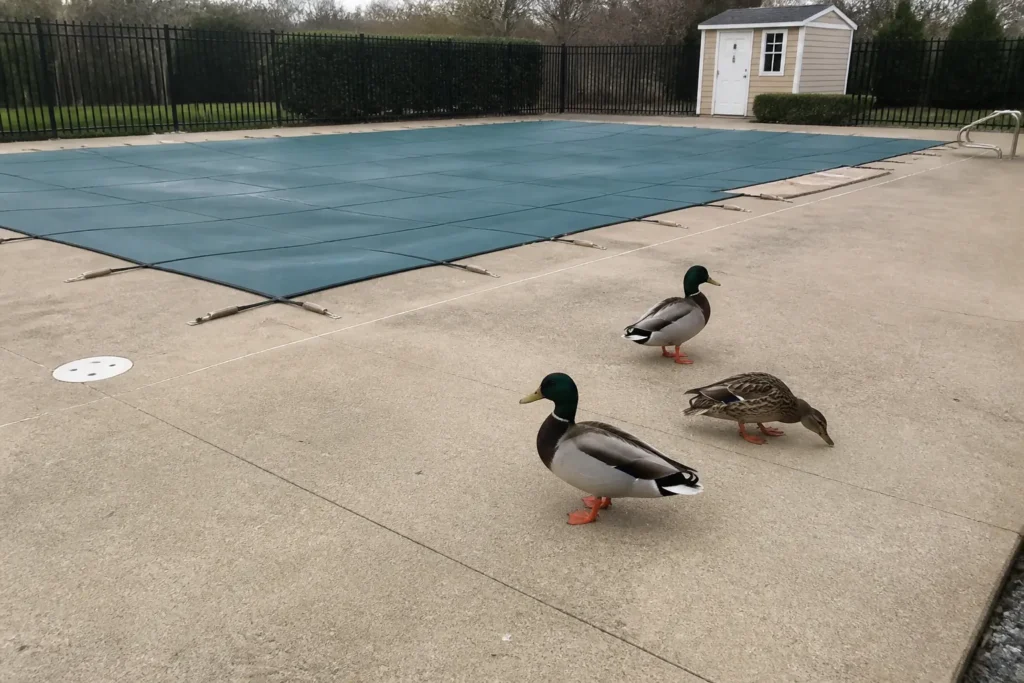
A duck on the water and a nesting duck in the yard are different situations. Pool safety, water hygiene and bird protection all matter. Natural ponds are wildlife habitat, so a visitor there is not automatically a conflict needing removal.

What attracts ducks to a pool or yard?
Assess the pool and nesting situation
Food
Spilled food and feeding can sustain visits.
Water access
Pool protection must follow safety directions.
Nesting
Eggs or young change the permissible response.
Water hygiene
Visible droppings require an appropriate pool response.
Duck deterrents: covers, food control and their limits
Protect the pool without trapping wildlife
Stop feeding and remove residue
Manage resources while birds are away.
Suitable safety cover
Use according to directions without trapping occupants.
Nest-specific advice
Obtain relevant wildlife guidance for eggs or ducklings.
Pool hygiene
Follow official cleanup and maintenance instructions.
Keep ducks away with safe pool and yard maintenance
Check a suitable safety cover
Inspect fitting according to the manufacturer’s instructions only when the pool is clear of birds and people. A tarp, loose net or fishing-line grid is not an appropriate substitute. Keep required child-safety measures in place.

Remove ordinary food residue
Clean spilled food from an unoccupied patio. This is distinct from managing bird droppings. Stop deliberate feeding and contain accessible pet food; do not promise the birds will permanently abandon the site.

Maintain the yard and pool gate
Check secure closure and ordinary safety barriers. A gate protects access for people and pets but does not automatically exclude flying ducks. Do not block a route around an active nest without wildlife advice.

Observe pond ducks without approaching
Leave suitable natural habitat undisturbed and do not feed or handle ducks. If ducklings are trapped in a pool or an active nest creates a conflict, follow the relevant wildlife authority’s instructions instead of transporting birds.

Duck-control sequence: assess nesting before prevention
Separate prevention from an active nesting response
Assess
Identify visitors, nesting or trapped birds.
Prevent when suitable
Manage food and pool cover safely.
Consult for nesting
Use appropriate wildlife advice for eggs or young.
Maintain
Follow pool-hygiene and safety requirements.
Duck repellent myths and facts
Replace line grids and calendar assumptions
Myth: fishing line is a harmless pool deterrent
Fact: avoid entanglement and unsafe barriers.
Myth: a pool gate excludes flying birds
Fact: maintain it for safety while using appropriate prevention.
Myth: every nest can be moved after a month
Fact: assess occupancy, species and applicable rules.
Myth: ducks on a natural pond need removal
Fact: distinguish habitat from a genuine conflict.
Ducklings trapped in a pool
USFWS recommends a nonslip exit ramp because ducklings may be unable to climb the pool edge. Arrange this only where you can do so safely without separating the family or compromising required pool safety. Keep children and pets away, and contact a licensed wildlife rehabilitator if the birds cannot leave. Do not chase the mother away or transport the family yourself.
Keep a clear exit from every pool
A pool cover or barrier should not trap birds on the water or create an entanglement risk. Ducklings that cannot clear a pool edge need a safe exit route and distance from people and pets.
Do not chase, net, or separate a family. Active nests, injured birds, or repeated trapping events call for local wildlife or rehabilitator guidance before changing the site.
Identify wild ducks, domestic ducks and the actual conflict
Start with what the birds are doing: briefly resting on water, returning for food, nesting beneath a shrub or becoming trapped in a pool. A natural pond visitor is different from a duck family unable to leave a fenced enclosure. The response should fit that observation.
Mallards, Anas platyrhynchos, are common wild ducks in many parts of North America. Domestic birds and other duck species can look different, and hybrids complicate identification. Take photographs from a distance and ask the wildlife authority if species status affects the options.
Do not classify every duck as an unprotected nuisance or every sighting as an infestation. Nesting, transport and capture rules depend on species and location. This guide focuses on preventing household conflict, not eliminating ducks from surrounding habitat.
Muscovy ducks need their own local guidance
Muscovy ducks, Cairina moschata, often have conspicuous red facial skin, although appearance varies. Florida treats its feral population differently from native waterfowl and prohibits release of captured Muscovy ducks. FWC explains the regional rules.
That is not permission to trap or move an unidentified bird elsewhere. Obtain current advice for your own location before authorizing removal. A provider should explain species identification and lawful disposition, not simply offer to drive the birds to another pond.
Remove food rewards before buying a duck deterrent
Stop deliberate feeding and ask other household members to do the same. Food scraps on the patio, spilled birdseed and accessible pet food can maintain repeat visits. Clean the specific feeding area while birds are away.
Use a covered container for feed and waste, and check the area after outdoor meals. A decoy beside a reliable food source leaves the attraction in place. For shared property, talk to the manager about a consistent no-feeding policy rather than moving the ducks from one unit’s patio to another.
Some food comes naturally from a pond or garden. You cannot remove every insect, seed and aquatic plant without changing the habitat. Concentrate on artificial food rewards and the household area that needs protection.
Choose a pool cover for safety, not just duck exclusion
A suitable, correctly fitted cover can make an unused pool less accessible. Check the manufacturer’s instructions, anchoring and intended use. Confirm that no people or birds are on or beneath it before installation.
A solar blanket is not automatically a safety cover. Loose tarps weighted with stones, chicken wire stretched over water and thin fishing-line grids can create hazards rather than a safe barrier. Do not copy a deterrent diagram that overlooks swimming, rescue access or entanglement.
Keep required child-safety fencing and gates functioning. A duck-prevention measure does not replace them, and a gate does not stop a duck flying in. Ask the pool installer about compatible cover options if the existing arrangement cannot be fitted safely.
Duck decoys, sprinklers, ultrasonic devices and pool cleaners
Plastic owls, coyote figures, swan decoys and floating objects are common duck deterrents. Any initial avoidance is not a guarantee that birds will stay away: a stationary object can become familiar. Don’t buy a second decoy before checking food access and the cover.
A motion-activated sprinkler is sometimes used as a temporary disturbance outside occupied nesting areas. It is not a reason to chase a family or direct a powerful jet at birds. Consider slippery surfaces, public paths, water use and local rules before trying a device.
An automatic pool cleaner is maintenance equipment, not a proven duck-control system. Do not run it around trapped ducklings or expect it to disinfect bird droppings. Ultrasonic products and sonic cannons likewise should not be described as reliable, duck-only household fixes; noise and non-target effects matter.
Prefer a prevention measure you can inspect and maintain. Product novelty is not evidence of lasting exclusion.
Barriers and landscaping around lawns and ponds
Break up the easy walking route between water and the affected lawn or patio where a compatible fence, hedge or planting can help. RSPCA describes physical barriers and landscape changes as options. A barrier can influence ground movement without stopping every bird from flying over.
Design for the site: drainage, visibility, access, children and pets still need consideration. Don’t prescribe a universal shoreline-buffer width or clear all vegetation from a pond. Some planting can provide nesting cover, so inspect occupancy before trimming or changing it.
For a shared pond, involve its owner or property manager. Habitat work, shoreline permissions and resident feeding are broader than one homeowner’s pool problem. Loose netting over a wildlife pond is not a shortcut.
Duck nests: why a calendar date is not an all-clear
Inspect from a distance without flushing the adult or touching the eggs. Under USFWS guidance, an active protected nest containing eggs, chicks or dependent young must not be destroyed without authorization. An apparently unattended nest can still be in use.
Contact the appropriate wildlife authority when nesting conflicts with maintenance or access. Don’t relocate eggs to a nearby planter, move the whole nest or assume every family will depart after 28 days. The date you first noticed a nest is not necessarily the start of incubation.
USFWS bird-nest guidance explains the distinction between active and inactive nests. Follow current local requirements before restarting work. Keep pets away while the family is present.
Duck droppings in a swimming pool: use the actual hygiene guidance
Close the pool to swimmers when droppings are found. CDC advises removing the droppings with a net, not a pool vacuum, and following its fecal-incident response guidance. Use gloves and wash your hands after cleanup.
Disinfection depends on measured water conditions and a functioning filtration system. Follow the CDC bird-dropping response or obtain help from the pool operator. A universal instruction to shock every pool at 10 ppm overnight is not an appropriate substitute.
Do not add bleach, essential oils or a pesticide as a duck repellent. Ordinary pool chemistry has a maintenance purpose; it is not a wildlife-removal treatment.
Frequently asked questions about ducks on your property
Can a dog keep ducks away?
A dog’s presence can affect bird behavior, but deliberate pursuit risks injury and family separation. Keep pets away from active nests and ducklings. Use food management and appropriate pool protection rather than sending a dog after the birds.
Why are ducks back after the decoy worked?
The object may have become familiar while water or food remained available. Record where the birds land and feed, then correct that access where feasible. Moving a decoy every few days is not a promise of permanent prevention.
Can I use a chemical duck repellent?
Only consider an actual product with directions covering the bird, site and method, together with relevant wildlife advice. A lawn product is not automatically permitted in pool water or a pond. Never substitute household cleaners or poison.
When should I call a wildlife professional?
Seek help for injured or trapped birds, unresolved nesting conflicts, uncertain species or a lawful removal proposal. Ask for the planned method, authorization, non-target precautions and follow-up prevention. There is no need to hire an exterminator merely because ducks visit a natural pond.
Publishing and affiliate notes
Some product links may be affiliate links. If you buy through them, we may earn a commission at no extra cost to you. Product picks are not lab tests. Read the legal disclaimer.