
Adult beetles and root-feeding grubs affect different sites. Plant tolerance and actual damage should guide intervention. Regional life cycles and soil conditions affect grub-management decisions, so an August treatment schedule or one biological product does not fit every lawn.

Identification and conditions
Identify the source and conditions
Adult identification
Confirm characteristic beetles and feeding.
Plant injury
Assess vulnerable plants and tolerance.
Pollination
Check whether exclusion is appropriate.
Turf injury
Confirm grubs rather than assume adults prove lawn damage.
Methods ranked by their role
Choose management for the actual problem
Plant monitoring
Base action on actual feeding.
Accessible adult removal
Reduce feeding on vulnerable plants.
Suitable exclusion
Preserve pollination and wildlife safety.
Qualified grub assessment
Treat turf only when identification and damage justify it.
Inspection and prevention steps
Inspect accessible plant foliage
Record characteristic feeding and confirm the beetle. Plant damage alone may have other causes. Remove accessible confirmed adults carefully rather than promise that eliminating a few scouts prevents all arrivals.

Monitor vulnerable flowers and leaves
Check damage and plant tolerance. A cooler morning or evening can make removal easier, but beetles are not guaranteed unable to fly before eight o’clock. Do not install a lure trap beside vulnerable plants as routine protection.

Check suitable exclusion on a nonflowering crop
Use appropriately fitted insect mesh and monitor it. Do not enclose blooming plants that require pollination. Repair loose material and avoid wildlife-entanglement hazards.

Inspect a small symptomatic turf area if appropriate
Grubs and other lawn stresses need identification. A few grubs or adults on roses do not alone justify broad lawn treatment. Ask local extension about actual damage and timing before selecting a label-permitted or biological treatment.

Sequence and reassessment
A sequence for ongoing management
Identify
Confirm the target and damage.
Prevent
Address the relevant access or growing conditions.
Manage
Use appropriate mechanical or label-permitted methods.
Monitor
Check recurrence and obtain local advice when needed.
Myths and facts
Correct common management assumptions
Myth: beetles cannot fly before eight
Fact: temperature and conditions vary.
Myth: trapping always protects nearby flowers
Fact: lures can draw beetles toward susceptible plants.
Myth: adult sightings require lawn treatment
Fact: assess separate grub damage.
Myth: August nematodes suit every lawn
Fact: species, conditions and regional timing matter.
Separate foliage feeding from lawn-grub decisions
Adult beetles on flowers do not prove that turf damage is caused by their larvae. Likewise, brown turf alone is not enough to justify a grub treatment.
Record adult feeding, inspect a small suitable turf sample only when damage supports it, and use local extension thresholds and timing. Avoid treating flowering plants while pollinators are active unless the exact label and local guidance allow it.
How to repel Japanese beetles naturally: protect the plant, not just the lawn
For a small garden, regular inspection and removal of accessible adult beetles are practical first steps. Use suitable insect netting only where it will not interfere with necessary pollination. Separate that work from lawn-grub decisions: adults can fly in from outside your property, so treating your grass cannot guarantee beetle-free roses.
Identify Japanese beetles and their feeding damage
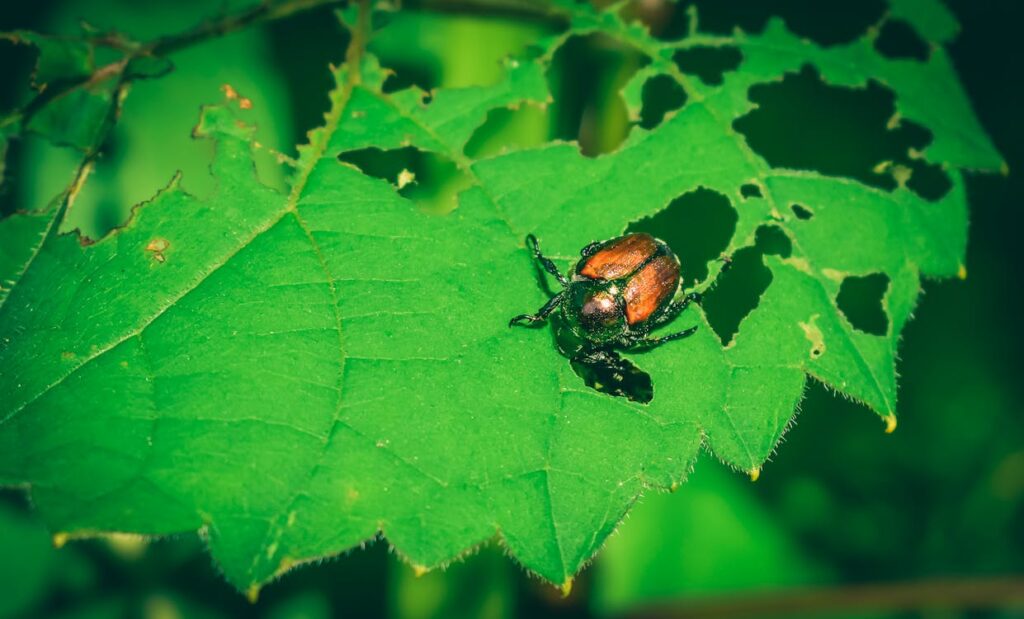
Adult Japanese beetles (Popillia japonica) have a metallic green head and thorax, copper-brown wing covers and distinctive white hair patches along the abdomen. They are roughly one-third to one-half inch long. Look at the insect itself as well as the leaf; ragged or skeletonized foliage can have more than one cause.
Adults chew the tissue between leaf veins, leaving a lace-like pattern, and also feed on flowers and some fruit. Check susceptible plants such as roses, grapes, raspberries and lindens, but base action on current feeding rather than treating every plant in anticipation. Photograph a beetle and its damage if you need help with identification.
C-shaped white grubs live in soil and feed on roots. Several beetle species have similar larvae, so a white grub is not automatically a Japanese beetle. Local extension can help identify the larva and assess whether the turf injury warrants intervention. Minnesota Extension’s guide includes identification details.
Adult beetles and lawn grubs: two treatment targets
The annual cycle includes eggs in soil, root-feeding larvae, pupae and leaf-feeding adults. Timing shifts with region and weather. Calendar dates from a northern garden cannot simply be copied into a warmer location. Record when adults first appear in your garden and ask extension about local grub development if lawn injury is also present.
Keep two records: one for feeding on plants and one for turf symptoms. In the plant record, note which leaves or flowers have fresh damage. In the lawn record, note patch locations, root condition and any identified grubs. Brown grass can have causes other than insects, and finding a few larvae is not by itself a reason to treat the whole lawn.
Healthy established plants may tolerate feeding better than young or stressed plants. Decide which plants need protection most; the aim is to reduce worthwhile damage, not to chase every beetle across the property. See Maryland’s plant and life-cycle guidance.
Handpicking Japanese beetles and using insect netting
Hold a container of soapy water beneath an accessible infested leaf and gently knock or pick the beetles into it. Keep the container away from children and pets. Cooler morning or evening conditions can make removal easier, but there is no universal hour before which beetles cannot fly. Repeat inspection rather than assuming one collection prevents later arrivals.
Do not spray the soapy collection water over plants as a homemade pesticide. Removing adults directly and applying a foliar product are different methods. If a plant is too high or fragile to handle safely, do not climb an unstable ladder or damage stems while pursuing beetles.
For a crop that no longer requires pollinator access, suitable fine insect netting can provide a physical barrier. Fit it without crushing foliage, close gaps and inspect for beetles trapped inside. Check it regularly for damage or wildlife entanglement. Do not cover blooming fruit or vegetable crops that need insects for pollination.
Why Japanese beetle traps can make nearby damage worse
Lure traps use attractive scents, including floral cues and sex pheromones. Capturing a bagful of adults does not demonstrate that nearby plants received less damage: more beetles can be attracted than captured. A trap next to the rose bed is therefore a poor default protection strategy.
Monitoring traps used by researchers or regional programs have a different purpose from protecting one small garden. Do not copy a fixed “safe distance” from a sales page and assume it prevents extra arrivals. Start with plant inspection and direct management instead. Minnesota’s feeding-management advice explains the trapping limitation.
Neem oil, biological controls and other pesticide options
Nonchemical management does not mean that every pesticide option is ineffective. The choice depends on the target, plant, feeding pressure and label. If damage continues on a valuable plant, ask extension or a qualified applicator which registered options fit the crop and local situation. Compare what the product controls, its application limits and its risks—not an invented efficacy percentage.
- Neem or azadirachtin products: these can have a role against adult feeding, but performance is not guaranteed under heavy pressure. Product formulations differ. Check that Japanese beetles and the plant use are covered, and follow bloom, harvest, weather and retreatment restrictions.
- Beneficial nematodes: some products containing Heterorhabditis bacteriophora target grubs. They are living organisms; storage, soil moisture, temperature and the larval stage affect suitability. Get local timing advice and follow the specific product instructions rather than automatically applying them in August.
- Milky spore: this targets Japanese beetle grubs, not adult beetles on flowers. Regional performance varies, and it is not an instant garden repellent. Confirm the grub species and local evidence before investing in a long-term lawn treatment.
- Other insecticides: a product for turf grubs is not automatically suitable for roses or edible crops. Check the exact site, pest and pollinator restrictions. Do not apply broad preventive treatments merely because beetles exist in the neighborhood.
The University of Kentucky landscape guide and Minnesota management bulletin discuss adult and grub options. Biological or plant-derived products still need a suitable use and application plan.
Japanese beetle questions
Does grub treatment stop beetles eating my roses?
Not reliably. Lawn treatment addresses larvae at that site, while flying adults can arrive from elsewhere. Keep plant protection and turf management as separate decisions so you do not pay for a lawn treatment expecting it to protect every flower.
Will damaged leaves become green again?
Chewed tissue will not be restored by removing beetles. Judge progress by new feeding and the plant’s overall condition, not by expecting existing holes to disappear. Avoid stripping off large amounts of remaining healthy foliage merely to make the plant look tidy.
Can companion planting guarantee beetles stay away?
No planting combination guarantees exclusion. When replacing plants, check locally suitable, less-preferred options rather than copying an invasive or climate-inappropriate plant list. Do not remove healthy valued plants solely because a sales page promises a beetle-repelling replacement.
When should I seek professional help?
Get advice for repeated severe feeding on young plants, suspected root damage across a large turf area, inaccessible tree canopies or uncertainty about pesticide use on edible crops. Share dated photographs and the plant names. Ask for identification, the treatment target, pollinator precautions and a follow-up plan before work begins.
Some specialist farm programs use high-capacity mass trapping outside cropped areas. Missouri research describes this as a setting-specific system, not proof that one bag trap protects a residential garden. Advice for a commercial blueberry planting should not be transferred unchanged to a small rose bed. Read the Missouri management discussion.
Bacterial products: the strain and target matter
Some registered products use Bacillus thuringiensis galleriae (Btg) against beetles. Do not substitute an ordinary caterpillar-targeted Bt product. Minnesota Extension distinguishes adult-control options from variable grub-control results and reports no demonstrated benefit from commercial milky-spore products in modern university trials. Ask local extension about evidence before purchasing, and check the exact product label rather than treating every biological option as equivalent.
Publishing and affiliate notes
Some product links may be affiliate links. If you buy through them, we may earn a commission at no extra cost to you. Product picks are not lab tests. Read the legal disclaimer.