
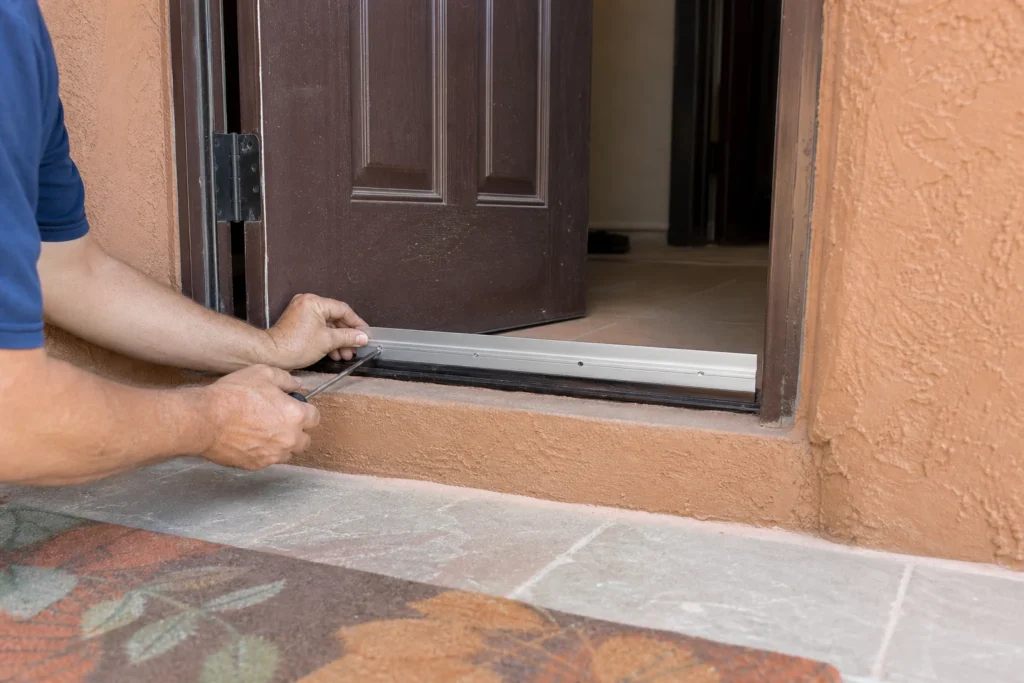
Scorpion home sealing starts with finding usable openings and repairing them safely. A door sweep is worth checking, but there is no source here establishing that doors account for 80% of all entries. Work around the whole accessible envelope and keep a record of indoor sightings.

The envelope audit: where to look
Walk the accessible perimeter in daylight. Check worn door seals and jamb corners, damaged screens, and gaps around utility penetrations. Photograph each finding rather than guessing which opening caused a sighting. Avoid electrical equipment, gas fittings, roof work and inaccessible attic edges.
Follow the route into the house
Shelter outside
Debris and stored materials provide daytime hiding places. UC IPM
Moisture nearby
Check irrigation and outdoor leaks. Utah State Extension
An opening indoors
Inspect door edges, screens and accessible pipe gaps; a sighting does not identify the entry by itself.
A place to hide
Check accessible indoor edges from a safe distance; avoid reaching into concealed spaces.

Sealing methods, ranked by practical role
Prioritize a repair where you find a real defect. Weather stripping must fit the opening and still allow normal door operation. Screens must fit securely without defeating their intended airflow. Use a compatible sealant only where the joint is suitable for sealing. This is an editorial priority order, not an efficacy score.
Choose repairs before routine spraying
First: repair entry gaps
Extension-supported prevention: tight screens, sound weather stripping and suitable crack repairs. Source
Alongside repairs: reduce shelter
Move loose debris and stored materials away from the building. Source
To check progress: inspect and record
A black light can reveal scorpions, but fluorescence does not prove a house is sealed. Source
Conditional: pesticide treatment
Treatment is a supplement; select a product labeled for the pest, site and application. EPA
The sealing plan
Check and repair doors
Inspect with the door closed, then check opening, closing and latching. Replace damaged weather stripping or fit an appropriate sweep. A daylight check can help locate gaps, but it is not a universal scorpion-proof certification.

Repair suitable screen and pipe gaps
Repair torn screens and loose frames. Assess accessible gaps around plumbing or air-conditioning lines before selecting compatible repair materials. Do not disturb hot equipment, wiring or pressurized fittings. A contractor should handle inaccessible or unfamiliar building details.
Keep drainage and ventilation functional
Do not caulk a weep screed or brick weep hole shut. The safe barrier depends on the wall system: ask a qualified building professional about a purpose-designed detail. This guide does not recommend packing every opening with copper mesh or foam.

When to review the work
Recheck after the materials have cured, then compare your record of indoor sightings during subsequent inspections. Keep checking after weather damage or building work. A persistent sighting can reflect an overlooked route or an animal already inside; it does not prove a particular weep hole is responsible.
A repair-and-review schedule
Before repair
Photograph accessible gaps and record where indoor sightings occur. Identify vents and drainage openings that must remain functional.
During repair
Fit door seals and screen repairs; use compatible materials on suitable stationary gaps. Leave structural or inaccessible work to a qualified contractor.
After materials cure
Check the repaired joints and door operation. Follow the sealant manufacturer’s cure instructions.
At the next review
Compare sightings and inspect for missed or newly opened gaps. Escalate persistent indoor activity; this schedule is not a promised elimination time.

Sealing myths and facts
Separate prevention from promises
Myth: every hole should be filled
Fact: drainage, combustion-air openings and ventilation must stay functional. Have a building professional specify any barrier for these openings.
Myth: one UV walk proves success
Fact: UV helps inspection; absence of a visible scorpion does not establish that every route is closed.
Myth: sealing has a fixed success percentage
Fact: these sources recommend exclusion, but do not establish a universal door-entry share or a guaranteed reduction for every house.
Myth: dust belongs in every wall void
Fact: pesticide placement depends on the exact current label, not a generic sealing checklist. EPA
When to call a professional
Seek help for repeated indoor activity, inaccessible openings or repairs involving drainage, roofing, electrical or structural systems. Ask for an inspection report that separates exclusion work, habitat corrections and any pesticide treatment.
Obtain several written local estimates. Compare the actual openings covered, materials, follow-up visits, exclusions and warranty terms. Prices vary with the property and scope; ask what each estimate includes before comparing the totals. EPA advice on selecting a pest-control service.
Frequently asked questions
What size gap can a bark scorpion use?
UC IPM describes entry through a crack as small as 1/16 inch. Treat this as a reason for careful inspection, not a guarantee that a credit-card test identifies every route. UC Pest Notes PDF.
Does a black light replace sealing?
No. It assists observation. Tight screens, weather stripping, suitable repairs and reduced outdoor shelter address the conditions that permit entry.
Should I apply silica dust before closing every gap?
No. A pesticide must have label directions for the pest, location and method. Do not improvise applications near electrical fixtures or treat a cavity simply because it is exposed. Label guidance.
How long will a repair last?
Durability depends on installation, material compatibility, weather and movement. Inspect repairs periodically and obtain the contractor’s written maintenance and warranty terms.
Related scorpion guides
UV inspection · Scent-repellent limits · Comparing professional quotes
Need the full control sequence? Combine these repairs with UV inspection, monitoring and habitat cleanup in the main guide to keeping scorpions out of the house.
Keep scorpions out: match the repair to the opening
Scorpion home sealing is not a single caulk purchase. A moving door needs a different repair from a stationary joint, and a drainage opening has a different purpose from an accidental crack. Sort observed defects into those categories before asking a shop or contractor for materials.
Take a photograph and note the location of each accessible defect. Include whether a door sticks, a screen frame is loose or a seal has pulled away. These details make the repair request specific. They also prevent a general pest control service quote from being mistaken for a complete building-envelope repair.
Door sweeps and weather stripping must work together
A sweep addresses the bottom edge; it does not fix a gap at a lower jamb corner or an uneven threshold. Inspect those parts with the door closed, then check normal opening and latching. Choose a compatible repair that closes the observed defect without making an emergency exit difficult to operate.
For a garage, document the visible gap rather than modifying door hardware yourself. Moving doors and their mechanisms can require qualified repair. Ask the installer to check the fit through normal operation and explain what maintenance will be needed as the seal wears.
Window screens are only as useful as their fit
A new piece of mesh does not fix a frame that sits loosely in its opening. Inspect the frame and its attachment as well as any tear. Do not promise that a standard insect screen has made every nearby joint scorpion-proof; review the accessible opening around it too.
Window and door maintenance forms part of extension-supported prevention. It should accompany reduced outdoor shelter rather than stand alone as a guaranteed way to get rid of scorpions. Utah State Extension describes exclusion and habitat corrections.
Utility penetrations, vents and wall drainage: avoid a costly sealing mistake
A pipe passing through a wall can leave an accidental gap, but the surrounding equipment may impose material or access requirements. Note the defect without moving wiring, disconnecting equipment or disturbing a hot surface. A qualified contractor should specify work when the fitting or wall system is unfamiliar.
Do not treat a ventilation grille, combustion-air opening or drainage detail as clutter to fill. The purpose of that opening matters. Blocking it can create a building problem unrelated to pest control. Ask for a purpose-designed barrier where appropriate, with its airflow or drainage function retained.
Ask what the contractor is actually sealing
A written scope should identify accessible joints, door or screen repairs, materials and excluded locations. Ask whether the price includes failed-material removal, preparation, installation and a post-cure check. “Seal the perimeter” is too vague to tell you what will happen at each opening.
Do not substitute an improvised foam or mesh combination for the building professional’s specification. A material sold at a home improvement store is not automatically appropriate near every appliance, pipe or wall system.
Why scorpions may still appear after sealing
An indoor sighting after work does not identify one cause. The animal might already have been inside, an accessible defect might have been missed, or another route may require assessment. Record the location and review the repairs instead of immediately filling functioning weep holes.
Also inspect conditions outside your home from safe access. Stored materials, debris and a visible leak can remain even after good door repairs. Those observations are reasons to improve maintenance, not evidence that every scorpion in the yard must be killed. Scorpion control combines several tasks; one completed repair cannot certify the whole property.
Compare the same areas before and after
Keep the original photographs, installation dates and sightings together. At review, inspect the same accessible joints and check door operation. If a seal has detached, describe the visible failure rather than recording only that “treatment did not work.” This gives the installer a repair issue to resolve.
If repeated indoor sightings continue, share that record with a qualified pest control professional. Request an inspection that separates actual building defects, outdoor conditions and any proposed pesticide application. Do not accept routine spray around every opening as a substitute for diagnosing the problem.
Home-sealing questions for renters and homeowners
What should a renter report?
Send the landlord or property manager the sighting location and photos of accessible damaged seals or screens. Ask how maintenance will be arranged. Do not alter shared walls, exterior equipment or drainage without the appropriate permission. Responsibility and local requirements vary; keep a written record rather than assuming one universal rental rule.
Should essential oil or dust go inside a repaired joint?
Not as a routine step. Lavender or another fragrance does not complete the repair. Any pesticide dust or spray requires label authorization for that pest, site and application, and must be considered separately from construction materials. EPA label guidance applies even when a joint will later be covered.
How do I compare two sealing quotes?
Compare their opening lists, access limitations, materials, follow-up and warranty conditions. Ask each provider what it will do if a documented repair fails and whether further inspection is included. A lower headline price or a promise to keep scorpions away permanently does not establish equivalent work.
Publishing and affiliate notes
Some product links may be affiliate links. If you buy through them, we may earn a commission at no extra cost to you. Product picks are not lab tests. Read the legal disclaimer.