
Quick answer: how to repel carpenter bees
Protect sound exterior wood with a maintained paint finish, inspect round holes for nesting activity, and repair galleries after the nest has been properly assessed and managed. Don’t plug an occupied tunnel or rely on a homemade scent spray to clear it. Get professional help for inaccessible holes or damaged structural wood.
Carpenter bees on your deck need a different response from bees visiting flowers. Eastern carpenter bees (Xylocopa virginica) can nest in wooden rails, trim, and eaves; many visits to your yard are simply pollination. Start with the wood, not the spray bottle.
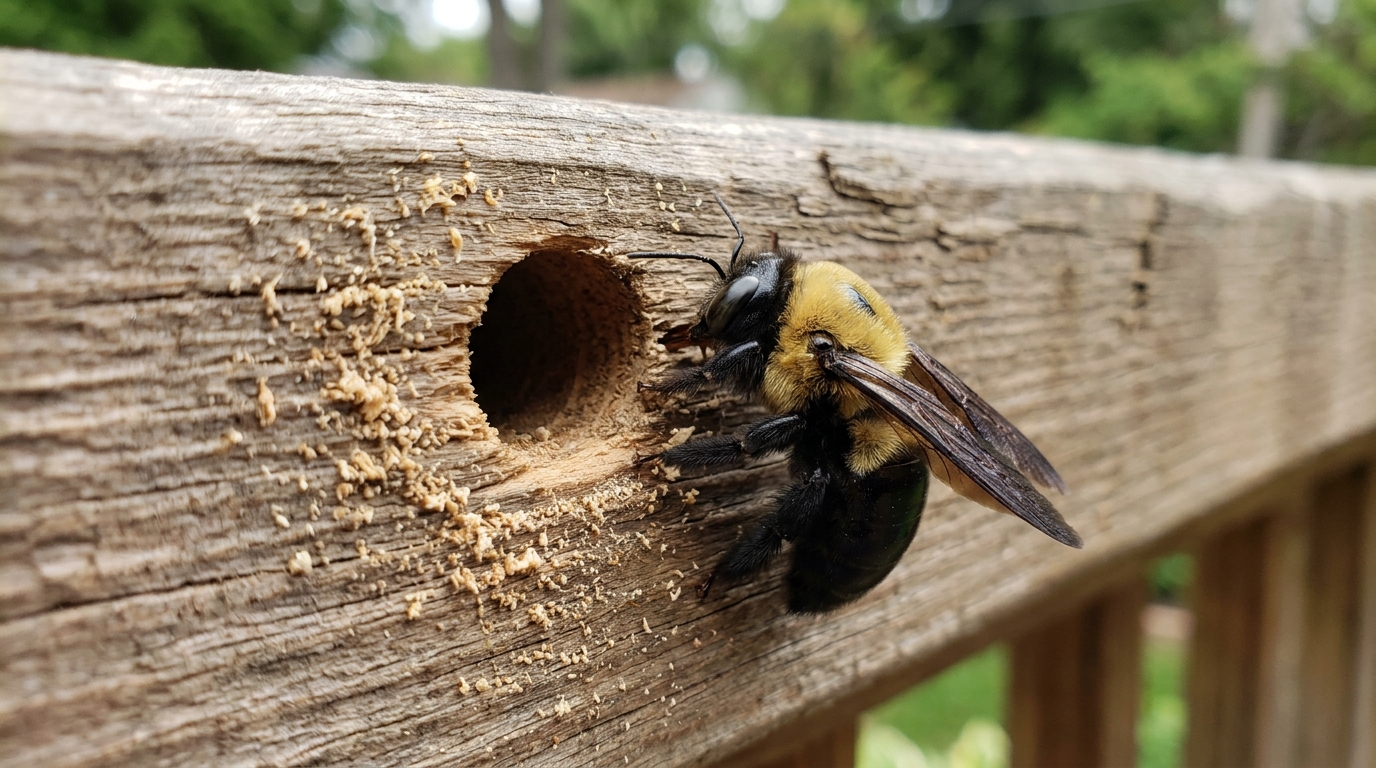
Regional carpenter-bee species vary, so use local extension help if identification is uncertain.
Keep pesticide use and high work within safe limits
Use a pesticide only when its current label permits the pest, site, method, and user. Follow its protective-equipment and access restrictions; keep children and pets away as directed. Don’t improvise an essential-oil recipe or work from an unstable ladder. EPA label guidance.
Why carpenter bees return to unfinished wood
Unfinished wood and reusable tunnels provide nest sites. Painting is preventive maintenance; existing galleries need their own assessment. That distinction prevents a common mistake: treating an occupied hole as a surface-coating problem. Penn State explains the difference.
Three clues that guide your next step
Round hole and sawdust
A circular entrance with fresh debris suggests nesting activity; check the surrounding timber. Maryland identification guidance.
Old gallery
A previously used hole can be reused. Record its location before choosing a repair. Clemson management guidance.
Exposed wood
A weathered finish is a maintenance cue. Finish and material choices belong in your prevention plan. Penn State prevention guidance.
Carpenter-bee methods ranked by evidence
Choose a method for the job it can do
Compare the practical role, source support, and limits of each method.
Maintain painted wood
Strong prevention support — Supported for reducing new nesting, not for clearing an occupied tunnel. Maryland Extension.
Manage an active gallery, then repair
Strong, conditional support — Use the labeled treatment and follow-up process or a qualified professional. Alabama Extension.
Almond oil on unoccupied wood
Limited scope — Penn State discusses it for prevention; this does not validate a homemade concentration or active-nest cure. Penn State.
Citrus, peppermint, tea tree, and decoy nests
Insufficient support here — Scent mixtures and decoy nests lack sufficiently specific field evidence here to replace wood maintenance and gallery assessment.
Step-by-step deck and siding plan
1. Confirm the bee and mark the holes
Compare the insect and nesting site. A shiny abdomen and nesting in wood help distinguish eastern carpenter bees from the fuzzy bumblebees often nesting elsewhere. Male carpenter bees cannot sting; females can, so avoid handling either. Maryland identification and biology. Use a photo and a simple location sketch rather than poking into the gallery.

2. Separate active nests from preventive work
If a hole is being used, leave it open until you have a suitable management plan. Bees trapped by an early plug can chew through it or make another opening. Alabama Extension guidance. A harmless nest away from vulnerable wood can be left alone. Ask a professional to assess galleries in rafters, high fascia, or compromised timbers.
3. Restore a protective finish on sound wood
Clean and prepare intact rails or trim, then apply a compatible exterior finish according to its directions. A coating is a prevention measure, not a substitute for assessing hidden damage. Clemson prevention advice. Schedule accessible maintenance before your local spring nesting period.

4. Repair only after nest management is complete
For an abandoned or appropriately managed gallery, fit a sound repair such as a suitable wood plug or patch material, then restore the finish. Alabama repair guidance. Measure the actual opening instead of assuming every hole takes an identical dowel. Follow the pesticide label and professional advice on timing; a universal 24–48-hour waiting rule is not established here.

5. Recheck repairs and get help for structural damage
Keep a short record of newly observed holes, repair dates, and locations you cannot reach safely. Compare the same areas when bees become active again. If the wood needs replacement, have a carpenter or pest-management professional coordinate that work rather than repeatedly filling the surface.

Seasonal wood-exclusion checklist
Plan by condition, not a guaranteed deadline
Before local nesting season
Inspect rail undersides, posts, and accessible eaves; prepare maintenance materials.
While bees are active
Photograph new holes and separate harmless flower visitors from timber nesting.
After gallery assessment
Complete the chosen management and repair process; log what was done.
At the next seasonal check
Compare locations, inspect the finish, and escalate repeat damage.
Carpenter-bee myths and facts
Check the scope of each claim
Myth: almond oil clears an established nest
Penn State separates surface prevention from nests already in the wood. Source.
Myth: close every hole immediately
A trapped adult can escape through a plug or make another opening. Source.
Fact: carpenter bees are pollinators
Control is tied to damage, not merely seeing a bee in the garden. Source.
Fact: finish maintenance helps prevention
Clemson supports a maintained protective coating, while distinguishing finishes and active galleries. Source.
Frequently asked questions
Does citrus spray reliably repel carpenter bees?
Citrus sprays lack sufficiently specific support here for a dependable dose or reapplication interval. Prioritize the supported wood-maintenance steps and don’t treat an unverified mixture as an active-nest solution.
Can I use almond oil instead of paint?
Penn State discusses almond oil as an option to discourage new nests where a natural finish is desired. It does not clear established galleries or establish a dependable homemade bitter-almond mixing recipe. Read the full prevention advice.
When should I plug carpenter-bee holes?
After the gallery has been assessed and its management completed. An apparently quiet entrance does not prove a nest is empty. Use the chosen product’s label and the professional’s directions rather than an arbitrary waiting period.
When is professional help warranted?
Choose help for inaccessible galleries, repeated nesting across the structure, uncertain species identification, or wood whose strength is in doubt. You do not need to wait for an arbitrary number of holes.
Related yard and structure guides
See bumblebee identification, the yard hub, and the cost estimator when planning professional work.
Sources and review notes
Reviewed October 2, 2026. Evidence labels describe the scope of the linked guidance; they are not measured success rates.
- University of Maryland Extension — Carpenter bees
- Alabama Cooperative Extension — Carpenter bee identification and control
- Penn State Extension — Prevention versus established carpenter-bee nests
- Clemson Extension — Carpenter bees
- EPA — Pesticide labels and permitted use
This guide was drafted with AI assistance and manually edited against these sources. Images illustrate the steps and are not field-test evidence. Product labels and local requirements take priority. See our editorial methodology, evidence database, and safety disclaimer.
Some product links may be affiliate links. If you buy through them, we may earn a commission at no extra cost to you. Product picks are not lab tests. Read the legal disclaimer.